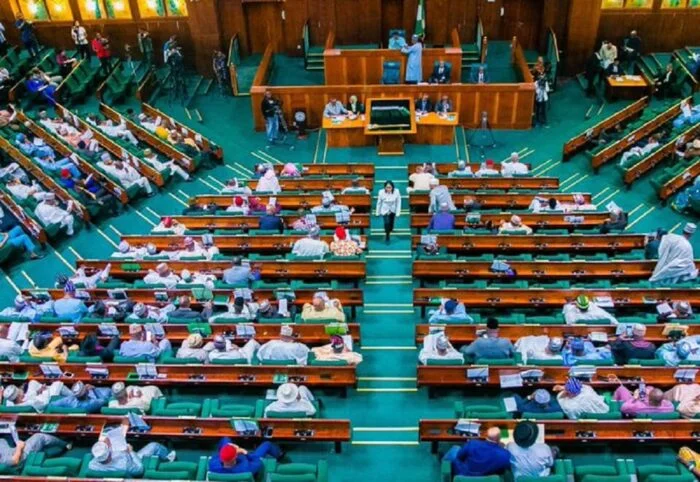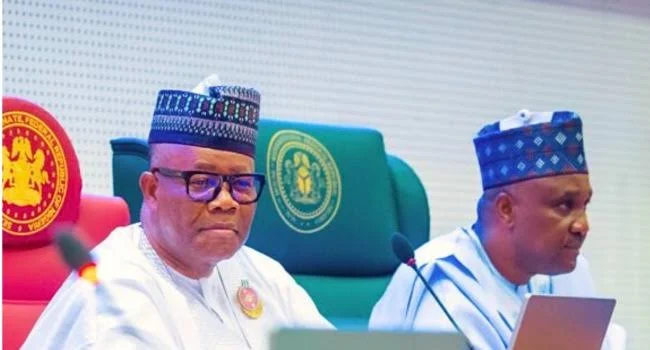

In a sweeping fiscal reset aimed at tackling revenue shortfalls, weak capital execution and overlapping budget cycles, the National Assembly on Tuesday approved revised budgets for 2024 and 2025, extending the implementation of the 2025 fiscal year to March 31, 2026.
Lawmakers approved a reworked N43.5 trillion 2024 Appropriation Act and a revised N48.3 trillion framework for the 2025 fiscal year following marathon plenary sessions in both chambers. The approval culminated in the passage of the Appropriation Act (Repeal and Re-enactment) Bills for the two fiscal years, which were transmitted to the legislature by President Bola Tinubu last Friday.
In the Senate, the revised budgets were adopted after the consideration of a consolidated report by the Committee on Appropriations, presented by its chairman, Senator Solomon Adeola (Ogun West). Adeola said the exercise was intended to realign Nigeria’s budget framework with current fiscal realities, address implementation gaps and restore discipline to the budgeting process.
He explained that the 2024 Appropriation Act was repealed from its original N35.005 trillion and re-enacted with an aggregate expenditure of N43.561 trillion, reflecting adjustments to statutory transfers, debt servicing, recurrent spending and capital expenditure.
For the 2025 fiscal year, Adeola disclosed that the earlier N54.99 trillion budget was repealed and replaced with a revised total expenditure of N48.316 trillion. He noted that part of the capital allocation was deferred to the 2026 fiscal year due to funding constraints identified during budget consultations with the executive.
According to Adeola, extensive engagements between the committee and the economic management team informed the decision, particularly in addressing concerns over revenue performance, rising debt exposure and effective budget implementation.
He revealed that an additional N8.5 trillion was injected into the capital component of the 2024 budget to fund special interventions in response to security, humanitarian and economic challenges. For the 2025 budget, N6.674 trillion was removed from the capital allocation and rolled over to 2026 to improve implementation efficiency in anticipation of better revenue inflows.
Adeola warned against the continued practice of running multiple budgets concurrently, stressing that overlapping budget cycles undermine fiscal discipline, transparency and accountability.
Based on its findings, the committee recommended approval of the revised N43.5 trillion 2024 budget and the N48.3 trillion framework for 2025, alongside an extension of the 2025 budget implementation to March 31, 2026. The Senate subsequently passed the bills after exhaustive debate.
Similarly, the House of Representatives passed the revised N43.56 trillion 2024 budget and the N48.31 trillion 2025 budget after adopting the report of its Committee on Appropriations. The passage followed clause-by-clause consideration at the Committee of Supply and approval at plenary presided over by Speaker Tajudeen Abbas.
A breakdown of the revised 2024 budget shows N1.74 trillion for statutory transfers, N8.27 trillion for debt servicing, N11.26 trillion for recurrent (non-debt) expenditure, and N22.27 trillion allocated to capital expenditure and development fund contributions for the fiscal year ending December 31, 2025.
For the revised 2025 budget, N3.64 trillion is earmarked for statutory transfers, N14.31 trillion for debt servicing, N13.58 trillion for recurrent (non-debt) expenditure, and N16.76 trillion for capital expenditure through development fund contributions. The budget will run until March 31, 2026.
In his communication to the National Assembly, President Tinubu said the revisions were necessary to accommodate previously omitted budgetary items and to adjust capital implementation targets in line with Nigeria’s revenue realities and execution capacity.
He explained that the revised framework adopts a more realistic capital implementation benchmark of 30 per cent, acknowledging persistent weaknesses in the execution of the 2024 capital budget that hampered infrastructure delivery nationwide.
According to the president, extending the lifespan of the 2025 budget would give Ministries, Departments and Agencies sufficient time to access and utilise capital releases effectively. He added that the move forms part of broader fiscal reforms aimed at ending overlapping budgets, improving planning, strengthening transparency and ensuring better value for money in public spending.