Category: Uncategorized

  • Ganduje Commends Legislature

    Ganduje Commends Legislature


    By Unukere Oboh

    Kano State Governor Dr. Abdullahi Umar Ganduje has observed that democracy in Nigeria has reached its present stage due to the diligent participation and commitment by the legislature in all the three tiers of government.

    The Governor made this observation on Monday  while declaring opened the 2019 retreat for Members and Management Staff of the 9th Kano State House of Assembly organised by LeGIS 37, held at Bafra Hotel, Kaduna.

    The Governor noted that the Nation’s nascent democracy had been grappling with various challenges ranging from constitutional crises to inter and intra party wrangling.

    “Despite these enormous challenges our democracy settings are blossoming day by day and this will not be unconnected with robust and diligent participation and strict observation of stipulated functions of our legislative Members,” he stated.

    Ganduje represented by his Deputy, Dr. Nasiru Yusuf Gawuna explained that democracy as popularly known is a system in which supreme power is vested on the people and exercised by them directly through a system of representation.

    “These representations were best portrayed in the legislative settings where each member represents a clearly identified constituency within a polity.

    ” Specifically,  our State Assemblies played an important role in ensuring that the people they represent have gotten a fair share of development in various aspect of government activities,” the Governor revealed.

    On the issue of constituency projects which came in to existence by the popular overture of the legislature, Dr. Ganduje declared that such constituency  projects had in many cases, become the benchmark with which government performances are measured.

    “Before the advent of this dispensation, during the military era, most of our rural areas are extremely regressive with no sign of any government activities. This is because governments at that time were much focused on urban and city areas as it is government without representation,” Ganduje said.

    He further appreciated the cooperation and understanding of the Members of the 9th Kano State House of Assembly usually given to the present administration, which the Governor described as pillars of the enormous achievements recorded.

    In his remarks, the Speaker Kano State House of Assembly Abdul’Aziz Garba Gafasa explained that the 2019 retreat  titled ‘ The role of Legislature in the Evolution of Democracy in Nigeria ‘ was intended to among other things build Members’ capacity to begin to rely less on the Executive for the initiation of the bill.

    Abdul’Aziz Gafasa said it was high time Members of House Assemblies should note that the practice of legislation should no longer be shrouded in secrecy and undue exclusion of relevant stakeholders, pointing out that without public participation, legislative inputs lose credibility.

    “I urged all participants to feel free and interact freely with colleagues and facilitators so that we may extract the maximum benefit from their experiences in legislative practice and procedures,” Gafasa said.

    Earlier, the Chairman LEGIS 37 Dr. Ibrahim Salim represented by Malam Isah Musa Farouk said the content of the inductions course had been carefully prepared to acquaint first timers and refresh the memory of the ranking Members of the historical relevant the legislative had been playing in the development of democracy in Nigeria.

  • FEC Okays N10.729trn Increase As Buhari Presents Budget

    FEC Okays N10.729trn Increase As Buhari Presents Budget

    By Lawrenve Ekwonu

    Barring any last minute changes in plan, President Muhammadu Buhari will on Tuesday present the Medium Term Expenditure Framework and Fiscal Strategy Paper (MTEF-FSP) to the National Assembly for passage.

    The presentation is sequel to the Federal Executive Council (FEC), approval to the N700 billion increase in the appropriations bill, raising the total figure from N10.O02 trillion to N10.729 trillion on Monday at an extra ordinary meeting held at the presidential villa.

    The changes in the appropriation bill was said to have been endorsed by FEC even as the Council members lauded the National Assembly for the increment of the crude oil benchmark from $55 per barrel to $57 per barrel.

    When the Senate took the decision, there were insinuations that the Executive may reject the jerking up of the proposed budget size in the MTEF with over N700 billion.

    Though the ministers did not disclose officially the outcome of the extraordinary meeting which lasted about five hours, it was reliably gathered that members of the cabinet commended the legislators for increasing the benchmark.

    The source who spoke on the condition of anonymity said, “FEC is happy with the National Assembly for increasing the benchmark to $57 per barrel. The additional $2 is to take care of recruitment in the security agencies and also attend to critical areas.

    “This is a sign that the legislature and the executive will work together for the interest of Nigerians. It is a good development.”

    The extraordinary FEC meeting was believed to have deliberated on the 2020 Appropriation Bill expected to be laid before the joint session of the National Assembly on Tuesday.

    Departmental heads of the Federal Ministry of Finance, Budget and National Planning led by the Director General of Budget, Ben Akabueze made submissions at the meeting.

    The meeting started with the rendition of national anthem and Christian prayer led by the Minister of Health while the Muslim prayer was led by the Minister of Aviation, Hadi Sirika.

    Recall that the extraordinary FEC meeting originally scheduled to hold on Saturday last week was shifted to Monday with no tangible reasons.

    Special Adviser to the President on Media and Publicity, Femi Adesina, had maintained that the meeting was to put finishing touches to the 2020 annual budget.

    Recall that the Senate had called for the increase of the oil benchmark from $55 per barre to $65 per barrel so as to have some funds to be injected into the economy.

    The Senate had noted that the nation’s economic growth which was less than three percent was poor.

    The upper chamber also argued that injecting money into the economy would help in the provision of infrastructure, security as well as other critical sectors. .
    ”We have seen an economic growth that is less than three percent. For a developing country, three percent economic growth is poor, it is not good enough. This is not a figure that we will be looking at as a developing country.

    “China has growth rate of five and six percent, India has growth rate of nine to ten percent. So for a development country that wants to get to where we want to get to, a two to three percent economic growth rate is very poor.

    “So, what does this mean? It means that we need to invest more in the economy, it means that there has to be more capital inflow into the economy, it means that the amount we are spending on infrastructure, security and other vital critical areas must be increased.

    “But where is the money? The money is there. If you raise the oil benchmark from $55 per barrel to $65 per barrel bearing in mind that the average price of crude oil has gone to $70 per barrel.

    “We easily realize enough money to begin to invest in some of these critical areas. So, my proposal is that the Finance Committee considers raising the benchmark for crude oil for the purposes of this budget from $55 per barrel to $65 per barrel.

    “You will have enough money to begin to invest into security and other critical areas, ” the Senate insisted.

  • INSECURITY AND GOVERNANCE: THE ROLE OF THE MEDIA.

    INSECURITY AND GOVERNANCE: THE ROLE OF THE MEDIA.


    A lecture presented by Victorson Agbenson, Editor ( Politics) Radio Nigeria.( BA Mass Communication, Abraka; MA Media Arts, Abuja) at the Press Week of Ibrahim Babangida University, Lapai, Niger State on the 7th of October 2019.

    Protocol/Appreciation.

    Joseph John Pulitzer, a Hungarian who lived from April 10, 1847 to October 29, 1911, was a newspaper publisher who became a leading national figure in the Democratic Party and was elected American congressman from New York.

    Pulitzer understood the importance of the media in any society. His thoughts on the issue are enshrined on a plaque at the Columbia University Journalism school in New York. Journalists and indeed every Nigerian would need to examine the words closely, hear him:

    “Our republic and its press will rise or fall together. An able, disinterested, public-spirited press, with trained intelligence to know the right and courage to do it, can preserve that public virtue without which popular government is a sham and a mockery. A cynical, mercenary, demagogic press will produce in time a people as base as itself. The power to mould the future of the republic will be in the hands of the journalists of future generations”

    I cannot agree more!

    Now, from the submissions of Pulitzer and many other scholars in the field of the media, both the print and electronic blocks constitute a major pillar that shape and build every society. The fundamental roles of the media in any society which include information, education and entertainment are so important that societies can hardly make meaningful progress without a vibrant mass media.

    It was in recognition of this fact, that the third President of the United States of America (USA), Thomas Jefferson declared those words that have become very famous in the Mass Communication parlance. Hear him: “were it left for me to choose whether we should have a government without newspapers or newspapers without government, I shall not hesitate a moment to choose the latter.”

    That again stresses the pivotal role of the media in every society.

    The increasing level of insecurity especially terrorism , banditry and kidnapping across the country in recent years has gravely undermined our national security. The twists and turns accompanying these occurrences have shown that for us to survive at all , all hands must be on deck to tackle this challenge. This is where the role of the media becomes very pertinent.
    It has probably been over flogged that an atmosphere devoid of peace does not attract foreign investors nor encourage local investors to invests. And without investment, the much needed growth cannot happen and without growth, there cannot be development. This is the circle of backwardness that we have found ourselves.

    Agenda Setting

    As a mass communication undergraduate one theory that fascinated me was the agenda setting theory. And it is for me one of the most strategic theories of the field.

    The media sets the tone for dominant issues, values, perceptions and attitudes of the society by its impact. It does this by setting agenda.

    Agenda-setting theory was formally developed by Max McCombs and Donald Shaw in a study on the 1968 American presidential election. The theory describes the “ability (of the news media) to influence the importance placed on the topics of the public agenda”. Agenda setting is a social science theory; it also attempts to make predictions. The theory also suggests that media has a great influence to their audience by instilling what they should think instead of what they think. That is, if a news item is covered frequently and prominently, the audience will regard the issue as more important.

    Two basic assumptions underlie most researches on agenda-setting:

    The press and the media do not reflect reality; they filter and shape it;
    media concentration on a few issues and subjects leads the public to perceive those issues as more important than other issues.

    Rogers and Dearing identified three types of agenda setting:

    public agenda setting, in which the public’s agenda is the dependent variable(the traditional hypothesis)
    media agenda setting, in which the media’s agenda is treated as the dependent variable (“agenda building”)
    policy agenda setting, in which elite policy makers’ agendas are treated as the dependent variable (“political agenda setting”)

    From the foregoing, the importance of the media in addressing social issues such as national security especially in a democratic setting cannot be overemphasized. In this terrain, the media serves as the bridge between the people and societal activities. For any activity or event to get noticed, it must be reported by the media. The media must therefore make national security a principal part of its agenda to make positive impact.

    Section 22 of the 1999 Constitution of the Federal Republic of Nigeria as amended empowers the media to monitor governance and uphold the Fundamental Objectives and Directive Principles of State Policy as enshrined in Chapter 2 of the Constitution. It is to hold government accountable. But that must be a media that knows its worth and is ready to be professional.

    Journalists must be bold, they must see their trade as a crusade not just as a means of daily bread. One small man doing the right thing in his small corner somewhere can do great things everywhere. Nigeria can only get better when the journalists becomes true to his calling. We must be ready to expose crime, unprofessionalism in the security agencies and in high places. But don’t forget this is risky too.

    Highlighting the role of the media in combating insecurity in any society, Pulitzer stated, “there is not a crime, there is not a dodge, there is not a trick, there is not a swindle, and there is not a vice which does not live by secrecy. Get all these things out in the open, describe them, attack them, ridicule them in the press, and sooner or later, public opinion will sweep them away.”

    Therefore, the media must set agenda in tackling insecurity. It must provide platforms for religious leaders to preach against criminal acts of any kind, especially violent crimes such as kidnapping and terrorism.

    We must ensure that security issues attract attention and we must take deliberate steps to raise citizens’ consciousness through our reportage, programmes and other engagements.

    The Colours of insecurity in Nigeria:

    *Boko Haram terrorism

    *Kidnapping

    *Banditry

    *Ethno-religious crises

    *Niger Delta Militancy

    *Agitation for the sovereign State of Biafra (MASSOB) and Indigenous People of Biafra (IPOB)

    * Widespread violent crimes.

    And all these are often coloured with considerations of tribe, bribe, region and religion.

    The media must therefore understand these issues and the underlining currents that fuel insecurity.

    For instance:

    Bullets will kill terrorists but education will kill terrorism.

    Though the nature of insecurity in its diverse shapes and forms in Nigeria is complex, through consistent meaningful and responsible coverage of actions and inactions that breed insecurity in the country, the media can sensitize the public against the menace. Frequent discussions on issues of insecurity will attract attention to the need to address such challenges head on and also raise citizens’ consciousness and that of the security agents on the need to combat insecurity fiercely.

    The mass media is no doubt one of the important institutions of socialization. It is the major industry for culture responsible for the broadcasting of ideas and opinion molding in the society.

    Therefore, it must continue to find better ways of deliberately designing news and other programmes to highlight the dangers of all forms of crimes.

    The media must rise up to the task of publicizing violence prone incidents and moves such as the Shites insurgency before they gets out of hand. Reporting such would help forestall a possible deterioration. Discussing such activities on Television and Radio as well as in Newspapers and Magazines will attract the attention of government and security operatives’ to nip them in the bud.

    The mass media also must continue to dedicate specific airtime and space for reports and discussions on terrorism, kidnapping and other forms of crime. This will provide opportunity of highlighting and exposing the negative impacts of such crimes on the society.
    The media should also be utilized by the people in exposing crimes and sensitizing the populace against criminal acts. By getting the citizens involved in information dissemination, the media would have mobilised Citizens Journalists.

    The Hungry Journalist and Insecurity.

    Despite the very important role placed on the mass media by the Constitution of the Federal Republic of Nigeria, journalists are yet to be effectively mobilized as tool for combating insecurity in the country. This is because the media itself is confronted with myriads of challenges, ranging from poor welfare package for media professionals, lack of training and retraining , sensorship – self or imposed, for fear of victimization by employers to reluctance of citizens to give information for fear of boomerang.

    Just as a hungry and I’ll equipped security personnel cannot effectively fight crime, a hungry cannot combat insecurity. It takes a well fed journalists to carry out investigative reports. This is the bane of indepth reports in our industry, as the surface reports that are often PR pieces that attract brown envelopes are they fast attraction in the current man must survive rat race we call journalism in Nigeria.

    For the media to effectively play its role in tackling insecurity in the nation there must be improved remuneration, welfare package , adequate training and insurance cover for journalists to motivate them to engage in the dangerous terrain of conflict reporting in the interest of the public. Also, security agencies must work closely with the media for effective crime fighting. Periodic workshops and seminars on sophisticated crime reporting and related topics are required to keep journalists up-to-speed with modern trends in mass media use in tackling criminal activities.

    The Analysis of National Paralysis

    Now let me draw your attention to a serious national affliction – the Paralysis and the Tragedy of the absence of a Shared National Vision. What has afflicted us is a general paralysis and the tragedy of the absence of a shared National Vision. The Biblical writer of Hebrews in chapter 12 verse 13 provides a fearful analogy which i think aptly fits Nigeria’s malady. He wrote:

    “…and make straight paths for your feet, so that which is lame may not be dislocated,but rather healed”

    This brings the images of words such as: Lameness, fracture, dislocation and paralysis which I think is the more appropriate malaise confronting us.

    What is paralysis?

    It is the loss of the ability to move (and sometimes to feel anything) in part or most of the body, typically as a result of illness, poison, or injury. Paralysis is a loss of muscle function for one or more muscles. Now think of the brain as a central computer that controls all the body’s functions. The rest of the nervous system is like a network that relays messages back and forth from the brain to different parts of the body. The brain is like a computer that controls the body’s functions, and the nervous system is like a network that relays messages to parts of the body. When a message comes into the brain from anywhere in the body, the brain tells the body how to react.

    FROM SOMALIA TO NIGERIA THROUGH THE AMERICAN VISION.

    Last year (2018), alongside six other Nigerian journalists I had the privilege of embarking on a tour of some States in the United States of America. While preparing for the tour something happened that left a lasting impression on me. It was during the formal visa interview. Of course the interview was just to fulfill all righteousness as we had been issued our visa numbers right from the day we were screened successfully after our CVs were examined and scrutinised by the US department of state.

    We had also been told to purchase our return tickets for the trip. Despite these, at the interview where 7 of us attended, a unique twist occurred when it was my turn. The young American embassy staff who interviewed me asked me a couple of questions which bothered on the purpose of the visit to which I responded as he typed away into his computer. Then came the significant part of the interview. He asked of the countries I had visited before and innocently I began to name – China, Ethiopia, Kenya , Republic of Benin, France… and immediately I mentioned Somalia the young man said wait a minute and took off .

    He kept me waiting for almost thirty minutes. I knew something was wrong but I was confident because i know who I am!

    Yes I was in Somalia in 2016. I went there alongside great journalists like Lara Owoeye wise then of AIT and now Media Aide to the Deputy Senate President, Ovie Omo- Agege and Seun Akioya then of the Nation and now with Centre for Communication and Social Impact CCSI.

    Somalia is one of the most dangerous places in the world. Immediately we landed in that country under the auspices of African Union and United Nations we were given documents to sign undertaking that if anything happened to us our families would not hold African Union or the United Nations liable.

    That’s how volatile Somalia is. The terrorists organisation Boko Haram which is troubling Nigeria is a child’s play compared to Alshabab, the terrorist group that has held Somalia hostage and prostrate for over thirty years.

    While we were in Somalia Alshabab was still killing and attacking both civilians and military personnel. I met and interviewed journalists who had lost limbs and other parts of their bodies due to these attacks. The walls of the UN/AU base where we stayed and their offices were riddled by bullets and mortars, a constant reminder that anything could happen anytime.

    When the American embassy staff eventually came back after about thirty minutes – am sure he went to carry out investigations and background checks about my person and activities he asked , ”who sponsored your trip to Somalia? ”

    ”Amisom” I responded. And I added “I hope you know Amisom, African Union / United Nations Mission in Somalia?”

    He answered in the affirmative and said “congratulations. You passed your visa interview”

    Now, that was a display of a shared national vision.

    What that episode taught me was that Americans do not joke with their national vision and public policy direction. They do not toy with the security of their country. No matter who you are they want to be sure that you are not going to undermine the safety of their people. In this regard, the American system of transmitting the vision of its leadership to its working population, civil servants and others is working. President Trump only had to declare it that his administration would not give room for any lapses in terms of terrorists or people of questionable characters infiltrating America and the country’s embassy working class is not removed from that focus. All of them bought into the vision including those in a far flung place from Washington like Abuja.

    Here we have the absence of a shared national vision which has affected our national security architecture. That is paralysis- when the head- the brain gives command and the leg does not carry it out. There is a fundamental disconnect in our society. Our current security malaise is a reflection of our general paralysis.

    Its as if W. B. Yeats had us in mind when he wrote his poem entitled; The Second Coming. He wrote;
    “Turning and turning in the widening gyre
    The falcon cannot hear the falconer; Things fall apart;
    the centre cannot hold;
    Mere anarchy is loosed upon the world,
    the blood-dimmed tide is loosed, and everywhere
    the ceremony of innocence is drowned;
    the best lack all conviction, while the worst
    are full of passionate intensity”

    Indeed the falcon can no longer hear the falconer. In my search for solutions to our myriads of national malaise, I often interview British and American officials in Nigeria and when I ask them how best to handle our internal affairs i notice that their standard response is usually: it is up to the Nigerian people to determine what they want for themselves. How true! And that is where I stand as we grapple with these issues. It is left for the Nigerian media to reinvent itself and rise up to the challenge of setting the right agenda on the widespread insecurity in our land. If not, all of us, including the journalist will be consumed.

    I thank you all for your attention.

    Victorson Agbenson, October 2019.

  • Practical tips on how to change your perspective about money

    Practical tips on how to change your perspective about money

    The rich and the poor definitely have different perspectives about money.

    Robert M. Gouge says the rich’s mindset of wealth is a by-product of the amount of money they have. That explains why you have to change the way you think about money if you want financial freedom.

    Here are practical tips for changing the way you think about money:

    1. Think of money as a tool not as a result

     3 practical tips for changing the way you think about money

    According to Robert M. Gouge, many people view money as a result. That is, something they gain from going to work or lose when they spend on bills and other expenses.

    Rather than viewing it as a result, money should be seen as a tool people have to acquire in exchange for their time and energy.

    The rich thinks and sees money as a tool they acquire to make more money. They use it for investment and consequently grow their wealth.

    2. Focus on prosperity not debt

     3 practical tips for changing the way you think about moneyFocus on prosperity not debt when you think about money

    A lot of people tend to focus more on spending their money to pay bills and paying off their debt.

    While it is a good idea to pay your bills on time and pay off your debt, you shouldn’t let it distract you from making money and creating wealth to meet your financial goals. Over-concentration on your debt will help you make decisions that will aid your financial freedom.

    3. Don’t put money on an emotional pedestal

     3 reasons you feel guilty after spending your own moneyPreventing yourself from overspending is one way to to stop worrying about your finances

    Some people’s mood is determined by money. They are never happy when they don’t have much money in their bank account.

    They allow money to dictate their happiness, appearance and state of mind.

    No matter the level of your financial stand, don’t let money determine your emotional state or your self-worth.

    Advising people not to get emotional about money is honestly easier said than done, yet it is a solid advice that has to be taken to encourage people to keep a positive mindset when they are broke.


  • SWAN elects Aigbona new president, suspend Sirawoo

    SWAN elects Aigbona new president, suspend Sirawoo

    The Sports Writers Association of Nigeria (SWAN) on Monday in Abuja elected new national executive committee (NEC) members to steer the affairs of the body in the next three years.

    The elections saw the emergence of Edo State chairman, Ahmed Aigbona, as president and Mike Oboh a member of the FCT chapter as Secretary-General.

    Both Aigbona and Oboh, who was a former Chairman of Kano State Chapter, were elected unopposed, alongside seven others who were also elected unopposed.

    The immediate-past Vice-President North West, Ado Salisu emerged Deputy President, while Femi Amusan from Oyo State became Vice-President South West.

    Emmanuel Uja from Benue is also the Vice-President, North Central, with Loveday Herbert from Bayelsa as the new Vice-President South South, and Ismaila Mohammed from Jigawa is Vice-President North West.

    Ikem Asika from Anambra is Vice-President South East, while Monica Iheajam of The Sun Newspapers in Lagos is the Financial Secretary.

    The new officials were immediately sworn in by Barrister  Rosemary Hamidu.

    Speaking after the inauguration, the new president, Ahmed Aigbona, said the association would work towards ensuring a new drive for sports writers to get their proper place in the development of sports in the country.

    • “The new leadership will carry out theè association’s activities in line with the constitution of the Nigeria Union of Journalists (NUJ) and the SWAN statutes.

    “That is where we are, and we will not trample upon the rights of members.

    “We will respect everybody, and give the association a better face,” he said.

    Aigbona said the former president of the association, Honour Sirawoo, has been suspended for carrying out acts inimical to the well-being of the body.

    There are several measures that we will need to take to instill discipline. But that is the first step,” he said.

    The SWAN president further said the association would vigorously pursue interests that would be of larger benefit to its members, just as he pledged to operate an open door policy.

    He charged members to be steadfast as they go along with the new thinking of the leadership.

    Aigbona then revealed that, as part of new measures to breathe a new lease of life into SWAN, the registration fee for members would now be N1,500 for three years.

    He urged all members who feel aggrieved over the events of the recent three years to return to the fold as the new  leadership would want the association to remain as a family

  • 4 Tips to trick yourself into saving money

    4 Tips to trick yourself into saving money

    Spending comes easier than saving. Actually, saving could prove to be hard but its results are sweet.

    So, if you really want to make savings a habit, you can try these tips to trick yourself into saving.

    1. Delay your purchase

    Spending problem can seriously affect your personal finance.

    Whenever you feel like buying an item, especially something you don’t really need, you might need to wait for sometime, then sleep on it.

    With this, you’ll be able to determine if that item is a need or a want. If it’s a want, the desire for it might fade after delaying it.

    2. Try a savings challenge

    Savings should be a habit and he does not have to feel like a work. You’ll actually find it interesting if you make it look like a game or a challenge. Challenge your friend or spouse on a saving competition and see who saves better. Try this and get yourself saving money effortlessly.

    3. Save the change

    There is always that petty cash on your table, in your wallet and pockets that you are always tempted to spend because it is a change.

    Yes, it is a change but you can keep it. You can always that small change and before you know it, it’ll become one huge amount.

    4. Reward Yourself

    How to manage your money effectively

    If you are able to save for one month uninterrupted, you honestly deserve some accolades.

    So, what you should do to keep your motivation is to reward yourself. You can take a little amount from the saving to give yourself a good treat or buy yourself a gift. But hey, please, don’t splash out on gifts that would break the bank.

  • 9 Things happy couples talk about regularly

    9 Things happy couples talk about regularly

    A couple is suppose to engage in deep meaningful conversations other than mere short-lived talks about ‘how was your day?’ and ‘how was the weather?’

    Actually a study in Psychological Science claims that people are happier when they spend more time discussing meaningful topics than engaging in small talk.

    That means that you’re not just info-dumping the events of your day and then vegging out on the couch. It means you actually dive into good conversation topics with your partner about things that matter in your life.

    One of the perks of being in a committed relationship is the ability to discuss subjects you likely avoided during the early stages of dating. So pour yourselves a drink, cozy up on the sofa and have yourselves a good heart-to-heart chat.

    Here are 9 things happy couples talk about regularly:

    1. Embarrassing moments
    If you can’t share the awkward moments that occurred throughout high school with your partner, who can you tell them to?

    Don’t be afraid to broach the subject, if you haven’t already. We wouldn’t be surprised if his stories are more horrifying (and hilarious) than yours.

    2. Political viewpoints
    How do you really feel about the next election or that new law that passed? You don’t have to agree with each other, although it would certainly help.

    A good relationship allows both parties to discuss their own philosophies without taking the opposing viewpoints personally.

    3. Fears and insecurities
    By fears, we don’t mean your phobia of earthworms. We’re talking about things that make you wake up with gray hairs.

    What worries you? What do you want to improve about yourself? What are your past skeletons?

    In being vulnerable, you risk judgment, but more importantly, you chance finally being understood.

    4. Your childhoods
    Ask your partner what he or she was like as a kid. Did he make friends easily? What kind of games did he like to play? Did he have trouble in school?

    Childhood memories make for fun conversations, but they can also lend insight into how your guy became the person he is today.

    5. Past relationships
    This is a touchy one because no one wants to hear their true love spouting sonnets about an ex. There is, of course, a difference between longing for (or being bitter over) the past and simply acknowledging what happened.

    With enough practice, seasoned, happy couples learn how to address why past relationships ended without inadvertently comparing their current partner to an old flame.

    6. Family ties
    Knowing a person’s upbringing and relationship with his or her parents (or siblings) is paramount to understanding his current attitude toward family.

    If you’re even slightly contemplating a future with this person, it helps to ask how well he gets along with his family.

    Why does he resent his mother? Why is he closer to his sisters than to his brothers? How well can he handle family gatherings?

    7. Current events
    In the age of information overload, it’s nearly impossible to stay up-to-date on everything going on around us.

    Here’s where teamwork comes into play: Ask your partner about his interests, be they economics or regional politics, and see if you can’t learn a thing or two about them. Who knows, maybe you’ll help him develop an interest in international affairs or science news.

    8. TV and movies
    Compared to politics and personal fears, entertainment might seem pretty shallow, but in the Psychological Sciencestudy, researcher Dr. Mehl actually classified discussions about movies in the “deep” category, given that people focused on character motivations and plots rather than on, say, the hot Hollywood leading actors.

    9. The future
    Need we ask what’s scarier or more inspiring than the future?

    We’re not saying you should pressure your partner into talking about his plans for marriage and children, but we do believe that whether he openly talks about them or you ask directly, you should know his dreams, goals, and aspirations.

    What is he working towards? What drives him to succeed? Where does he see himself in five years?

    Someone who desires growth and is not afraid of the unknown is surely dynamic enough to deserve you.

    Eleanor Roosevelt once said, “Great minds talk about ideas; small minds talk about people.” So, further your relationship happiness by talking about the deep stuff with your significant other.

  • 3 Personality traits that make one irresistible

    3 Personality traits that make one irresistible

    Here are the 3 personality traits that make one simply irresistible:

    1. Humility
    This trait is the root of all growth, learning, and kindness.

    It’s the belief that you are not yet so great that your mind cannot be opened, and it’s the presence of mind to remember that we are all interconnected equals and that injustice against one is an injustice against all.

    It is, flatly, an absence of entitlement.

    People who exhibit humility let their work speak for itself, they remain stoic in the face of their own suffering, and they remind themselves — and others — that life is fragile and therefore valuable.

    Humility quells ignorance and cultivates grace. I want this in the people I hold dear.

    2. Curiosity
    Without curiosity, you cannot be enthralling or even engaging, nor — most rudimentary of all — successful. It is frankly impossible.

    Curiosity drives an insatiable quest for knowledge, culture, novelty, experience, beauty, art and connection. It is the bedrock upon which you can build a life filled with stories, memories, accomplishments, and relationships.

    People who exhibit curiosity can become masters, or polymaths, or auteurs — but they must first always have an open mind. They first seek to listen, to absorb, to immerse, to traverse. The world is too large and their time on it too short to ever remain fully satisfied in their pursuit of whatever new ideas pass in front of them.

    I want people around me to remain curious, routinely examining the world through fresh eyes, and using their eyes to find fresh corners of the world.

    3. Empathy
    This trait is the miracle drug of humanity (and elephants, and dolphins). It is the simplest, sweetest attribute one can possess, and the most worthwhile one worth cultivating for social success.

    Empathy brings people closer, and makes others feel understood and less alone inside. And if there is one thing we’re all looking to become a little less of, it’s alone.

    When I see truly empathetic people, I see people who genuinely care, but also people who remind us that sometimes it’s okay to be still with someone else and not invade their space or encroach their boundaries.

    This unique ability to understand the world through others’ eyes and cut to the heart of what others are feeling and experiencing. Empathy breeds compassion, connection, and love. It is an important precursor for honesty.

    You may have noticed the three are closely related. This is no mere accident. In fact, when you stack humility, curiosity, and empathy, you can easily see how they amplify each other.

    Humility is the soul. Curiosity is the mind. Empathy is the heart.

    Humility is how you value yourself. Curiosity is how you value your others. Empathy is how you value the bonds between yourself and others.

    Humility is the soil of knowledge. Curiosity is the water that helps it grow. Empathy is the sunlight that shows us which way to bend.

    And if you take any two without the third, you’re missing a crucial component: Humble, curious, apathetic people are slothful. Humble, disaffected, empathetic people are sensitive but not very interesting. Brash, curious, empathetic people are exhausting.

    But when you bring them all together, you create a benevolent triad.

    These three personality traits are the key to becoming warm, smart and memorable. They’re irrepressible and irresistible. They’re my favorite qualities in others: the most attractive, the strongest, the most admirable.

    And whether I’m hiring them, dating them or learning from them, these are the qualities I look for above all others.

  • Why you should Regularly change Air Compressor Oil

    Why you should Regularly change Air Compressor Oil

    If you have invested a lot of your money in an air compressor, you should know how to maintain it and keep running it well. That’s where you would need an air compressor oil so that your air compressor runs as you want it whenever you need it. It works just like oil in your car and needs to be changed regularly. But what does the air compressor exactly do that we have to change it frequently? Let’s find out!

    Importance of changing Air Compressor Oil

    Air compressor oil acts as a lubricant for the ball bearings and reduces the carbon deposits inside a compressor. It cools down the moving parts and tightens the seal in certain areas.

    It helps in removing all the impurities and keep the device’s components running smoothly. If you change the oil regularly, you can prevent overheating in your air compressor and reduce the overall wear and tear of your motor.

    Without lubricating your compressor oil, the moving components of the compressor will decay at a faster rate and break away at any time. And you need to do the lubrication regularly because oil loses its viscosity gains and thickens with time, being unable to distribute evenly.

    At Bestfordriver website has a lot of best synthetic compressor oil which we can recommend, it has worked great so far, and users love it. Thus, air compressor oil has a significant role in defining the life of an air compressor.

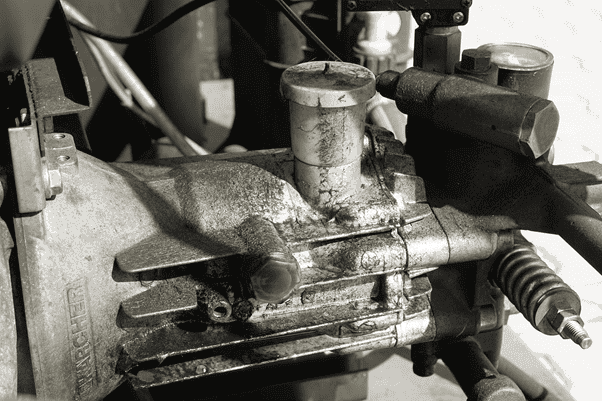
    Old Dirty Air Compressor

    When should you change Air Compressor Oil?

    Now you know how important it is to change the compressor oil for the effective running of the machine. But the next big thing you need to worry about is what should be the periodicity to change your air compressor oil.

    The regularity of changing the oil entirely depends on the type of air compressor you are using. Majorly, there are two types of air compressors; rotary screw and reciprocating compressor.

    If you have a rotary screw compressor, it will run continuously without any on and off switch. Large industries often use this type of compressor.

    The ideal recommendation of changing the oil in this compressor is 7000-8000 machine hours usage. But if your manufacturer has provided different guidance based on your compressor, you can follow that.

    Another type of compressor, the reciprocating compressor uses pistons driven by a crankshaft to compress the gas. You can observe metal-to-metal contact in these machines; therefore, lubrication is necessary to prevent such incidents.

    And thus, we recommend lubricating your compressor every 500 hours of usage or three months whichever is earlier. But, as we said, your manufacturer may have a different type of recommendation for the frequency of changing compressor oil, so keep that in mind.

    Conclusion

    Air compressor oil acts as blood in your body and ensures movement in your limbs. If the oil is not running in some parts of your machine, it might get jammed and may not function properly. So, keep a check on the oil in your compressor. And read all the manuals carefully before lubricating your machine yourself.

    Source: naijatechguide.com

  • TEACHERS IN CROSS RIVER STATE CALLED FOR BETTER WELFARE – DEMAND FOR RURAL AREA STATION ALLOWANCE

    TEACHERS IN CROSS RIVER STATE CALLED FOR BETTER WELFARE – DEMAND FOR RURAL AREA STATION ALLOWANCE


    By Joseph ETTA in Calabar.

    The president of Cross River State teachers council, Comrade Eyo Itam, has canvassed for better welfare for teachers in the state.

    In the occasion to marked this year’s teachers day  in Calabar, he also stressed the need for special allowance for teachers teaching in the most remote rural area of the state. He stated that teachers teaching in the rural areas with their meagre salary cannot support themselves with high cost of transportation, noting that in most of those areas you have to use canoe or speed boat to cross daily, for instance a place like Greek town and Bakassi area, teachers going to work pay a very exorbitant fare   daily.

    Comrade Itam, called on the Cross-River State government to do all in its power to revamp the education sectors – “there is so much rot and decay in the system; in some schools, you see children sit on the floor to learn, in some other area wind had removed the roof so people sit in an open air.

    The situation is very deplorable as a matter of fact, in Cross River State, Education and Teachers welfare is in total neglect.

    The lack of facilities and poor teachers’ welfare is the reason for the deteriorating standard of education in the state.

    The NUT President opined that instead of building super high way, build people for a better future.

    When Daybreak visited Bakassi L.G.A and Akpabuyo L.G.A, it is a very sorry sight, very deplorable and sad situation, children learn under the trees, damaged class room and shortage of man power – teacher Okon Ita, principal of secondary school, Ikot Ene, Akpabuyo disclosed that there is a general apathy and disenchantment against teachers, salaries are not paid. Even with the poor salary, it’s not being paid regularly, adding that no classroom, no working facilities. It’s a state of total neglect. He added.