
Nigeria will soon commence a $1 billion National Integrated Poultry Project in Enugu, Kaduna and Oyo states as part of broader Nigeria–China cooperation designed to strengthen food security, create jobs and stimulate agro-industrial development.
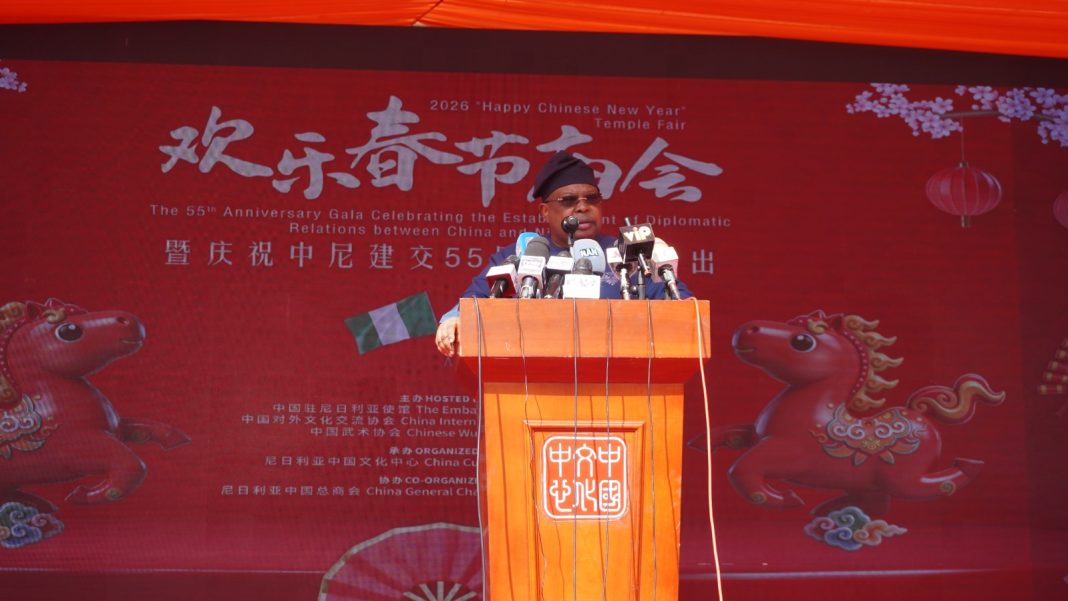
Joseph Tegbe, Director General and Global Liaison of the Nigeria–China Strategic Partnership (NCSP), made this known on Saturday at the 2026 Chinese New Year Temple Fair held at the China Cultural Centre in Abuja. The event, organised by the Chinese Embassy in Nigeria, marked the Year of the Horse and the 55th anniversary of diplomatic relations between the two countries.
He explained that the poultry project, modelled after China’s advances in agricultural productivity, will begin with pilot operations in the three states before expanding to other parts of the country.
Providing details of the initiative, Tegbe said the fully developed programme is expected to produce about six million eggs daily, manage over seven million layers and more than two million broilers, and cultivate upwards of 60,000 hectares of maize and soybeans for feed production. He added that existing farmers would benefit from subsidised feed inputs under the scheme.
According to him, the project is designed not only to close Nigeria’s food supply gap but also to generate employment and economic opportunities along the agricultural value chain.
Tegbe reaffirmed Nigeria’s adherence to the One-China Principle, describing it as central to the longstanding relationship between both nations. He noted that cooperation with China has played a visible role in Nigeria’s infrastructure growth, citing rail development and the Lekki Deep Sea Port as examples of transformative projects.
He also drew attention to renewed efforts to revive the Ajaokuta Steel Complex through collaboration with Chinese partners.
“The revitalization of Ajaokuta Steel Complex marks another inspiring chapter in our partnership. Long a symbol of unrealized potential, Ajaokuta is now poised for renewal through collaboration with China. With an expected output of 10 million metric tonnes per annum, a revitalized Ajaokuta will transform Nigeria’s economic trajectory, powering industries, creating jobs, and positioning Nigeria as a leading manufacturing and innovation hub in Africa,” he said.
Beyond infrastructure and industry, Tegbe highlighted the importance of academic exchanges and research collaboration between Nigeria and China. He said growing educational partnerships are laying the groundwork for innovation, skills development and the creation of industrial parks driven by shared technical expertise.
He emphasised that the Nigeria–China relationship must continue to prioritise people-centred outcomes, urging Chinese enterprises in Nigeria to focus on capacity building and skills transfer that benefit local communities.
Tegbe expressed confidence that the momentum generated by President Bola Ahmed Tinubu’s visit to Beijing in September 2024 would translate into visible progress across several joint initiatives in the coming year.
“As we celebrate the New Year, we must also look ahead with clarity of purpose. This is about projects that will define our shared future and deliver real impact to our people,” he added.
Also speaking, the Chargé d’Affaires of the Chinese Embassy in Nigeria, Zhou Hongyou, described the Spring Festival as a deeply symbolic celebration for the Chinese people and a time of reunion observed across the globe. He noted that the festival, to be celebrated worldwide on February 17, 2026, was added to UNESCO’s Representative List of the Intangible Cultural Heritage of Humanity in late 2024.
Zhou said the temple fair was conceived as a cultural bridge to promote understanding between Nigerians and Chinese through shared experiences in cuisine, arts, sports and tradition.
Recalling that diplomatic ties between the two countries were formally established on February 10, 1971, he said the relationship has grown steadily over five and a half decades, expanding from political goodwill into strong cooperation in trade, infrastructure, education, science and people-to-people engagement.
He described China–Nigeria relations as an example of effective South–South cooperation and disclosed that discussions are ongoing regarding zero-tariff arrangements aimed at supporting Nigeria’s development aspirations.
“Over the past 55 years, regardless of changes in the international landscape, both sides have always upheld mutual respect, equality and win-win cooperation. From political mutual trust and economic cooperation to people-to-people exchanges, China–Nigeria relations have grown ever stronger and more fruitful,” he said.
According to Zhou, the year 2026 is particularly significant as it coincides with both the 55th anniversary of diplomatic ties and the China–Africa Year of People-to-People Exchanges, which he said will further deepen mutual understanding and collaboration beyond official channels.
The celebration featured colourful cultural performances, music, games and an array of traditional Chinese dishes, drawing diplomats, government officials, members of the Chinese community and Nigerian guests into a festive atmosphere of friendship and cultural exchange.