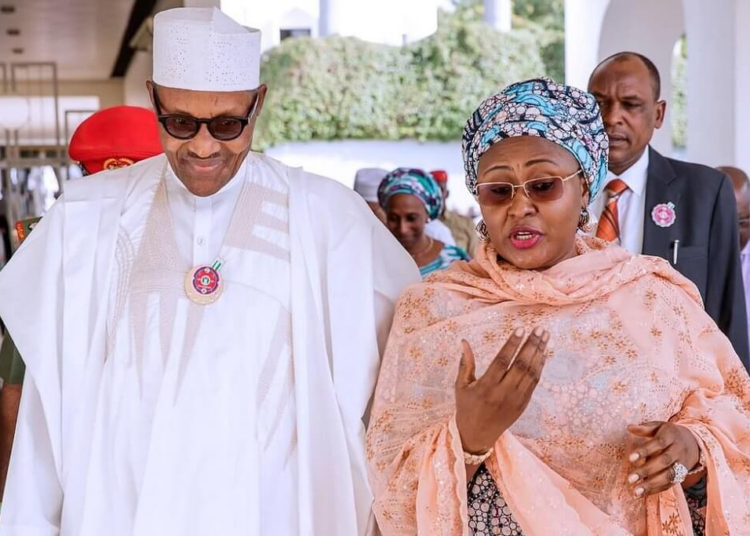

Former First Lady, Aisha Buhari, has explained why her late husband, former President Muhammadu Buhari, was often reluctant to dismiss underperforming ministers and aides during his time in office, as well as why he later intervened on behalf of some allies facing investigations.
Her account is contained in a new 600-page biography titled From Soldier to Statesman: The Legacy of Muhammadu Buhari, authored by Dr Charles Omole and unveiled on Monday at the State House in Abuja.
The book traces Buhari’s life from his childhood in Daura, Katsina State, to his death in a London hospital in July 2025.
According to Aisha Buhari, advancing age and the former president’s sensitivity to criticisms stemming from his 1980s military rule made him cautious about being perceived as authoritarian or ruthless.
“As you age, performance changes,” she was quoted as saying, noting that Buhari was wary of reinforcing the long-standing “dictator” label associated with his past. She added that some aides took advantage of this hesitation, often appealing to his sense of restraint.
She recalled Buhari’s guiding principle: “Even if a man ‘eats,’ if he can still deliver 50 per cent, keep him; but if he both eats and cannot perform, then he must go.”
Dr Omole noted that her reflections provide insight into the persistent criticism of Buhari’s leadership style, particularly his perceived unwillingness to sack non-performing ministers and service chiefs — a shortcoming acknowledged even within his family.
The biography also revealed that after leaving office, Buhari pleaded with the succeeding administration on behalf of some close associates who were asked to step aside for investigations.
“When asked to step aside for investigations, Buhari intervened on behalf of his kinsmen, seeking leniency because he still relied on them for many personal matters,” the book stated.
Several senior officials who served under Buhari are currently facing corruption probes, including former Accountant-General Ahmed Idris, ex-Minister of Power Saleh Mamman, and former Minister of Aviation Hadi Sirika.
Aisha Buhari disclosed that she declined requests to return to Daura to assist in facilitating prosecutions, describing those involved as “illiterate in their maturity.”
She also reflected on Buhari’s final months, saying he became increasingly withdrawn, often responding in monosyllables and avoiding eye contact — a change she described as a mixture of “shame, duty, and love” in his final days.