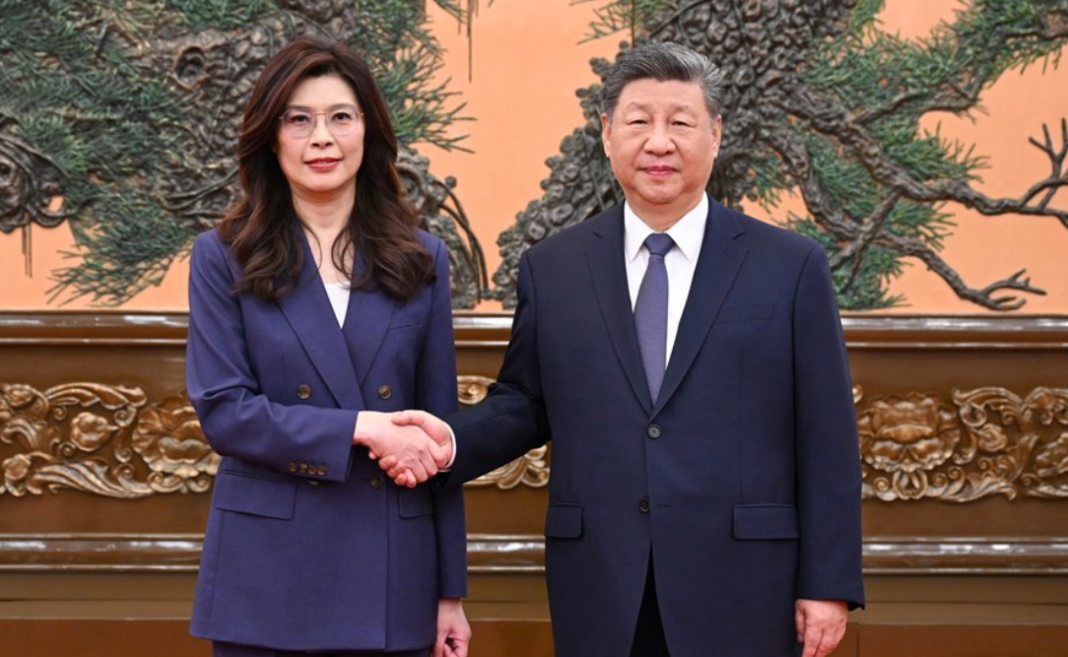

Chinese President Xi Jinping and Taiwanese opposition leader Cheng Li-wun met in Beijing on Friday, pledging to strengthen ties between both sides of the Taiwan Strait and advance what they described as the “great rejuvenation of the Chinese nation.”
The meeting took place at the Great Hall of the People, a venue typically reserved for high-level engagements between China’s leader and foreign heads of state, highlighting the significance Beijing attaches to the visit.
In remarks before closed-door talks, Xi, speaking in his capacity as head of the Communist Party of China, reiterated China’s longstanding position that Taiwan is an “inalienable” and “inseparable” part of its territory.
“As the world faces great changes, the broader trend of the great rejuvenation of the Chinese nation will not change, and the great tide of people on both sides of the Strait growing closer and coming together will not change,” Xi said, describing reunification as a “historical inevitability.”
The concept of “national rejuvenation” is central to Beijing’s long-term goal of transforming China into a leading global power by 2049, the centenary of the People’s Republic of China. It also encompasses the objective of achieving what Beijing calls “national reunification,” including Taiwan.
Xi stressed that China is open to dialogue with all political parties and groups in Taiwan, but under a clear condition: adherence to the “1992 consensus” and opposition to Taiwan independence.
The “1992 consensus” refers to an understanding reached between Beijing and Taipei that both sides belong to “one China,” though interpretations differ.
Cheng, who leads the Kuomintang (KMT), echoed Xi’s emphasis on closer engagement, calling for reconciliation and cooperation across the Strait. She said both sides should move beyond political differences and work toward what she described as a “symbiosis of co-prosperity.”
“The great Chinese rejuvenation involves people on both sides of the Strait. It is about the reawakening and resurgence of Chinese civilization,” Cheng said, adding that mutual respect should guide relations despite differences in political systems.
She also called for the establishment of sustainable mechanisms for dialogue and cooperation, warning against external interference and urging efforts to ensure the Taiwan Strait does not remain a geopolitical flashpoint.
Relations between Beijing and Taipei remain deeply complex. China considers Taiwan part of its territory and has not ruled out the use of force to achieve reunification. Taiwan, formally known as the Republic of China, operates as a self-governing entity and rejects Beijing’s sovereignty claims.
The United States remains Taiwan’s most significant international partner and arms supplier, despite the absence of formal diplomatic ties. Washington’s continued military support for Taipei has drawn repeated criticism from Beijing, which has urged the U.S. to halt arms sales to the island.