

By Du Yifei, People’s Daily
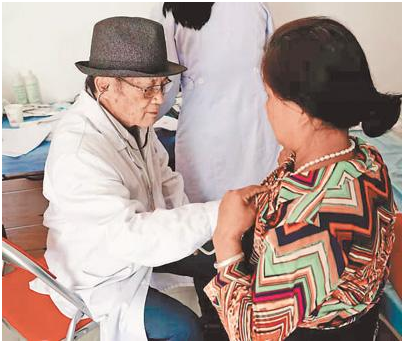
Wu Tianyi, 86, is a member of the Chinese Academy of Engineering and former research fellow with the Qinghai Province Cardiovascular and Cerebrovascular Disease Specialist Hospital.
As a pathfinder of Chinese hypoxia physiology and high altitude medicine, Wu has worked on plateaus for over six decades. He made international standards on the prevention and treatment of altitude sickness, initiated studies on high altitude adaptation in Tibetans, and diagnosed and treated more than 10,000 Tibetan patients. He’s nicknamed “doctor on horseback” by local residents.
Responding to the call of the nation to build the Qinghai-Tibet Plateau, Wu came to the northwestern province of Qinghai for work in 1958, where he saw many constructors fall ill and even sacrifice their lives due to anoxia and low pressure. Back then, high altitude medicine was still an area that no one in China had ever stepped onto, so he determined to get somewhere in this specific field.
To find the cause for altitude sickness and acquire more reliable information, Wu went on field trips to remote places with extremely high altitudes. At that time, transportation infrastructure was still poor on the plateau, so he and his colleagues had to ride horses and have yaks carry instruments and devices. Fighting with altitude stress, Wu slept in tents and lived on frozen bread and snowmelt. During the past decades, he has left his footprints in most of the high-altitude areas in Qinghai, Gansu and Sichuan provinces, as well as Tibet and Xinjiang Uygur autonomous regions. He has collected millions of pieces of scientific data, laying a solid foundation for the study of high altitude medicine.
Different from general medical studies, high altitude medicine would place researchers in harsher natural environments. Wu has had 14 bone fractures during his field trips. Once four of his ribs were broken, with one almost piercing into his heart. However, he just said that dedication is important for everyone who studies high altitude medicine.
In early 1990s, Wu designed the largest comprehensive hypobaric-hyperbaric chamber in China which was able to simulate pressure ranging from 12,000 meters above the sea level and 30 meters under it. The device played an vital role in the study of high altitude medicine.
After conducting animal experiments, Wu volunteered to be the first human going into the chamber, taking high risks. “I designed it, and I must be the first to try it,” he said. Due to a lack of operational experience, the operator of the chamber decompressed it too fast, which led to an acute headache of Wu and an eardrum rupture. Even so, Wu continued the experiment after his eardrum was recovered, but his hearing ability was very much impacted.
Later, his experiment results were massively applied. During the construction of the Qinghai-Tibet railway, which features the highest elevation in the world, Wu made a series of prevention and treatment plans for altitude sickness, as constructors must maintain high work intensity at an altitude of over 4,500 meters. Under his suggestion, 17 oxygen generation stations and 25 hyperbaric chambers were built up along the construction route, which successfully rescued nearly all who were struck by acute altitude sicknesses, including encephaledema and pneumonedema. No death was caused by altitude sickness among the 140,000 railway constructors, which was a miracle and earned Wu the tile of the “guardian of life.”
Today, Wu, in his eighties, is still working on the plateau region wearing a cardiac pacemaker. Every time someone persuades him to retire, he would refuse and say that the Qinghai-Tibet Plateau is where his career lies.