
BY CHARLES ONUNAIJU
Even before the waterway of the Strait of Hormuz got in the way of the bitter conflict of the recent U.S/Israel war on Iran, many Western pundits have set their calculations on the purported looming conflagrations on another strait, the Strait of mainland China and its island region of Taiwan, connecting the South and East China seas. It is about the world’s busiest shipping lanes through which half of world’s container traffic is conducted prodding the separatist forces in China’s Taiwan and setting up to the fatal adventure of seeking “independence” and setting up the island as a forward post for containing China, the strait has been projected as a geopolitical hot bed designed entirely to unravel China’s development trajectory.
Africa has historically held the view that the Taiwan question is China’s internal affairs and has never wavered in its conviction about the ability of China to resolve its major national question, which is left over by her own history. From upholding the United Nations iconic resolution 2758 to the practice of “one China policy” which resolutely recognises that there is only one China in the world and Taiwan is an inalienable part of China’s sovereign expression, 53 countries in Africa have demonstrated boundless optimism on China’s peaceful re-unification. Africa is proven right, sooner or later.
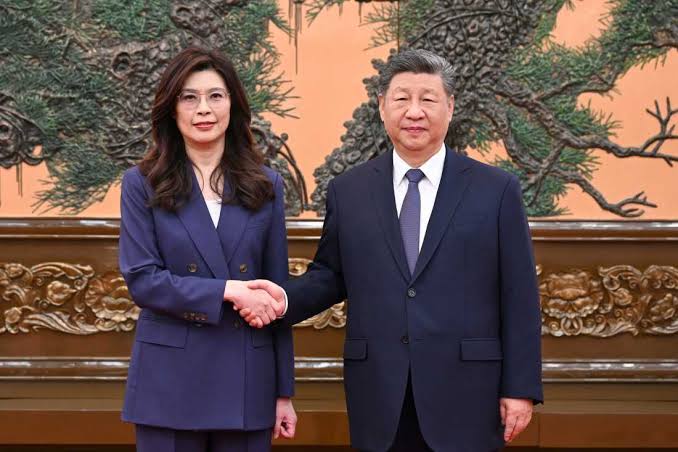
Early this month, China’s two legacy political parties, the Communist Party of China and the Kuomintang (KMT) or Nationalist Party, met in Beijing to reaffirm the strategic centrality of cross-straits dialogue communication and commitment to the 1992 consensus on “one China principle”.
The three day visit of the chairwoman of the largest party in the Taiwan regional parliament, Ms Cheng Li-Wun to mainland which culminated to the meeting with the general secretary of the Communist Party of China, Xi Jinping was an unmistakable signal that instead of the strait of confrontations gamed by western pundits, it is one of peaceful exchanges, shared prosperity and dialogue among all the Chinese people across the straits.
While the historic trip of the KMT leader to mainland was in the works, a bipartisan delegation of U.S senators visited Taipei in late last month, to urge politicians in the island to rally together and approve an increased military spending, claiming that “deterrence is the most important thing we can build on to prevent a conflict that would be devastating for the region and for the world”.
Though framed as security cooperation, the 40 billion special defence budgets that the Americans are nudging the Taipei authority to shoulder are in reality premised on hawking fear, amplifying confrontation and driving risks even higher in the straits. In reality, Washington would never care about the well-being of Taiwan residents.
However, Ms Cheng Li-Wun’s visit to the mainland, just like the former KMT chairman Lien Chan’s historic “journey of peace in 2005 opened a brilliant chapter of cross-straits dialogue between the two Chinese legacy political parties. In 2005, the two parties tore through the long standing ice and enabled a high-level dialogue since 1949. At the historic meeting, the two parties affirmed their commitment to the peaceful development of cross-straits relations and also endorsed the 1992 consensus, while rejecting “Taiwan independence”.
The visit to the mainland by the KMT leader is coming against the background of cross-strait tensions fanned and exacerbated by external forces and separatist voices on the island, and the visit patently and graphically made clear a simple but vital message: efforts by outside forces in cahoots with local separatists to inflame cross-strait confrontation would fail. In several respects, the trip of the KMT leader amplifies the shared wish for peace, development, exchange and cooperation on both sides of the strait and demonstrates the Chinese wisdom to come round to their nagging national question, a leftover of their history without falling prey to hostile external manoeuvres.
Cheng Li-Wun who during her campaign to become Kuomintang chairperson has said that she wants “all Taiwanese people to be able to proudly and confidently say ‘I am Chinese’ made the last leg of her visit of the mainland to Beijing and was received by the general secretary of the Communist Party of China (CPC), a powerful symbol that the two major Chinese legacy political parties may have their differences on a number of other issues, but national reconciliation and re-unification is common ground, that brooks no external interference.
At the meeting general secretary Xi Jinping, pointed out that “despite the vicissitudes of history, Taiwan compatriots have ever forgotten that their roots are on the mainland, that their hearts are with the motherland, that their souls belong to the Chinese nation… the Chinese roots and the Chinese soul shared by all sons and daughters of the Chinese nation come from our bloodlines are grounded in history and are etched in our hearts”. Further elaborating and reinforcing historical trends and its trajectories, the CPC general secretary added that “no matter how the international landscape or the situation in the Taiwan strait may evolve the overarching direction of human development and progress will not change and the great tide of compatriots on both sides of the strait becoming closer, more connected and coming together will not change”.
Chairwoman Li-Wun in her turn said, there is no denying that, over more than a century of interaction, the relationship between the Kuomintang and the Communist Party has seen twists and turns. Yet what we have both pursued, throughout has always been to lead the Chinese nation from decline to rejuvenation” and indicated that “peace and reconciliation across the strait should be only the starting point of the joint efforts of two parties, and urged that the great “rejuvenation of the Chinese nation” must be a shared rejuvenation for people on both sides of the strait”.
Echoes of the historic meeting of the CPC and KMT and its major theme of shared vision and determination for a rejuvenation of the Chinese nation would strike a familiar note to the Chinese people across the strait, but it would be an ultimate nightmare to Washington and other western capitals, where playing the ‘Taiwan card’ is a routine politics to contain and constrain China. U.S. President Donald Trump, still smarting from the strategic debacle of the ill-thought-out war for regime change in Iran and due to visit Beijing next month, would find the edges of the traditional Taiwan card always wielded by Washington thoroughly blunted.
The Chinese have obviously come into their own to resolve their lingering national question. That Africa has always demonstrated eternal optimism in the process of China’s national reconciliation and re-unification must imply China’s spirit of creativity, originality and inclusion in resolving outstanding issues of national questions in the various countries in Africa. The context of mutual learning’s and experience sharing in the contemporary China-Africa cooperation would avail both sides, the historical lessons of their respective national constructions.
From the Strait of Tensions and a potential regional hot spot, the Chinese on both sides of the straits have by their action, refused to dress their homeland in the garb, orchestrated by meddlesome external profiteers. In the current situation of the Taiwan region, it is the separatist platform of the Democratic Progressive Party (DPP) that is isolated and needs to come to terms to the trend and reality of peaceful national reunification. As a Chinese commentator said, “facts will ultimately show that any political manoeuvre that ties Taiwan to an external war chariot and pushes its residents toward the front line of danger will fail the test of public, reality and history” as Taiwan’s future is firmly tied to national reunification.
The precision, tenacity and optimism which Africa held and shared in the peaceful reunification of China and the ability of her people to make it happen, can help turn around the fortunes of Africa and place it on the firm path to modernisation and renaissance.
Mr Onunaiju is an International Affairs analyst based in Abuja.