

By XuPeiyu, People’s Daily Overseas Edition
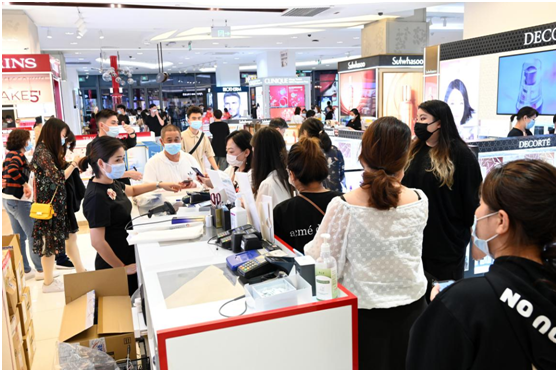
China’s consumption has been on a continuous rise in recent years, and its consumption structure is also being optimized.
Last year, the country’s total retail sales of consumer goods reached 39.2 trillion yuan ($6 trillion), and final consumption contributed 54.3 percent to China’s GDP. As a result, China maintained its position as the second largest consumption market of the world.
New business forms such as online shopping and influencer marketing experienced rapid development. In 2020, a total of over 24 million livestream shows were aired on e-commerce platforms; online sales of national entity bucked the trend and grew 14.8 percent; the express delivery industry handled 31.2 percent more parcels than it did a year ago. China has become the world’s largest market of online retailing for eight consecutive years.
The robust recovery of China’s consumption, despite the severe impacts from COVID-19, showcased the strong resilience and huge development potential of the Chinese market.
As a major force of consumption, the middle-income group is a pillar of economy. At present, China has 400 million middle-income earners that account for around 30 percent of its population. In developed countries, the distribution of household income is always in an “olive shape” that is sharp at both ends and plump in the middle. In other words, middle-income group usually accounts for 60 percent to 70 percent of the population in developed countries. Such a structure is considered healthy and good for economic and social development. In contrast, China still has a long way to go to expand the size of its middle-income group.
Vice Minister of Commerce Qian Keming said that with 1.4 billion people, China boasts a super large market and huge development potential. In the next 15 years, the number of Chinese middle-income earners is expected to reach 800 million, which will generate robust momentum for consumption upgrading and bright prospects.
According to China’s 14th Five-Year Plan, China will work to increase the income for graduates of universities and vocational schools, skilled workers and migrant workers in the next five years. Experts believe that it’s both possible and necessary to include them in the middle-income group.
Graduates of universities and vocational schools come in huge size and are well educated and skillful, which makes them possible to become middle-income earners. “Most people from this group, with their degree of education and competence, will not work simple and repetitive jobs, so it’s possible that they become middle-income earners,” Su Hainan, a contract research fellow with China Association for Labor Studies, told People’s Daily during an interview.
According to the latest statistics from the Ministry of Human Resources and Social Security (MOHRSS), China has over 200 million skilled workers, who take 26 percent of its total jobs, up from 20 percent a few years ago. More than 50 million of them are highly skilled workers. In recent years, skilled workers are in a short supply in China, and their income keeps rising.
The MOHRSS recently issued a guideline, encouraging enterprises to institute annual salary system and offer special awards for skilled talents, especially highly skilled ones.
“Migrant workers are a major part of China’s workforce, many of whom are also well educated and skillful, and are able to work complicated and innovative jobs,” Su said.
Last year, the number of migrant workers in China reached 280 million, including 170 million who worked out-of-town. The average monthly income of them stood at 4,072 yuan. Many of them are getting close to the threshold of middleincome if calculated in terms of household.
“To make a part of migrant workers middle-income earners is necessary for narrowing rural-urban income gap, improving the competence of workforce and accelerating rural vitalization, and it’s also feasible to do that,” Su noted.
As the income of these major groups rises in the future, the size of China’s middle-income group will be further expanded, turning the country’s household income distribution into the “olive shape.” By that time, China’s consumption vitality will have been further activated, and the country will also release more dividends to the world.

