
By Francis Wilfred
The Economic and Financial Crimes Commission (EFCC) has raised serious concerns over the alleged negligence and compromise of some banks and fintech companies in two major fraudulent schemes that have reportedly cost victims a total of ₦18.74 billion.
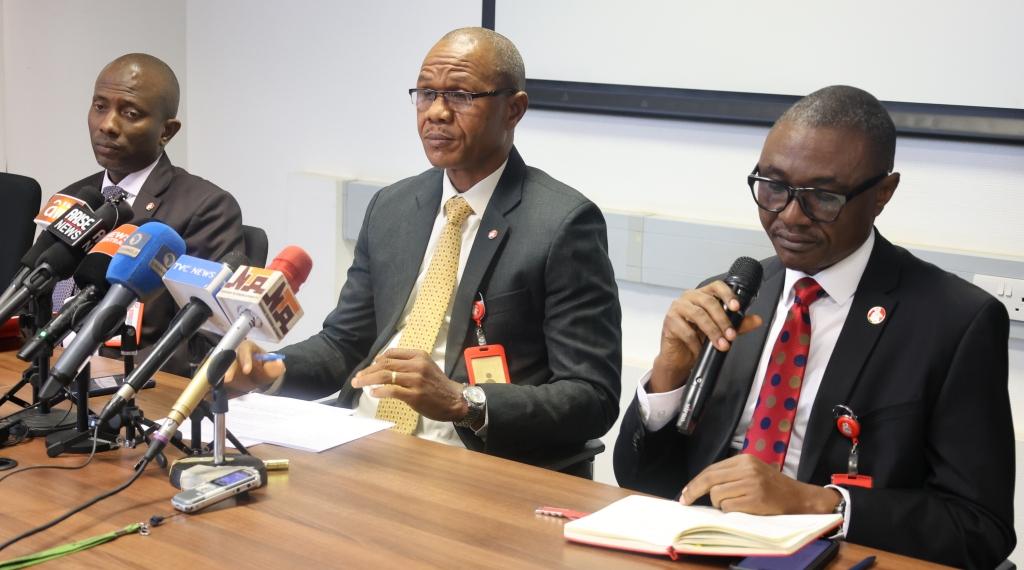
The commission disclosed this in a press briefing in Abuja on Thursday, January 22, 2026, where its Director of Public Affairs, Commander of the EFCC, CE Wilson Uwujaren, addressed journalists on the operations of two separate fraud schemes currently under investigation.
According to a statement signed by the EFCC’s Head of Media and Publicity, Dele Oyewale, Uwujaren revealed that one new-generation bank and six fintech and microfinance banks were implicated in facilitating transactions linked to the scams.
He explained that the first scheme involved airline discount fraud, through which unsuspecting victims were lured into making payments for discounted flight tickets that ultimately resulted in the loss of their funds.
“The fraudsters advertise fictitious airline discount offers designed to attract travellers, especially those flying on international routes. Their payment platforms are structured to convince victims that funds are being paid directly to airline accounts. However, once payment is made, victims’ entire bank balances are swiftly drained,” Uwujaren said.
He disclosed that more than 700 victims had fallen prey to the scheme, losing a cumulative ₦651,097,755.00, out of which the EFCC successfully recovered and refunded ₦33,628,000.00 to affected persons.
Uwujaren warned Nigerians to remain vigilant, noting that foreign operators behind the scheme were converting proceeds into cryptocurrency and transferring them to offshore platforms, including Bybit, to evade detection.
The second scheme, he said, involved Fred and Farid Investment Limited, popularly known as FF Investment, which allegedly defrauded over 200,000 Nigerians through fictitious investment packages.
According to the EFCC, a total of ₦18,088,901,272.35 was mobilised through nine associated companies offering various bogus investment schemes. In total, more than 900 Nigerians were reportedly fleeced through the connivance of some financial institutions.
Uwujaren revealed that foreign nationals masterminded the fraud, aided by three Nigerian accomplices, who have since been arrested and charged to court.
Providing further details, Abdulkarim Chukkol, Director of Investigations, and Michael Wetcas, Acting Director of the Abuja Zonal Directorate of the EFCC, explained that lapses within the financial sector played a major role in enabling the schemes.
They stated that compromised banking procedures allowed fraudsters to convert illicit proceeds into digital assets and transfer funds across borders undetected.
“A total sum of ₦18,739,999,027.35 passed through Nigeria’s financial system without appropriate customer due diligence. Investigations also revealed that cryptocurrency transactions valued at ₦162 billion flowed through a new-generation bank without proper scrutiny,” they said.
According to the EFCC officials, one customer was discovered to have operated 960 bank accounts within a single financial institution, all allegedly deployed for fraudulent activities.
The EFCC therefore called on financial regulators to enforce strict compliance with Know Your Customer (KYC) standards, Customer Due Diligence (CDD) procedures, and Suspicious Transaction Reports (STRs) obligations.
It urged regulatory agencies to suspend and refer any financial institution found complicit in fraud to the EFCC for thorough investigation and possible prosecution, warning that negligence in monitoring suspicious transactions would no longer be tolerated.
The commission reaffirmed its commitment to intensifying efforts against money laundering, cyber fraud, and financial crimes, while urging banks and fintech firms to strengthen internal controls and safeguard Nigeria’s financial ecosystem.
Uwujaren said, “Financial institutions must firm up their operational frameworks to prevent leakages that are bleeding the nation’s economy.”