
By Joyce Remi-Babayeju
The European Union has expressed readiness to collaborate with the Federal Capital Territory (FCT) Administration in key sectors, including infrastructure, investment promotion, and justice reform.
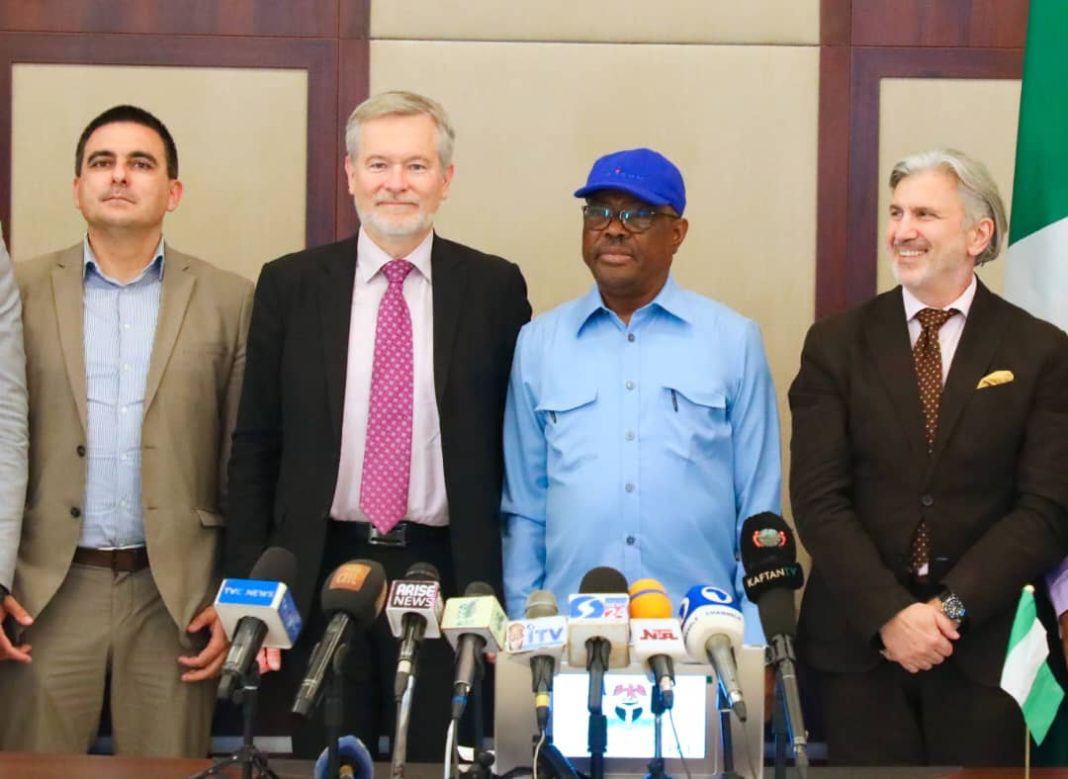
The EU Ambassador to Nigeria, Guatier Mignot, disclosed this on Thursday in Abuja during a high-level meeting with the FCT Minister, Barr. Nyesom Wike.
Mignot said that the collaboration is a significant opportunity to strengthen ties with the FCT.
He added that since presenting his credentials to Bola Ahmed Tinubu last year, he has been keen to foster closer cooperation with key government institutions in the FCT.
According to him, the EU remains one of Nigeria’s foremost trade and development partners, with a long-standing and mutually beneficial relationship that is now entering a more strategic phase.
He recalled the recent visit of the EU High Representative and Vice President of the European Commission for the 8th EU–Nigeria Ministerial Dialogue, which, he stated, underscored a shared commitment to elevate bilateral relations amid evolving global challenges.
Furthermore, the envoy noted that the EU, comprising 27 member states with over 450 million citizens, maintains a strong diplomatic footprint globally, including in Nigeria, where 19 member states are represented in Abuja.
He also highlighted the growing European presence in the capital, citing the recent inauguration of the Irish Embassy and the expansion accommodating the Belgian Embassy.
As part of efforts to strengthen the engagement, he invited the FCT Minister to a meeting with EU member states’ ambassadors to exchange ideas on Abuja’s development priorities and explore new areas of cooperation.
Mignot identified waste management, water management, and urban development as critical sectors where European expertise could support the FCT, as efforts to attract European investment into the nation’s capital.
The ambassador emphasized that Abuja is not only an administrative hub but also a rapidly growing city with strong economic potential.
Speaking on development cooperation, he outlined several EU-supported initiatives already impacting the FCT, including programmes with the police to strengthen human rights protections within the criminal justice system.
He also listed support for Sexual Assault Referral Centers, including one at Wuse General Hospital, which provides free medical and psychosocial services to survivors of gender-based violence.
Other interventions include the establishment of disability desks across FCT institutions and capacity-building programmes for the judiciary through training, specialized courts, and improved case management systems.
Meanwhile, the ambassador stressed the importance of justice sector reforms, particularly in the area of the digitalization of court processes under the EU-funded Rule of Law and Anti-Corruption Programme (RoLAC), with the FCT selected as a pilot location.
He noted that aligning this initiative with the FCT Administration’s plans would enhance efficiency and position Abuja as a model for other states such as Lagos, Edo, and Abia.
End