
Reviewed by Prof. Yemi Osinbajo
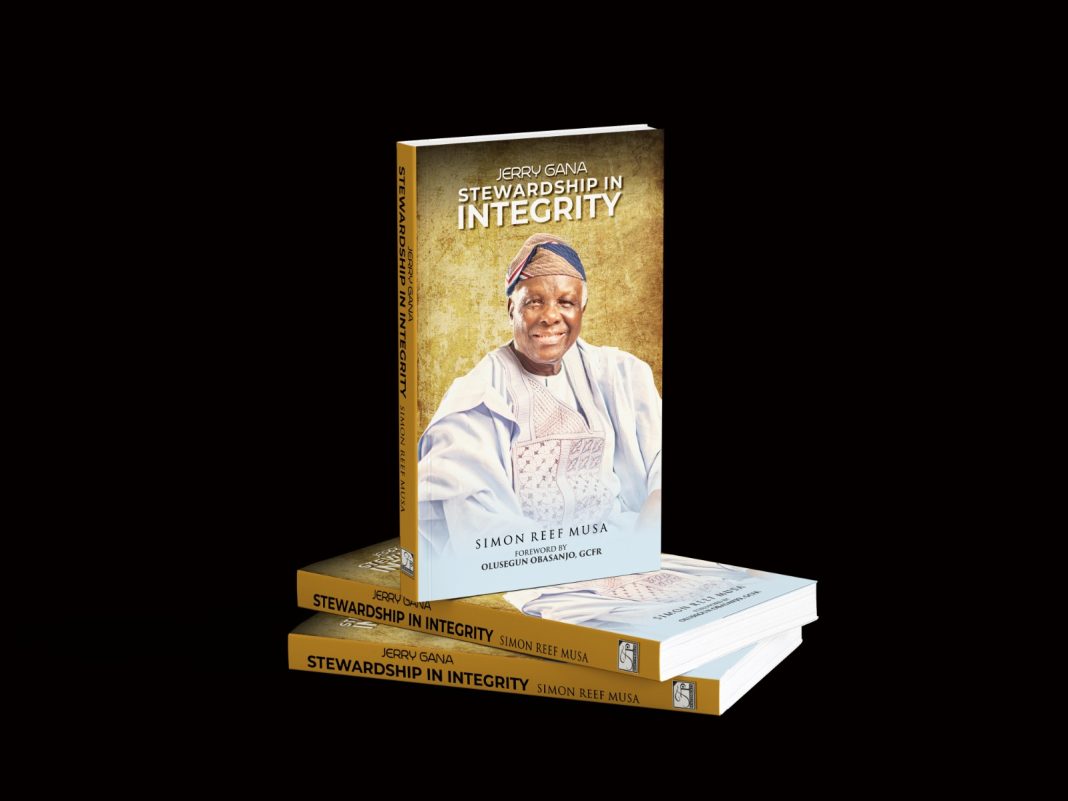
BOOK REVIEW OF “JERRY GANA: STEWARDSHIP IN INTEGRITY” by Simon Reef Musa. Presented at the 80th Birthday Celebration of Professor Jerry Gana, CON, delivered by PROFESSOR YEMI OSINBAJO, SAN, GCON, Former Vice President, Federal Republic of Nigeria, Abuja, November 2025.
Protocols & Opening Pleasantries
Your Excellencies—former Heads of State and Government, My Lords Spiritual and Temporal, Distinguished Governors, Ministers, Eminent Academics, Senior Public and Civil Servants, Captains of Industry, Leaders of Faith, Ladies and Gentlemen:
It is a profound honour to join you in celebrating a man who is not merely a personage but an institution. At fourscore years, the occasion demands not only festivity but reflection—the sort of contemplation befitting a life of extraordinary purpose. Now, I must confess that when I was asked to review this book, I experienced what lawyers might call a conflict of interest. You see, both the celebrant and the reviewer suffer the same affliction: we are Professors who, for reasons that continue to baffle our academic colleagues, voluntarily left the quiet dignity of the ivory tower for the muddy trenches of Nigerian politics. The difference, of course, is that Professor Gana has been navigating those murky waters since some of us were still learning to read—and he has done so without drowning, and without the usual aquatic acquisitions that often accompany such prolonged immersion.
Yet there was another dilemma. A book is silent. But if there is anything we all know about Professor Jerry Gana, it is that he is emphatically not silent. To fit his legendary oratorical thunder into the cold, quiet pages of a book seems almost unfair. One almost expects that upon opening Chapter One, the book should shout “Jeri-Jeri-Jeri!” Simon Reef Musa’s work faces the formidable challenge of capturing a man whose voice has mobilised generations. And yet, surprisingly, the book’s quietude provides a sharp contrast that allows the scholar, the public intellectual, and the mobiliser to emerge with deliberate clarity. The book is structured into seven distinct parts, spanning twenty-four chapters spiced with extensive quotations from Gana and several key figures who are part of the life long story. The text is therefore, not merely a biography—it is, in the best sense, a jurisprudential argument: a demonstration that excellence and integrity in public service are still possible in our polity.
The Scholar & the Mobiliser (Education & MAMSER)
Part I: The Genesis of Brilliance
The book begins in the Nupe Kingdom—land of Tsoede, ancient regalia, and cultural sophistication. From this heritage emerges a young Al-Hassan who was christened Jeremiah, and later simply “Jerry,” who excelled with almost irritating consistency. From Busu Village to Bida, to Okene where in 1967, got the best results in the entire Northern Nigeria, to ABU Zaria, where he narrowly misssed a first class degree in Geography, his academic record reads like the script of someone in an indecent hurry to reach the summit. But what strikes me most profoundly in the book’s account of his educational journey is not merely his intellectual prowess—it is the integration of that prowess with purpose. At the University of Aberdeen, Scotland, where he obtained his Master’s and PhD in record time and at the age of 28, the book notes that he did not merely pursue Geography, he pursued rural development. He understood, even then, that knowledge divorced from the service of the common man is mere intellectual vanity. To be sure, there is a revealing anecdote in the book about his choice of Aberdeen over Oxford. He chose Aberdeen, he explained, because its programme in rural resource planning aligned with his vision to transform rural communities. This was not the choice of an academic careerist; it was the choice of a man who had already decided that his scholarship must serve his people.
Parts II & III: The Philosophy of Mobilisation
If any chapter of our national history bears the indelible imprint of Professor Gana, it is MAMSER—the Mass Mobilisation for Self-Reliance, Social Justice and Economic Recovery. When the Political Bureau, headed by Dr. Cookey, recommended the establishment of a mobilisation agency, the choice of Gana as founding Chairman was, as the author notes, ‘no surprise to many.’ Here was a man with an unparalleled gift for articulation, a scholar with grassroots credibility, and—crucially—an optimist who believed that Nigerians could, indeed, change. The book records how Chief Obafemi Awolowo, in a letter to the Political Bureau, expressed scepticism about the prospects of national reorientation, writing that ‘as long as Nigerians remain what they are, nothing clean, principled, ethical, and idealistic can work with them.’ It was a pessimism born of experience. Yet Gana, armed with his oratorical skills and his conviction, set out to prove the Sage wrong—or at least, to try. Where others saw Nigerians as irredeemably cynical, Gana saw a people who could be awakened. Whether MAMSER ultimately succeeded is debatable, but that it marked a serious, intellectually coherent attempt at national reorientation is unquestionable.
The Political Question (Democracy & the PDP)
I was particularly struck by Part V, which chronicles the “Struggle For Restoration Of Democracy” and the “Formation of the PDP”. Regardless of one’s political leaning, this section is a vital historical repository. It reminds us that democracy did not fall from the sky; it was fought for. The book details the courage of the G-18 and the G-34, where Prof. Gana served as Secretary . Chapter 16, on the formation of the PDP, is particularly instructive. Gana was not merely a participant; he was the founding National Secretary of what would become the largest political party in Africa. The book records his words about the party’s founding vision: ‘We chose the umbrella because under the umbrella, we are all together. There is inclusiveness; from whatever part you have come, we are together, we are one and the same because we are each other’s brothers and sisters.’
Reading these words today, one cannot help but reflect—with a certain melancholy—on the distance between founding ideals and present realities. The umbrella that was meant to shelter all Nigerians appears, shall we say, to have developed some rather significant holes. The party that was founded on the principles of internal democracy and inclusivity has, in recent times, been more notable for its internal convulsions than its democratic credentials.
But I digress. Or perhaps I do not. For this is precisely the value of a book like this: it holds up a mirror not only to the man but to the nation. It reminds us of what we aspired to be, and invites us to consider what we have become. That the founding Secretary of the PDP remains a voice for integrity while the party he helped birth struggles with existential questions of identity and direction—well, that is a commentary that requires no elaboration from me.
Areas for Further Inquiry: The Silence in the Text
However, Your Excellencies, as an academic myself, I would be remiss if I did not point out that no work of history is without its silences. In reading “Stewardship in Integrity,” I found myself yearning for a deeper excavation in two or three critical areas. First, the anatomy of the “AGIP” Phenomenon. The book addresses the popular acronym associated with Prof. Gana—’AGIP’ (Any Government In Power)—by explaining that he was always “invited to serve” due to his competence . While this is factually accurate, the book is somewhat shy in exploring the internal ideological conflict that such service must have entailed.
Second, the “Third Term” Paradox. The book vigorously defends Prof. Gana’s role during the 2005 National Political Reform Conference, stating he was “unaware” of the Third Term agenda . While I do not doubt the integrity of the account, the student of history might ask: How could the Political Adviser to the President be insulated from the biggest political manoeuvre of that era? The narrative presents Prof. Gana as a man of immense influence; yet, in this specific instance, it presents him as an outsider to the plot. This paradox invites further interrogation.
Third, the 2007 Primaries. The account of the 2007 PDP Primaries is riveting. The book details how the “lightning vote” of the Presidency swung away from Gana to Yar’Adua at the last minute . However, the text attributes this almost entirely to the whims of one man—President Obasanjo. For a political biography, one would have hoped for a more structural analysis. Was there a failure in the Gana campaign machinery? Was the reliance on the “anointing” of the incumbent a strategic error?. The book frames the loss as a betrayal; a colder political analysis might frame it as a miscalculation of the power dynamics of the time.
But perhaps, Distinguished Ladies and Gentlemen, these gaps are not flaws of the author, but rather a testament to the complexity of the subject. Jerry Gana is a man who defies easy categorization—a technocrat in khaki regimes, and a politician in civilian robes.
THE CENTRAL ARGUMENT: DECONSTRUCTING THE TITLE
Let me now turn to what I consider the central intellectual contribution of this biography: the deconstruction of the title itself—’Stewardship in Integrity.’ In the Nigerian political lexicon, ‘integrity’ has become something of a liability. It is, in the popular imagination, the attribute of those who are too foolish, too naive, or too unfortunate to have figured out how the ‘system’ works. To have integrity, we are told, is to be poor. To maintain your principles is to be left behind. The logic of our politics suggests that integrity is a burden to be discarded, a handicap to be overcome.
This book offers a profound counter-narrative. It presents integrity not as a burden but as a resource. And not just any resource—but a resource to be managed, to be deployed, to be invested. That is the meaning of ‘stewardship.’ The book argues that when you hold public office, you are a trustee. And as every lawyer knows, a trustee is held to a higher standard of care than an owner. Consider the testimony recorded in the book: that Gana ‘would come back to almost square one after leaving office, to the awe of his associates and most onlookers.’ Yet, the same testimony notes, ‘surprisingly, in spite of his refusal to soil his hands, he never lacks.’ His children are accomplished. His reputation is unsullied. He remains relevant, consulted, respected. His integrity has not impoverished him; it has enriched him—in ways that cannot be measured by bank accounts. The Psalmist declares in Psalm 37:25: ‘I have been young, and now am old, yet I have not seen the righteous forsaken or his children begging for bread.’ Professor Gana, at eighty years, stands as a living testament to this ancient promise. His integrity has been his stewardship—a faithful management of the most valuable resource any public servant can possess: the trust of the people.
A WORD FOR OUR TIMES
If I may be permitted a brief departure from strict literary criticism—and this is, after all, a book review—this biography speaks directly to our present moment. We live in times when public trust is at a premium. When citizens question not only the competence but the very motives of those who govern. When the gap between official pronouncements and lived realities has become a chasm. This book, in documenting the life of a man who walked the corridors of power for four decades without losing his soul, poses an uncomfortable question: if it is possible for one man to maintain his integrity in these same corridors, why is it impossible for others? If Gana could emerge from military and civilian governments alike without ‘aquatic acquisitions,’ what excuse do his contemporaries—and successors—have? The answer, I submit, lies in the very concept this book illuminates: integrity as stewardship. Those who treat power as an opportunity for personal enrichment have misunderstood the nature of their position. They are not owners; they are stewards. The resources they control, the authority they wield, the trust they have received—these are not theirs to exploit but theirs to manage, to preserve, to pass on.
Conclusion: The Triumph of Faith
The final chapters reveal the engine room of Professor Gana’s remarkable journey—a seamless blend of public service and unwavering spiritual devotion. From leading the Fellowship of Christian Students at ABU, to attending Bible school in Aberdeen while pursuing his PhD, and chairing the Abuja Festival of Praise, his life has always been guided by faith and a commitment to serve. It was this same spiritual grounding that shaped his approach to relationships. During his time at Okene, Professor Gana was drawn to Lucy, a student at St. Faith’s College, Kaduna. Despite his sincere intentions, Lucy remained resolute; she refused to entertain his presence and even incinerated a heartfelt love letter he had penned—a gesture not uncommon among young ladies of that era. Yet, his perseverance, perhaps rooted in his faith and hope, eventually won her heart. In 1974, they married—a union that has flourished for 51 years, blessed with four children and several grandchildren.
His journey demonstrates that faith and governance need not be estranged; that spirituality can animate public service; that conviction can coexist with competence. Simon Reef Musa has done Nigeria a great service. He has shown, in documentary form, that it is possible to pass through the fiery furnace of Nigerian politics and emerge without the smell of smoke. Professor Jerry Gana, at eighty, stands as a testament to excellence anchored in integrity, scholarship married to service, and faith expressed through action. And so, as Scripture declares in Proverbs 16:31: “Gray hair is a crown of glory; it is gained in a righteous life.” Sir, you have earned your crown
In the final analysis, “Jerry Gana: Stewardship in Integrity” is not just a book about Jerry Gana. It is a manual for the next generation. It is a rebuttal to the claim that you cannot be smart, spiritual, and successful in Nigerian politics simultaneously. At 80, Prof. Gana remains a reference point. This book is the evidence. I unreservedly commend it to the reading public, to the student of history, and to every Nigerian who dares to believe that a new Nigeria is possible.
May the Lord grant you many more years of fruitful service. Happy 80th Birthday, Professor. And thank you for showing us that in Nigeria, stewardship in integrity is not only possible—it is profitable.
Thank you, and God bless you all.