
By Daniel Dalyop
The 8th National Convention of the All Progressives Congress arrives at a defining moment not just for the party but for Nigeria itself, a moment where the usual rituals of political transition must give way to something far more deliberate, far more consequential.
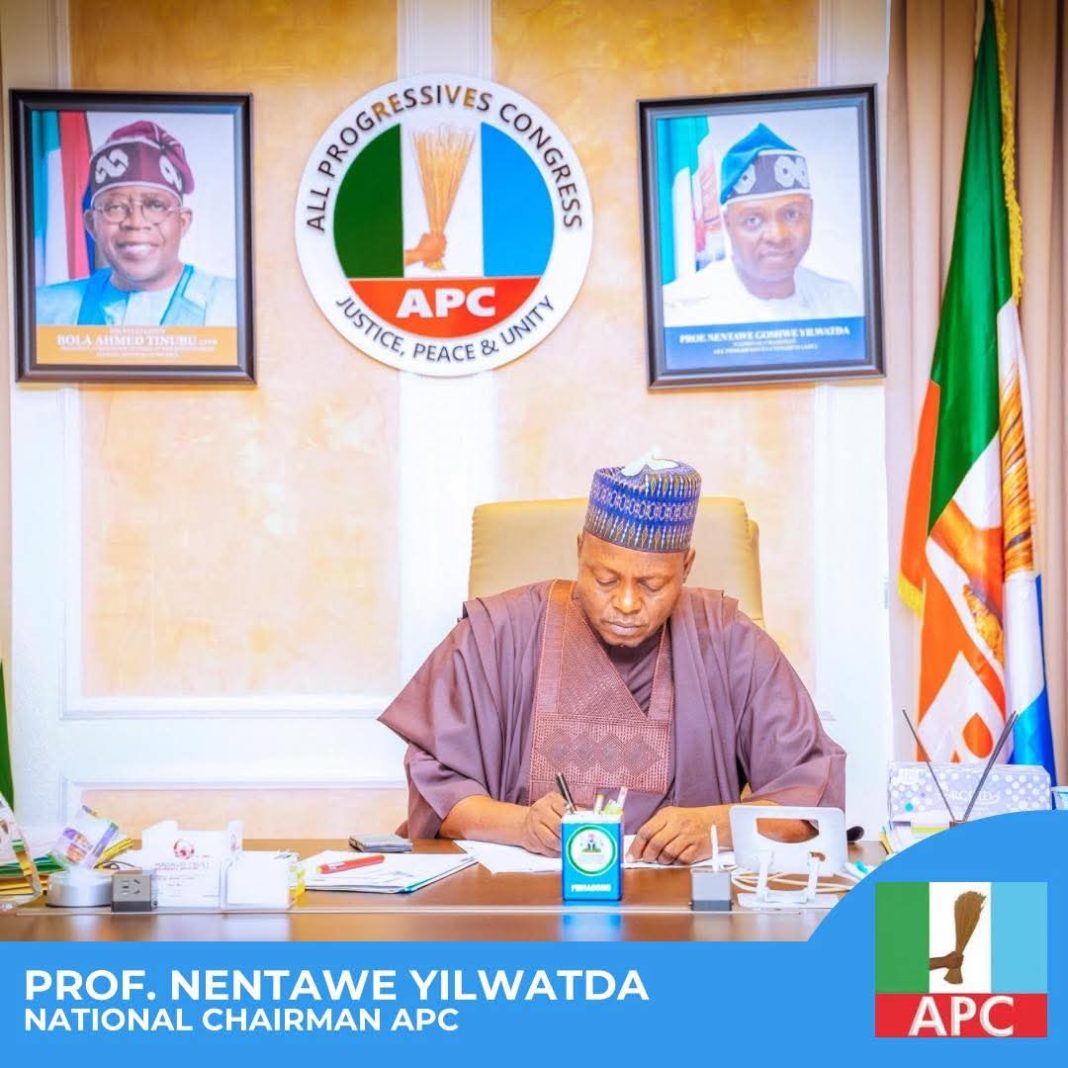
At the center of this moment stands Nentawe Yilwatda, not merely as a beneficiary of internal party consensus, but as a symbol of an urgent and necessary shift in the way politics is conceived, organized, and deployed in service of national progress.
His emergence is not accidental; it reflects a growing recognition within the APC that the future cannot be secured through the habits of the past, and that a new kind of leadership must be actively supported, protected, and empowered if the party is to remain dominant and if Nigeria is to move forward with clarity and purpose.
There is something profoundly different about the politics Nentawe represents. It is not built on noise or spectacle, nor is it anchored in the old arithmetic of transactional alliances that often produce short term victories but long term instability.
His approach is measured, intentional, and deeply rooted in systems thinking. It is the kind of politics that understands that power, in its most meaningful form, is not merely about winning elections but about building structures that can sustain governance, deliver results, and inspire confidence across diverse constituencies.
In a country where citizens are increasingly impatient with empty promises and symbolic gestures, this approach is not just refreshing, it is necessary. It speaks directly to a national mood that is searching for credibility, coherence, and direction.
Yet, it must be said clearly and without hesitation that this moment will not sustain itself on goodwill alone.
The success of Nentawe’s leadership over the next four years will depend, to a very large extent, on the willingness of the party, its stakeholders, and its power centers to rally around him with sincerity and discipline. Support in this context cannot be superficial or ceremonial; it must be strategic, consistent, and rooted in a shared understanding that his success is inseparable from the success of the APC itself.
Too often in Nigeria’s political history, promising leadership moments have been undermined by internal contradictions, quiet resistance, and the inability of key actors to subordinate personal ambitions to collective goals.
This is precisely what must not happen now. If the APC is serious about consolidating its position as the party to beat in 2027, then it must recognize that the strengthening of Nentawe’s leadership is not optional, it is foundational.
The visible confidence and political warmth that Bola Ahmed Tinubu, the President and Commander in Chief, has shown toward Nentawe introduces a rare and powerful dynamic into this equation. In the intricate ecosystem of Nigerian politics, alignment with presidential authority often determines the pace and depth of institutional effectiveness.
However, what is unfolding here goes beyond routine alignment; it reflects a deliberate trust in capacity and a recognition of shared purpose.
The President, widely regarded as one of the most astute political organizers in Nigeria’s recent history, appears to see in Nentawe a leader capable of translating executive vision into party cohesion, capable of ensuring that the APC does not merely exist as a vehicle for power but evolves into a platform for sustained national transformation.
This relationship, if properly understood and carefully managed, could become the single most important enabler of progress within the party over the next four years. It offers Nentawe something that very few party leaders in Nigeria have enjoyed in full measure, which is the combination of political legitimacy, executive backing, and intellectual space to innovate.
However, it also places a responsibility on him to rise to the demands of that trust, to ensure that proximity to power does not dilute independence of thought, and to demonstrate that loyalty to leadership can coexist with a commitment to institutional integrity.
For the party, the implication is equally clear; it must leverage this alignment not for narrow consolidation but for broad based strengthening, ensuring that every level of the APC reflects coherence, discipline, and purpose.
The argument for supporting Nentawe, therefore, is not sentimental, it is strategic.
It is about recognizing that the APC stands at a crossroads where it must transition from being a successful electoral coalition to becoming a deeply institutionalized political force.
This transition requires leadership that is not only competent but also forward looking, leadership that can embed systems, enforce standards, and create pathways for inclusion that go beyond rhetoric.
Nentawe’s disposition toward data driven decision making, structured engagement, and outcome oriented politics positions him uniquely for this task. But even the most capable leader cannot succeed in isolation. Without unified backing, even the best ideas will struggle to take root; with it, even the most ambitious reforms can become reality.
There is also a broader national implication that cannot be ignored. Nigeria’s political stability and economic progress are closely tied to the strength and coherence of its ruling party.
When the governing party is fragmented, distracted, or internally conflicted, the effects ripple across governance, policy implementation, and public confidence. Conversely, when the party is disciplined, aligned, and focused, it creates the conditions for effective governance and sustained reform.
Supporting Nentawe, therefore, is not just about internal party success; it is about contributing to a more stable and functional political environment for the country as a whole. It is about understanding that the quality of leadership within the APC has direct consequences for the quality of governance Nigerians experience.
As 2027 approaches, the political landscape will inevitably become more competitive, more scrutinized, and more demanding.
The APC cannot afford to enter that cycle with unresolved internal tensions or unclear strategic direction. It must present itself as a party that has learned, adapted, and evolved, a party that is not only capable of winning elections but also of governing effectively and inclusively. Nentawe’s leadership provides a pathway to that outcome, but only if it is backed by a collective commitment to success.
The party must resist the temptation to fragment into competing camps, must avoid the distractions of internal rivalry, and must instead channel its energy toward building a unified, disciplined, and forward looking organization.
What is at stake here is larger than any individual, yet it is precisely through the support of this individual that the larger goal can be achieved.
History often turns on moments like this, moments where the difference between progress and stagnation lies in the choices made by those within the system.
The APC has, in Nentawe, an opportunity to redefine its internal culture, strengthen its institutional capacity, and position itself not just as the dominant party of today but as the enduring party of tomorrow.
To fail to support him fully would be to risk repeating the cycles of underperformance that have limited party leadership in the past.
To support him decisively, however, would be to unlock a period of progress that could surpass anything the party has previously experienced and set a new standard for political organization in Nigeria.
In the final analysis, the call is simple but profound. This is a moment for clarity, for unity, and for deliberate action.
The APC must recognize that its future, and in many ways the country’s trajectory, is closely tied to how it navigates this leadership phase. Supporting Nentawe is not just about loyalty, it is about vision; it is about choosing a path that prioritizes structure over chaos, progress over stagnation, and collective success over individual ambition.
If that choice is made, and made with conviction, the next four years may well stand as a defining chapter in Nigeria’s political evolution, one in which the promise of effective, disciplined, and purposeful politics begins to take firm and lasting root.
Daniel Dalyop is a public commentator and writes from Jos