
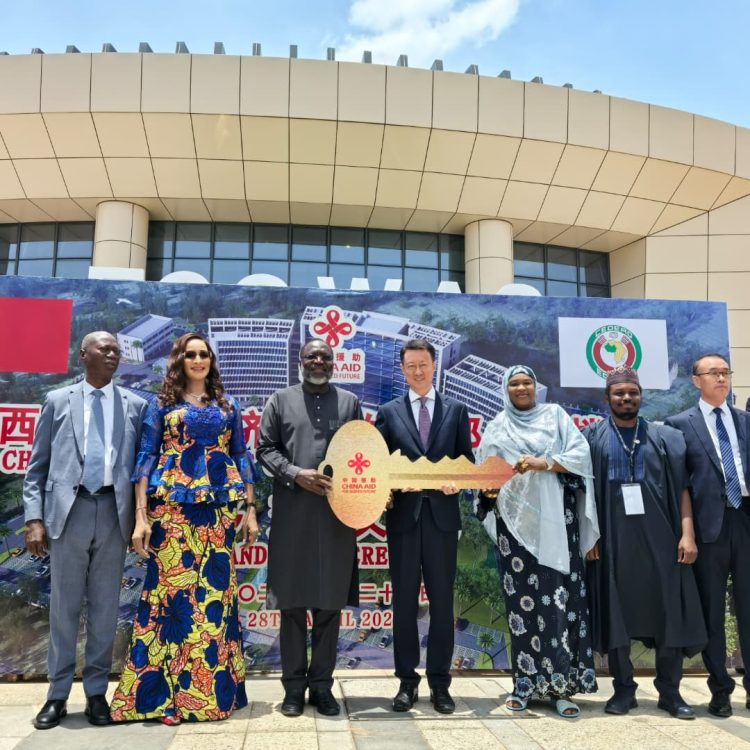

The Federal Government has commended the People’s Republic of China for strengthening regional integration in West Africa following the handover of a new headquarters complex to the Economic Community of West African States (ECOWAS) in Abuja.
The state-of-the-art facility, valued at $56.5 million, was fully funded by the Chinese government and constructed by Shaanxi Construction Engineering Group Corporation.
Speaking at the official handover ceremony in Abuja on Tuesday, Nigeria’s Minister of State for Foreign Affairs, Bianca Odumegwu-Ojukwu, described the project as a landmark achievement that goes beyond infrastructure, symbolising unity, resilience and renewed commitment to regional cooperation.
She said the new headquarters reflects ECOWAS’ determination to deepen integration, strengthen institutional capacity and respond effectively to emerging challenges across the region.
According to the minister, the project stands as clear evidence of the enduring partnership between China and West Africa, as well as Beijing’s continued support for Africa’s development priorities.
“This is not just the commissioning of a building, but the consolidation of a shared vision for peace, stability and sustainable development,” she said.
The minister noted that since its establishment in 1975, ECOWAS has evolved into one of Africa’s most dynamic regional blocs, playing a central role in peacekeeping, economic integration, democratic governance and humanitarian response.
She added that the new headquarters would serve as a strategic asset to enhance coordination among member states, promote policy innovation and strengthen the Commission’s ability to address regional and global challenges.
In his remarks, Chinese Ambassador to Nigeria and ECOWAS, Yu Dunhai, described the building as a symbol of enduring friendship and cooperation between China and Africa. He said the complex, popularly referred to as the “Eye of West Africa”, represents a blend of modern technology and regional cultural identity, and is designed to enhance the operational efficiency of the ECOWAS Commission.
According to him, the facility will provide a solid institutional base for advancing peace, economic integration and development across member states, while also reflecting China’s long-standing commitment to Africa’s growth through practical, demand-driven cooperation.
Yu highlighted China’s long-standing engagement with Africa, noting that the relationship spans decades of cooperation rooted in mutual respect, non-interference and practical outcomes. He said China remains committed to supporting African countries in pursuing development paths suited to their unique conditions.
He also referenced recent policy initiatives aimed at strengthening China–Africa ties, including zero-tariff treatment for 100% of tariff lines to all African countries having diplomatic ties with China, expanded trade access and development partnerships, which he said are designed to promote shared growth and modernization.
Also speaking, the President of the ECOWAS Commission, Omar Alieu Touray, described the occasion as a historic milestone for the regional bloc. He noted that although the building has now been handed over, it will be formally commissioned at a later date by regional leaders, including Bola Ahmed Tinubu and Julius Maada Bio.
Touray commended the speed and quality of the project’s delivery, recalling that construction began in late 2023. He expressed gratitude to the Chinese government and President Xi Jinping for what he described as a generous contribution that will serve as the institutional home of ECOWAS for generations.
He added that the new headquarters is more than a physical structure, describing it as a symbol of unity, shared vision and collective progress for West African nations. He also highlighted China’s broader support for ECOWAS, particularly in strengthening regional peace and security initiatives.
The new ECOWAS complex
Located along Airport Road, about 15 kilometers from the city center, the complex spans 70,186 square meters, with a total floor area of 36,606 square meters.
It comprises an office building, a conference center, and a range of supporting facilities, including internal roads, utility networks, public plazas, parking areas, and a helipad—forming a modern complex that integrates administrative, conference, and service functions.
This China-Aid Project, a flagship initiative under China–ECOWAS cooperation, was funded and implemented by the Chinese government. The idea was first proposed by ECOWAS during the first meeting of the China–ECOWAS Joint Committee on Economic and Trade Cooperation in November 2015. In March 2018, the two sides signed exchange of letters confirming China’s support for the project. Construction began in November 2021 and was completed in December 2025.
Designed and built to international standards, this project draws on China’s experience in large-scale public architecture, with a focus on quality, safety, and efficiency. Its master plan centers on the office building and conference hall, arranged in a symbolic layout defined by sweeping curved forms. Together with the surrounding road network, the design evokes the image of the “Eye of West Africa,” representing ECOWAS’s role in fostering regional unity and integration.
The main office building covers approximately 29,800 square meters, rising 11 stories at its central section and nine stories on either side, creating a tiered profile.
Inside, it houses offices, meeting rooms, and a wide range of facilities, including a data center, training rooms, a medical unit, childcare services, a gym, a library, and dining areas. The design emphasizes usability and comfort, with thoughtfully placed lounges, pantries, and viewing spaces, as well as informal social areas integrated into corridors and staircases.
The conference center is a two-story elliptical structure covering 4,450 square meters, featuring a 720-seat main hall, multiple meeting rooms, and offices, designed to host international conferences and high-level exchanges. Its circular form draws inspiration from traditional communal dwellings, symbolizing unity, while its drum-like silhouette reflects cultural motifs of celebration and shared identity across West Africa.
The complex’s flowing façade echoes the winding course of the Niger River, while its glass curtain walls and layered shading elements are designed to evoke the region’s mangrove ecosystems—expressing both environmental awareness and a sense of vitality.
Beyond construction, the project placed emphasis on local participation. Chinese contractors promoted local hiring and technical training, contributing to skills development and capacity building. Environmental considerations were also integrated throughout, in line with green construction principles.
A solar photovoltaic system provides clean energy for the complex, complemented by smart systems for fire safety, lighting, and security management, improving both efficiency and operational safety.
The new headquarters is expected to significantly enhance ECOWAS’s administrative and coordination capabilities, providing a stronger institutional platform for advancing regional integration in West Africa.
More broadly, the project stands as a symbol of deepening cooperation between China and Africa. As the new home of ECOWAS, the “Eye of West Africa” represents not only a modern architectural landmark, but also a shared future for regional integrity and prosperity.
The new ECOWAS complex
Located along Airport Road, about 15 kilometers from the city center, the complex spans 70,186 square meters, with a total floor area of 36,606 square meters.
It comprises an office building, a conference center, and a range of supporting facilities, including internal roads, utility networks, public plazas, parking areas, and a helipad—forming a modern complex that integrates administrative, conference, and service functions.
This China-Aid Project, a flagship initiative under China–ECOWAS cooperation, was funded and implemented by the Chinese government. The idea was first proposed by ECOWAS during the first meeting of the China–ECOWAS Joint Committee on Economic and Trade Cooperation in November 2015. In March 2018, the two sides signed exchange of letters confirming China’s support for the project. Construction began in November 2021 and was completed in December 2025.
Designed and built to international standards, this project draws on China’s experience in large-scale public architecture, with a focus on quality, safety, and efficiency. Its master plan centers on the office building and conference hall, arranged in a symbolic layout defined by sweeping curved forms. Together with the surrounding road network, the design evokes the image of the “Eye of West Africa,” representing ECOWAS’s role in fostering regional unity and integration.
The main office building covers approximately 29,800 square meters, rising 11 stories at its central section and nine stories on either side, creating a tiered profile.
Inside, it houses offices, meeting rooms, and a wide range of facilities, including a data center, training rooms, a medical unit, childcare services, a gym, a library, and dining areas. The design emphasizes usability and comfort, with thoughtfully placed lounges, pantries, and viewing spaces, as well as informal social areas integrated into corridors and staircases.
The conference center is a two-story elliptical structure covering 4,450 square meters, featuring a 720-seat main hall, multiple meeting rooms, and offices, designed to host international conferences and high-level exchanges. Its circular form draws inspiration from traditional communal dwellings, symbolizing unity, while its drum-like silhouette reflects cultural motifs of celebration and shared identity across West Africa.
The complex’s flowing façade echoes the winding course of the Niger River, while its glass curtain walls and layered shading elements are designed to evoke the region’s mangrove ecosystems—expressing both environmental awareness and a sense of vitality.
Beyond construction, the project placed emphasis on local participation. Chinese contractors promoted local hiring and technical training, contributing to skills development and capacity building. Environmental considerations were also integrated throughout, in line with green construction principles.
A solar photovoltaic system provides clean energy for the complex, complemented by smart systems for fire safety, lighting, and security management, improving both efficiency and operational safety.
The new headquarters is expected to significantly enhance ECOWAS’s administrative and coordination capabilities, providing a stronger institutional platform for advancing regional integration in West Africa.
More broadly, the project stands as a symbol of deepening cooperation between China and Africa. As the new home of ECOWAS, the “Eye of West Africa” represents not only a modern architectural landmark, but also a shared future for regional integrity and prosperity.