
By Austin Maho (Ph.D.)
Faced with the facts, Western media propaganda against China’s Xinjiang Uygur Autonomous region seems to be thawing if a recent CBS news report on the region is anything to go by.
A recent article in CBS news title “The rebranding of Xinjiang” anchored by Elizabeth Palmer gives an insight into the strides and development being recorded in Xinjiang contrary to several Western media reports of events in Xinjiang Province.
The reporter who was part of a tour arranged by the Chinese Information Office agreed that they, “showed us everything from agricultural machinery to ancient ruins, to e-sales of local plums on TikTok”.
The reporter admitted that the Chinese government, “has been investing heavily in Xinjiang, including a multi-billion dollar high-speed train” noting that, “everywhere we saw evidence of the eye-watering money China is spending on infrastructure, like wind farms, and tourist development.”
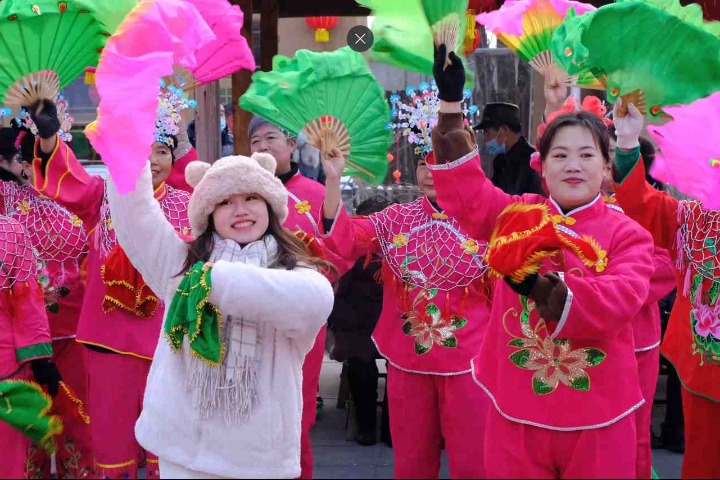
We didn’t see, “evidence of the detention centers and prisons that turned Xinjiang into an international scandal”. The report said. But rather, ‘we saw ethnic dancing, local wine production, and a village remodeled and beautified especially for tourists”.
The report actually celebrated the working spirit of the people of the region and their determination to improve quality of life and building enduring and modern infrastructure. Social cohesion was praised and night life was booming and crime rate low. “The policing and the atmosphere were relaxed” in Xinjiang the report noted.
The need by the reporter to adhere to the journalistic tenets of fairness, objectivity and balance does in anyway remove from the fact that life in Xinjiang is on the upward swing
Xinjian region in China is one of the 5 ethnic autonomous regions in China. The region consists of numerous ethnic groups with the Uyghurs said to consist 45% of the population.
For many years, Xinjiang has often been in the news for the wrong reasons, mostly fueled by Western media propaganda.. The dominant narrative was that the region had several internment camp for forced labour.
There seems to have been a deliberate attempts to keep that region of China on the global news agenda and to stir the debate to human rights violation by the communist government. The substantive issues of security and sovereignty of the Chinese state to deal with its own internal affairs and challenges were deliberately ignored.
To the credit of the Chinese government, it substantially crafted a homegrown solution to separatism and violent extremism that has defied solutions in most parts of the world.
From 2012 to 2016 China probably experienced the worst form of violent extremism and separatism in its recent history. Incidentally, virtually all the cases were linked to the Ughurs of Xinjiang region of China, who are also the largest group of ethnic Muslim in China. Xinjiang shares borders with eight countries including Pakistan, Afganistan and Uzbekistan, countries with a large Muslim population. These countries are battling homegrown terrorist groups within their borders, which often spill into the Xinjiang region of China.
A chronicle of terrorist and violent attacks in China from 2012 to 2016 is revealing. In February 2012, an attack in Yencheng killed 24 while clashes in Bachu killed 21 people including 15 police officers in Kashgar.
According to China’s main news agency, Xinhua, in July of 2014, 37 civilians were killed by a gang of extremist armed with knives and axes in Shache county. Security forces later kill 59 attackers in a mop up operation that followed.
In September of 2014 Xinhua news agency also reported that a series of bomb blast killed 50 people in Luntai county in Urumbi, while on October 4, Ughurs armed with knives and explosives attacked a farmers’ market in Xingjiang, killing 22. In November 2014, 15 were killed in Shache County while 11 of those killed were Ughurs.
All these killings were linked to extremist Ughur groups within and outside China. From 2012 to 2016 about 542 deaths and 682 injured are attributed to violent extremism in China.
Evidently, this was a tipping point, for a government that sees violent extremism as an evil that should be tackled because it has destabilising effect on social stability, economic progress and national security.
In May 2014 the Chinese government launched the “Strike Hard” campaign, its war on terrorism to deal with ethnic separatists, and Islamists in Xinjiang province.
It was a policy of carrot and stick, Kinetic and non-kinetic in handling the crisis in its Xinjiang region. The approach adopted by China is bottom-up and focuses on mobilising the strength of the citizens in countering violent extremism.
One major non- kinetic approach to dealing with the problem by the Chinese government, was the introduction of vocational training centres across Xinjiang region, with the primary objective of skill acquisition, de-radicalisation and re-integration into the Chinese society.
These training facilities were denounced by the West, especially critics in the United States who describe them as concentration camps and accused the Chinese government of human rights violation. They viewed these camps as holding facilities for indoctrination where the occupants are denied of their rights.
Over the years the Chinese government has denied these allegations, insisting that its doors were open for anyone to visit the region for assessment and truth.
Those who have taken up the challenge to see things for themselves includes, diplomats, journalists, religious leaders among others.
Vladimir Voronkov, the United Nations, Under-Secretary-General for counter-terrorism is the highest UN official to have visited the region. Reports indicates that over 4,300 foreign guests from nearly 400 groups from countries around the world have visited Xinjiang.
They have been invited into Xingjiang and many of them have expressed satisfaction with conditions in Xinjiang irrespective of Western propagandato the contrary. Ironically many US politians, critics and media have not visited the region themselves until the recent visit by the media team of CBS news.
It is noteworthy that there have been no violent attacks in China since the vocational training facilities were closed down in 2019.
China has always insisted that these facilities are purely for skill acquisition and reintegration into society. The participants are not held against their will as they are free to go in and out as they please during the course of their study.
The logic to this philosophy is simple, rather than use the enormous power of state to crush violent extremism and dissidents why not engage a policy of ideological reorientation and in the process equip the Ughurs, with useful skill, integrate them into mainstream Chinese society and make them valuable to themselves and others.
How can anyone question this approach which has shown to be a practical solution to a problem that has remained intractable in other parts of the world? China has chosen to use soft power to deal with its internal problem and the outcome is self-evident.
Nigeria has a lot to learn from how China has nipped in the bud violent extremism in its country by using soft power. Helping those who are susceptible to indoctrination to acquire relevant skills, reorientation and reintegration. These are the corner stones of the Chinese model. No matter the criticism against the Chinese homegrown solution to violent extremism the result shows so far that it is working. Xinjiang has not been overrun by terrorism but is now a tourist destination and an infrastructural marvel, the people are happy and productive.
Violent extremism is one problem confronting the Nigerian state for which it has not been able to craft a comprehensive policy that would remove the oxygen that fuels extremism in the country. What we have succeeded in doing so far is to react with military force which has often aggravated the problem rather than abating it.
However the Chinese model has been able to prove to the global community that violent extremism can be eradicated through the twin approach of wielding the stick and at the same time offering a carrot. China has through, education, reorientation and reintegration dealt with a problem that many parts of the world are still grappling with.