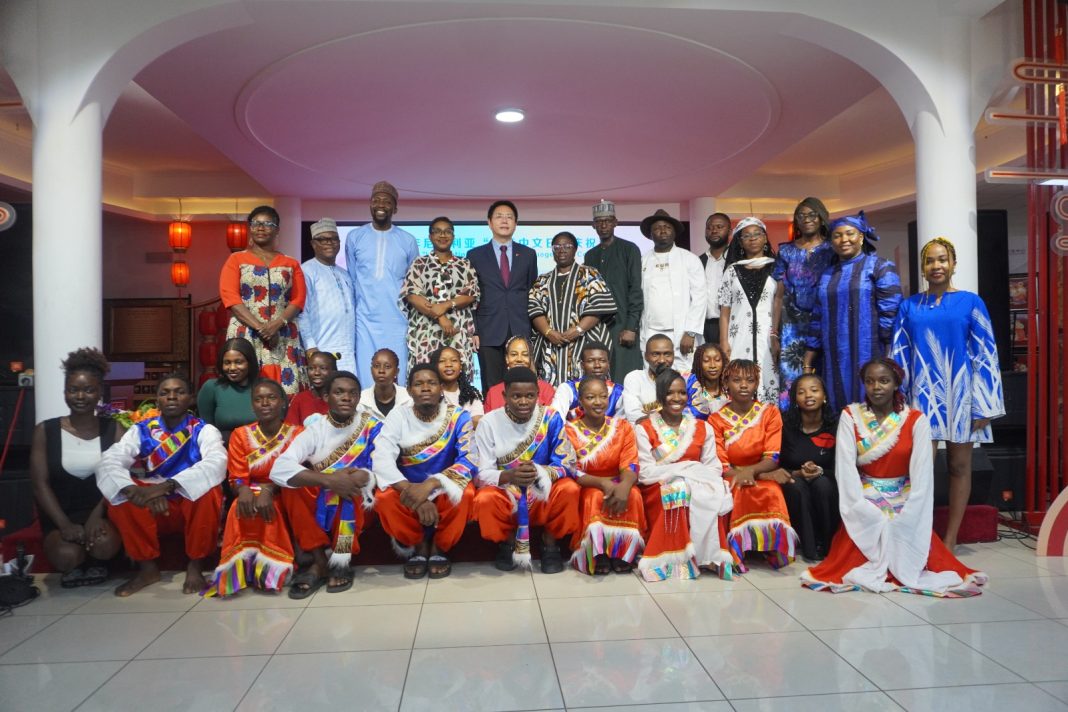

Nigeria and the People’s Republic of China on Monday marked the 2026 International Chinese Language Day with a colourful cultural showcase at the China Cultural Centre in Abuja.
The event, organised by the Chinese Embassy in Nigeria, brought together diplomats, media leaders, students, and cultural enthusiasts in a celebration that highlighted the growing importance of language in strengthening international cooperation.
In his opening remarks, the Cultural Counsellor and Director of the China Cultural Centre, Yang Jianxing, described the Chinese language as a powerful link between generations and civilizations. He noted that the language reflects over 5,000 years of historical evolution, carrying with it the philosophies, traditions, and artistic expressions that define Chinese culture.
He pointed out that Mandarin continues to gain global relevance, with over 200 million learners worldwide, and remains one of the official languages of the United Nations. According to him, the growing interest in the language presents opportunities for deeper engagement and collaboration between Nigeria and China, especially within the framework of China’s current development agenda.
The Cultural Counsellor linked the importance of language learning to China’s development trajectory under its newly adopted 15th Five-Year Plan (2026–2030), noting that increased cultural exchange and cooperation would open new opportunities for Nigeria-China relations.
He encouraged Nigerians to learn Chinese as a pathway to deeper understanding and participation in bilateral cooperation.
Also speaking, the Director General of the Federal Radio Corporation of Nigeria (FRCN), Mohammed Bulama, stressed the broader significance of language beyond communication. He described it as a reflection of identity and a vital tool for diplomacy, trade, and cultural exchange in an increasingly interconnected world.
Bulama highlighted the role of FRCN as a leading broadcast institution with multilingual programming that reaches diverse audiences. He referenced the introduction of the “Ni Hao China” radio programme in 2025, developed in partnership with the Chinese Embassy to promote Mandarin learning and cultural awareness.
He explained that the initiative aligns with bilateral agreements reached during the official visit of Bola Ahmed Tinubu to China in 2024, aimed at expanding cooperation in areas such as trade, tourism, and communication. He added that language learning continues to create new opportunities for storytelling, knowledge exchange, and mutual respect.
In her remarks, Chairman of the Nigeria Union of Journalists (NUJ) FCT Council, Grace Ike, emphasised the role of communication in building bridges between nations. She described the celebration as a reflection of how language can promote unity and strengthen bilateral relationships.
Ike commended the Chinese Embassy and the China Cultural Centre for fostering a cooperative relationship with journalists in Abuja, noting that such engagement has contributed to balanced reporting and enhanced cultural understanding.
The event featured language, musical and cultural performances from both Chinese and Nigerian contingents.
With over a billion native speakers, Chinese remains the most widely spoken first language globally and is increasingly becoming a key medium for international engagement, reinforcing its role in fostering global connections and shared progress.