
By Joyce Babayeju
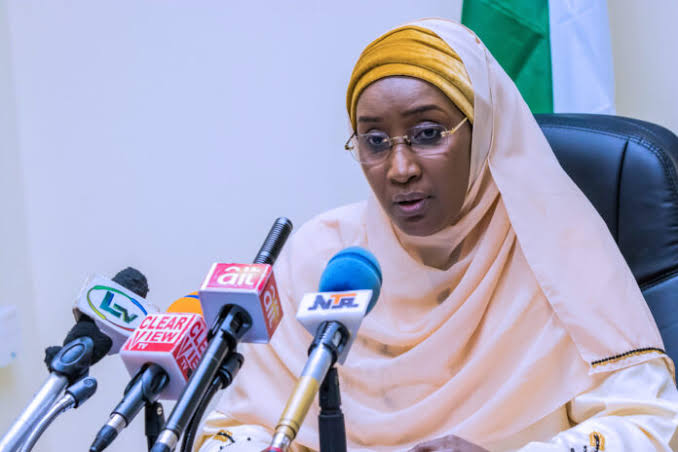
The Minister of Humanitarian Affairs, Disaster Management and Social Development, Sadiya Farouk, has dismissed as “elitist assertion” comments that the regime’s N5,000 monthly national conditional cash transfer to some poor and vulnerable people is insufficient to lift Nigerians out of poverty.
She said this to State House correspondents on Thursday during the weekly ministerial media briefing organised by the Presidential Communications Team at the Presidential Villa, Abuja.
According to her, the government has discovered through direct contact with the beneficiaries that the money has helped the poor and vulnerable of the society to escape from their dire situation even as some have been able to save from the amount.
She stated, “If you look at the people that you are taking this intervention to, N5,000 means a lot to them, because these are poor and vulnerable households, and it changes their status; but for you and me, N5,000 is not even enough for us to buy recharge card; that’s the difference.
“But for these poor people in the communities, they were able to save out of that N5,000; if it’s not making any impact, if it’s not changing their economic status, I don’t think anybody will force them to contribute that N1,000 to provide that vehicle for their use. So, N5,000 goes a long way.
“When people say N5,000 does not save people, that is an elitist statement, because we’ve had causes to go to the field and we have seen these people that when you give them this N5,000, they cried and shed tears, because they’ve never seen N5,000 in their lives. So, it goes a long way, it changes their status, and by that, it lifts them from one stage to another.
The Minister of Humanitarian Affairs, Disaster Management and Social Development, Sadiya Farouk, has dismissed as “elitist assertion” comments that the regime’s N5,000 monthly national conditional cash transfer to some poor and vulnerable people is insufficient to lift Nigerians out of poverty.
She said this to State House correspondents on Thursday during the weekly ministerial media briefing organised by the Presidential Communications Team at the Presidential Villa, Abuja.
According to her, the government has discovered through direct contact with the beneficiaries that the money has helped the poor and vulnerable of the society to escape from their dire situation even as some have been able to save from the amount.
She stated, “If you look at the people that you are taking this intervention to, N5,000 means a lot to them, because these are poor and vulnerable households, and it changes their status; but for you and me, N5,000 is not even enough for us to buy recharge card; that’s the difference.
“But for these poor people in the communities, they were able to save out of that N5,000; if it’s not making any impact, if it’s not changing their economic status, I don’t think anybody will force them to contribute that N1,000 to provide that vehicle for their use. So, N5,000 goes a long way.
“When people say N5,000 does not save people, that is an elitist statement, because we’ve had causes to go to the field and we have seen these people that when you give them this N5,000, they cried and shed tears, because they’ve never seen N5,000 in their lives. So, it goes a long way, it changes their status, and by that, it lifts them from one stage to another.”
Following its inspection of some southern states, she said the problem of out-of-school children was not peculiar to the North.
The minister, who presented a detailed brief of the activities of her ministry, confirmed that there were over 10 million out-of-school children strewn across the country, who were earlier believed to be domiciled in the North.
Farouk, who cited a recent survey in Makoko in Lagos, Enugu and Jos, said the situation of out-of-school children was widespread as there were about 7,000 such children in Makoko alone.
Answering questions about the impact of the government’s school feeding programme on the number of out-of-school children, the minister said while the initiative increased school enrolment, the sheer number of out-of-school.
The Minister of Humanitarian Affairs, Disaster Management and Social Development, Sadiya Farouk, has dismissed as “elitist assertion” comments that the regime’s N5,000 monthly national conditional cash transfer to some poor and vulnerable people is insufficient to lift Nigerians out of poverty.
She said this to State House correspondents on Thursday during the weekly ministerial media briefing organised by the Presidential Communications Team at the Presidential Villa, Abuja.
According to her, the government has discovered through direct contact with the beneficiaries that the money has helped the poor and vulnerable of the society to escape from their dire situation even as some have been able to save from the amount.
She stated, “If you look at the people that you are taking this intervention to, N5,000 means a lot to them, because these are poor and vulnerable households, and it changes their status; but for you and me, N5,000 is not even enough for us to buy recharge card; that’s the difference.
“But for these poor people in the communities, they were able to save out of that N5,000; if it’s not making any impact, if it’s not changing their economic status, I don’t think anybody will force them to contribute that N1,000 to provide that vehicle for their use. So, N5,000 goes a long way.
“When people say N5,000 does not save people, that is an elitist statement, because we’ve had causes to go to the field and we have seen these people that when you give them this N5,000, they cried and shed tears, because they’ve never seen N5,000 in their lives. So, it goes a long way, it changes their status, and by that, it lifts them from one stage to another.”
Following its inspection of some southern states, she said the problem of out-of-school children was not peculiar to the North.
The minister, who presented a detailed brief of the activities of her ministry, confirmed that there were over 10 million out-of-school children strewn across the country, who were earlier believed to be domiciled in the North.
Farouk, who cited a recent survey in Makoko in Lagos, Enugu and Jos, said the situation of out-of-school children was widespread as there were about 7,000 such children in Makoko alone.
Answering questions about the impact of the government’s school feeding programme on the number of out-of-school children, the minister said while the initiative increased school enrolment, the sheer number of out-of-school kids was a national problem.
Giving specifics on behalf of the minister, the Coordinator of the National Social Investment Programme, Umar Bindir, said, “Some people here, if you talk about out-of-school children, they think you are talking about Almajiri in the North. Some people think it’s actually religious or a Muslim thing. But I can tell you that we have established it as a national issue in this programme.
“We sent a team to Lagos. They went to Mokoko; they met 7,000 out-of-school children picking things from the dirt. The guys returned shaking. We sent another chap to Jos; he returned shaking also. We sent another guy to Enugu, and for the first time, everybody realised that the out-of-school children issue is a national problem.”
Explaining the controversial exit programme of the N-Power, Farouk affirmed the Federal Government’s plan to enrol about 300,000 applicants into a training programme, while the Central Bank of Nigeria would give them loans.
She stated, “On the N-Power, thank you for bringing that up, and you asked another question if anybody really benefited from the programme. We have 500,000 on the programme, with the batches ‘A’ and ‘B’ being on the programme for four years and two years, respectively. Batch ‘A’ was on the programme for about four years, and we were giving them N30,000 stipend monthly. And Batch ‘B’ benefited for two years.
“So, yes, the N-power beneficiaries have benefited, because these are people who were not employed, who had nothing to do, but were engaged and were being paid stipends to earn a decent living.
On the humanitarian effects of the 13-year-old insurgency in the North-East, Farouk maintained that there had been heightened humanitarian assistance from her ministry.
However, she warned against letting international donor agencies lead the charge, noting that the Federal Government had devised a framework to ensure local resources control.