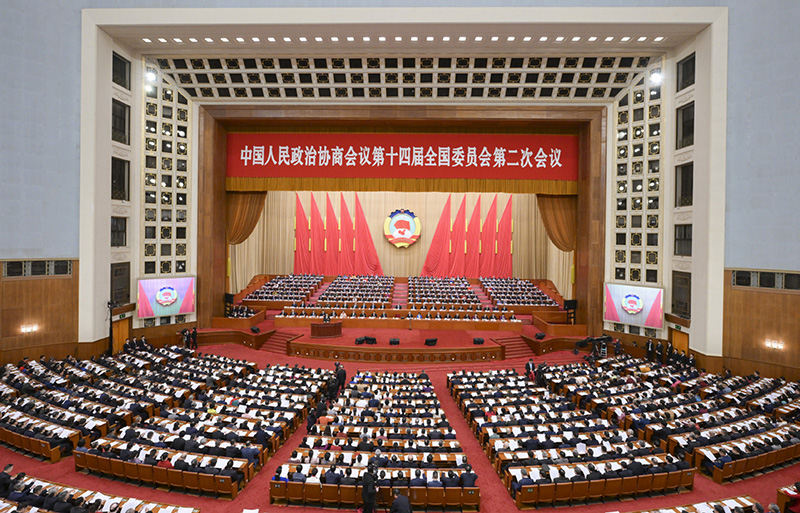

China’s leading political advisory institution, the National Committee of the Chinese People’s Political Consultative Conference (CPPCC), will hold its annual plenary session in Beijing from March 4 to March 11.
Spokesperson Liu Jieyi announced at a press briefing that the fourth session of the 14th CPPCC National Committee will open at 3 p.m. on March 4 and conclude on the morning of March 11.
The CPPCC is widely regarded as China’s foremost advisory platform. Although it does not possess legislative authority like the National People’s Congress (NPC), it plays a central role in policy consultation, consensus-building and fostering multiparty cooperation under the leadership of the Communist Party of China (CPC). The body serves as a channel for incorporating perspectives from across Chinese society into national governance through what authorities describe as “whole-process people’s democracy.”
The CPPCC’s origins date back to September 1949, when representatives from various political groups and social sectors gathered in Beijing shortly before the proclamation of the People’s Republic of China. At that inaugural meeting, delegates adopted foundational documents, selected national symbols, and effectively functioned as an interim legislative authority.
Following the establishment of the NPC in 1954 as the country’s highest organ of state power, the CPPCC transitioned into a permanent consultative and united front body. After a period of disruption during the Cultural Revolution, the institution was revitalized in the late 1970s and has since been further strengthened through successive reforms and policy directives. In recent years, it has been positioned as a key pillar of China’s consultative governance framework.
The National Committee operates on a five-year term and convenes a full plenary session each year, typically alongside the NPC meetings in what is commonly known as the “Two Sessions.” Between annual sittings, a Standing Committee oversees routine affairs.
The current National Committee comprises 2,169 members, supported by a 324-member Standing Committee and several specialized committees focusing on areas such as economic affairs, foreign policy, culture, education, ethnic and religious matters, and environmental issues.
The 14th National Committee is chaired by Wang Huning, a member of the CPC Politburo Standing Committee. He is assisted by multiple vice-chairpersons and a secretary-general, reflecting the body’s broad-based leadership structure.
Membership spans 34 sectors of society, including the CPC, eight legally recognized non-Communist parties, independent public figures, people’s organizations, ethnic minorities, religious representatives, professionals from diverse industries, as well as delegates from Hong Kong, Macao, Taiwan and overseas Chinese communities. Members are selected through consultation rather than direct election, underscoring the institution’s emphasis on consensus and inclusivity.
According to its charter, the CPPCC performs three principal duties: political consultation on major national policies before decisions are finalized; democratic oversight through constructive feedback on policy implementation; and participation in the discussion and management of state affairs.
In practice, members submit thousands of proposals each year covering economic reform, environmental protection, education, healthcare, science and technology, among other topics. Government agencies review these submissions, many of which inform policy adjustments or administrative action. The body also organizes thematic forums, research visits and regular consultative meetings to deepen its advisory contribution.
As this year’s session approaches, attention is expected to focus on economic priorities, social development goals and broader governance initiatives, with the advisory body once again providing a platform for diverse viewpoints to be integrated into China’s policy agenda.