
By Zhang Zhifeng, People’s Daily
Zhangjiakou, the co-host city of Beijing 2022 Winter Games in north China’s Hebei province, is working to deliver the Olympics in 2022 with a green approach. Since the city was approved to build a national-level demonstration zone for renewable energy in July 2015, the installed capacity of renewable energy in the city had hit 2,003 MW at the end of last year, and the number is still growing.
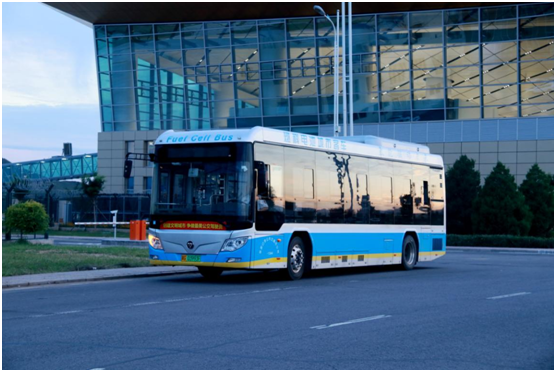
Three years ago, the first 74 fuel cell buses purchased by Zhangjiakou started operation in the city. Today, there are 304 such buses running there, accounting for around 40 percent of the city’s bus fleet.
“The temperature in Zhangjiakou always falls below minus 20 degrees Celsius in winter, but it has no impact on the launching of the bus,” said Li Baosheng, who has been steering buses for over 30 years. As a driver who has driven diesel, gasoline and electric vehicles, he speaks highly of the fuel cell buses, which are powered by electricity turned from hydrogen energy. “They have better acceleration, run effortlessly even when fully loaded with passengers.
“Fuel cell buses’ performance does not degrade in low temperature. They are powerful and able to keep a long range. Most importantly, they discharge no pollutants,” said Huo Junqing, vice general manager of Zhangjiakou’s municipal bus corporation.
According to him, 80 fuel cell buses attended a test program held in February this year examining the service ability of the Zhangjiakou competition zone. Twenty kilograms of hydrogen could enable a bus to run 400 kilometers, he said.
By the beginning of July this year, fuel cell buses in Zhangjiakou had run a total mileage of 15 million kilometers, carrying over 43 million passengers. Another 140 such buses are expected to be put into operation in the city in October.
Bai Yan, head of a hydrogen energy company under Zhangjiakou City Traffic Construction Investment Holding Group Co., Ltd., introduced that Zhangjiakou plans to build seven hydrogen stations to serve the Beijing 2022 Winter Games, and three have been completed.
One of the stations on Weisan Road was built in February last year. “Four vehicles can have their hydrogen refilled simultaneously at the station, and it only takes five to ten minutes for each of them, much faster than charging an electric vehicle,” Bai said.
According to Zhao Hui, who’s in charge of the technical work of a new energy company in Zhangjiakou, introduced that electricity and water are needed to create hydrogen fuel, and as a city rich in wind power and solar resources, Zhangjiakou enjoys natural advantages in making “green” hydrogen with “green” electricity. The consumption of hydrogen energy generates water, which can be recycled. Therefore both the production and use of hydrogen energy are green and pollution-free.
“To encourage the hydrogen industry, Zhangjiakou offers favorable electricity price for relevant enterprises. We sell hydrogen energy at a price that is lower than its fair market value to nurture the market,” Zhao said.
China has set its goal to peak carbon emissions and carbon neutrality. By making “green” hydrogen with “green” electricity, Zhangjiakou is striving for whole-process carbon reduction and even zero emission.
The city has made a plan on hydrogen energy construction for the next five years and long-range objectives through the year 2035, which aims to comprehensively and synchronously advance the planning and policy making of the sector and enhance both industrial and enterprise development.
So far, a wind power hydrogen production project has been completed in the city’s Guyuan county, producing nearly six tonnes of hydrogen on a daily basis. In addition, another green hydrogen demonstration base built by Zhangjiakou City Traffic Construction Investment Holding Group Co., Ltd. is also under construction.
Seven hydrogen projects have been put into operation across the city, and 23 are under construction. A whole industrial chain is taking shape, covering the manufacturing of hydrogen making, processing and storing equipment, core parts of fuel cells, and hydrogen car making.