Connect with us

News

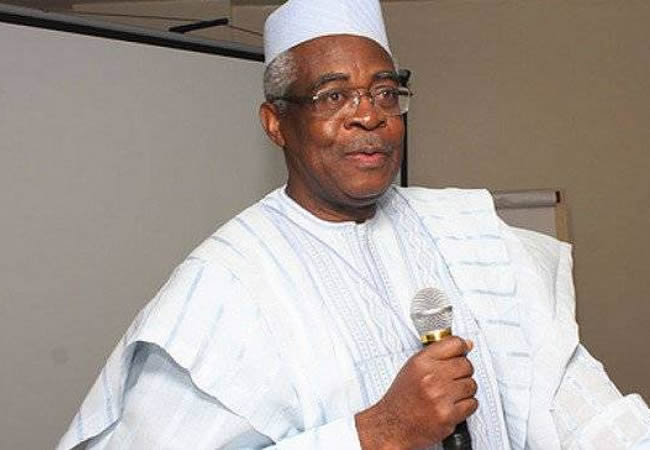
Danjuma donates ₦3bn, Dangote gives ₦500m at Gowon autobiography launch

Published

on

Former Defence Minister Theophilus Danjuma on Tuesday donated ₦3 billion at the public presentation of former Head of State Yakubu Gowon’s autobiography, My Life of Duty and Allegiance, unveiled in Abuja.

The event also saw billionaire businessman Aliko Dangote donate ₦500 million in support of the book launch, while Abdul Samad Rabiu purchased copies of the memoir worth ₦25 million.

Representing President Bola Tinubu at the event, Vice President Kashim Shettima joined top government officials, diplomats and senior military officers at the unveiling ceremony.

The 20-chapter memoir chronicles Gowon’s life, military career and years in public service. It was reviewed during the event by Matthew Kukah.

Danjuma, who served as chief presenter, was represented by former Chief of Defence Staff Martin Luther Agwai.

In addition to his ₦3 billion donation, Danjuma directed that 12 copies of the autobiography be purchased and distributed to libraries in each of the 20 universities that awarded Gowon honorary doctorate degrees.

Continue Reading
Click to comment

You must be logged in to post a comment Login

Leave a Reply

News

FG to Launch Military Medical College for Armed Forces in 2026

Published

on

By Abigail David

The Federal Government has unveiled plans to establish the Armed Forces College of Medicine and Health Sciences, with the first set of military medical cadets expected to begin training during the 2026 academic session.

Minister of Education, Olatunji Alausa, announced the initiative in Abuja while inaugurating a Technical Working Group tasked with accelerating the college’s establishment. According to a statement from the ministry, the institution is intended to provide a dedicated pipeline of doctors, nurses and other healthcare professionals trained specifically for military service.

Alausa said the project would reduce the Armed Forces’ reliance on civilian universities for medical personnel and strengthen healthcare support for military operations. He noted that the college would focus on producing professionals equipped to meet the unique demands of military and battlefield medicine.

The minister also highlighted the government’s ongoing efforts to expand medical education nationwide, stating that admissions into Medicine and Dentistry have increased to over 10,000 annually, while nursing enrolment has risen significantly.

The Technical Working Group, comprising representatives from the Ministries of Education and Defence, regulatory agencies and other stakeholders, has been directed to develop the curriculum, secure accreditation and ensure the institution is ready for the 2026 academic session.

Chairman of the committee, Major General Idris Babatunde Solebo, said the college would operate from the Nigerian Army Reference Hospital in Kaduna and follow a model similar to the Uniformed Services University in the United States. He added that medical cadets would receive both academic and military training, including battlefield medicine and Tactical Combat Casualty Care.

According to Solebo, the Armed Forces currently face a significant shortage of medical personnel, making the new institution a key step toward strengthening military healthcare capacity.

Continue Reading

News

Tinubu Explains Why Security Forces Targeted Families of Oyo Kidnappers

Published

on

By Abigail David

President Bola Tinubu has said the Federal Government refused to negotiate with or pay ransom to the kidnappers who abducted pupils and teachers in Oriire Local Government Area of Oyo State, insisting that security agencies instead relied on intelligence-led operations to secure the victims’ release.

Speaking on Thursday while receiving the Olubadan of Ibadanland, Oba Rashidi Ladoja, and other Oyo traditional rulers at the Presidential Villa in Abuja, Tinubu said the kidnappers demanded ransom and the release of detained gang members, but the government rejected the conditions.

According to the President, security agencies intensified operations by tracking the criminals and their networks, leading to the successful rescue of the victims after 56 days in captivity without paying ransom.

Tinubu commended the armed forces for the operation, describing it as a major success achieved through intelligence gathering and a detailed understanding of the terrain.

The President said the incident informed his decision to expand the Nigerian Army from eight to 12 divisions, explaining that the move is intended to improve response times and strengthen the country’s capacity to combat terrorism and banditry.

He also reaffirmed plans to establish state police with safeguards against abuse and announced that forest guards would be retrained and equipped to support security operations in forests and remote communities.

Tinubu urged traditional rulers to encourage residents to provide timely information on suspicious activities, stressing that community intelligence remains vital to addressing insecurity.

He also called on state governments to prioritise road construction to improve access for security agencies and enhance economic development.

Speaking on behalf of the delegation, Oba Ladoja thanked the President and the armed forces for securing the release of the abducted pupils and teachers. He also expressed appreciation for ongoing federal road projects in Oyo State, describing them as critical to improving connectivity and economic activities.

The Oriire abduction occurred on May 15, 2026, when gunmen attacked three schools and abducted about 39 pupils and seven teachers. The victims were rescued on July 10 in an intelligence-led operation that authorities said was carried out without the payment of ransom.

Continue Reading

News

APC’s Substitution Storm: Can the ruling party survives the legal fireworks?

Published

on

The ruling All Progressives Congress (APC) is fighting a two-front war of its own making. Having conducted primaries across the federation, the party’s National Working Committee (NWC) moved to replace a swath of candidates before final submission to the Independent National Electoral Commission (INEC) and in doing so, triggered litigation from its own governors, aggrieved aspirants, and rival parties. All of it converges on one question: does the APC have the legal room to rewrite its primary outcomes?
What began as internal party grumbling has hardened into a full-blown constitutional and statutory contest, now before the Federal High Court, with INEC itself effectively siding against the party it is meant to regulate.

Mapping the Fallout: Nine States, Dozens of Casualties

INEC records show a significant number of Senatorial and House of Representatives candidates who won APC primaries in May were substituted before the final list reached the commission. Aggrieved aspirants allege the changes favoured influential party leaders and senior political office holders, with some claiming officials exploited the window between the conclusion of primaries and submission of names to alter the original list.
The affected senatorial districts and constituencies span nine states: Abia, Benue, Ebonyi, Kaduna, Kogi, Kwara, Niger, Ondo and Taraba. Among the casualties: former Governor and Senator Gabriel Suswam, who had earlier emerged as APC’s Benue North-East (Zone A) senatorial candidate, and House member Gbenga Elegbeleye, previously the party’s Ondo North senatorial candidate.
The internal alarm reached the presidency early. Fourteen prominent APC stakeholders — including sitting senators and former lawmakers appealed to President Tinubu and the NWC to intervene in what they described as a deepening internal crisis.

The Party’s Defence

APC spokesman Felix Morka has mounted a public rebuttal. He says the NWC received more than 720 petitions from aspirants after the primaries, which were reviewed by appeal committees before recommendations went to the National Working Committee — which then re-evaluated the cases itself before approving changes.
Morka rejects claims that tickets went to non-participants, saying he is unaware of any case where someone who never bought forms or was never screened was suddenly handed a ticket while conceding that losing aspirants naturally have reason to be dissatisfied. His central argument is procedural: that a primary election “is a process, not an event,” and that the appeal mechanism is an integral part of that process rather than an invention to cause mischief.
Beyond individual states, the party told INEC the National Assembly changes stemmed from recommendations of its Primary Election Appeal Committee following resolution of petitions. The NWC’s transmittal letter framed the changes as the party’s “final position,” citing compliance with “the Electoral Act 2022 (as amended).”
That citation may itself be a problem the process is now governed by the Electoral Act 2026, not 2022, and the mismatch could become a legal vulnerability in its own right.

The Legal Fault Line

Critics counter that the appeal-committee route is itself the problem. Legal practitioners and affected aspirants argue the substitutions contravene Section 33 of the Electoral Act, which permits candidate changes only in cases of death or voluntary withdrawal and that the process may separately breach the right to fair hearing under Section 36 of the 1999 Constitution.
Roughly 26 National Assembly candidates are said to be affected by this dispute alone, prompting development partners to caution INEC chairman Amupitan against letting internal party appeal committees become a backdoor to rewrite primary outcomes.
That caution has since become litigation. APC state governors have gone to the Federal High Court, dragging both the NWC and INEC into court over the substitution of 26 legislative candidates nationwide, securing an interim injunction from Justice Ekwo in mid-July. In Benue and Ondo, aggrieved candidates are separately seeking court orders restraining APC from substituting candidates they say were validly nominated through the party’s June 29 correspondence to INEC — with insiders warning the suit could force fresh primaries or candidate-list changes ahead of 2027.

A Widening Judicial Backdrop

The substitution fight is unfolding against a broader battle over INEC’s own election timetable. In May, Justice Umar voided INEC’s compressed deadlines, ruling the commission cannot abridge the 120-day statutory window for submitting candidate particulars under Section 29(1), and — citing Section 31 — lacks power to shorten the 90-day period parties have to withdraw and substitute candidates. Justice Omotosho separately ordered INEC to amend its timetable to conform with the Electoral Act on membership registers and candidate substitution.
However, the Court of Appeal, ruling on INEC’s appeal, vacated the judgment that had nullified the electoral body’s 2027 timelines — adding another layer of procedural uncertainty to an already tangled picture.

Case Study: FHC/ABJ/CS/1429/2026 The Benue and Ondo Suit

In a suit marked FHC/ABJ/CS/1429/2026, Engr. Sesugh Kaaba and other aggrieved APC candidates from Benue State (loyalists of Governor Hyacinth Alia), commenced action against the APC and INEC. Ondo plaintiffs joined the same fight, naming Gbenga Elegbeleye, Dr. Taiwo Fasoranti, and several House aspirants replaced in the NWC’s revised list.
The plaintiffs asked the court to determine whether, under Sections 6(1) and 36(1) of the 1999 Constitution and Sections 29(1), 33(1), 84(1)–(2), 86, 87 and 88(2) of the Electoral Act 2026, the APC could — through its June 29, 2026 correspondence or any other — substitute validly nominated candidates absent voluntary withdrawal, death, or disqualification.
They sought a declaration that any such substitution is null and void, and an order compelling APC and INEC to recognise the original primary winners — among them Rev. Fr. Dr. Hyacinth Alia (Governorship), Senator Gabriel Suswam, Benjamin Terseer Aber, and Francis Otta Agbo, alongside a full slate of House of Representatives including Engr. David Terhemba Nongo and 32 House of Assembly candidates.
Interim relief: Before the substantive hearing, Justice Inyang Ekwo issued a preservative order directing the parties to maintain the status quo ante, holding that once issues were joined — particularly with INEC before the court — the defendants were bound by law to preserve the subject matter. It was, he told counsel, “not a matter of advice but of law.” APC and INEC were restrained from any action capable of altering the disputed candidate list pending determination of the substantive suit.

The Core Statutory Provision

Section 33 of the Electoral Act 2026 states plainly that a party may not change or substitute a submitted candidate except in the case of death or withdrawal by the candidate. A legal commentator summarised the practical effect: once a party submits its list to INEC, substitution is strictly limited to death or voluntary written withdrawal, and a fresh primary must follow within 14 days of a valid withdrawal.
On its face, this is the plaintiffs’ whole case – the NWC’s “appeal committee” mechanism is not one of the two statutory grounds.

The Plaintiffs’ Dual-Track Argument

Beyond the bare statutory point, the plaintiffs are stacking a due-process claim on top of it: that overturning a delegate-certified, INEC-monitored primary through an internal appeal panel could violate the fair-hearing guarantee under Section 36, since the original winners were displaced without an adversarial hearing. In Benue, plaintiffs went further, framing the NWC’s move as “an unconstitutional subversion of the Electoral Act.”
This combination of statutory violation plus constitutional fair-hearing violation gives the court two independent grounds to rule against APC, even should one theory falter.

INEC’s Position: An Unusual Alignment

In its affidavit filed July 5 in reply to the originating summons, INEC threw its weight behind the plaintiffs, telling the court that those listed in the suit had emerged winners at APC’s Benue primaries which it monitored but were illegally substituted.
The affidavit, deposed by Ayuba Mohammed of INEC’s litigation and prosecution department, argued that granting the plaintiffs’ application would serve the interest of justice and spare the commission “needless litigation arising from unjustified substitution of candidates.” INEC counsel Oluwole Olukunle told the court the commission is constitutionally bound to defend the integrity of the Constitution and the Electoral Act, and that parties, while free to nominate candidates of their choice, must do so within their own constitutions, INEC guidelines, and the law.
Olukunle’s submission distilled the commission’s broader philosophy: “The law now has long moved away from the era where political parties exercised unquestionable discretion in the selection and random/arbitrary substitution of candidates. Aspirants who emerge victorious at party primaries monitored by INEC automatically become candidates of the party at such elections.”

The Weight of Precedent

The plaintiffs’ position draws support from two Supreme Court authorities:
Abdulazeez v. Shittu (2023) 14 NWLR (Pt. 1904) 293 (SC) where it held that a claimant to a party’s candidacy must show he was an aspirant in an INEC-monitored primary in which he scored the highest votes.
Nongo v. Achado & Ors (2023) LPELR-60110(SC) wherein the court held that under Section 84(5)(c)(ii) of the Electoral Act 2022, a party is bound to forward the name of the aspirant with the highest votes to INEC, a duty that admits no discretion.

The Precedent That Cuts Both Ways: Machina v. Lawan (2023)

This is the case every lawyer in the dispute is watching, and it does not sit neatly on either side.
Bashir Machina won an INEC-monitored APC primary in Yobe North in 2022. The party nonetheless submitted Senate President Ahmad Lawan’s name instead, after Lawan lost the presidential primary and a second, uncancelled Senate primary was hastily organised to produce him. The Federal High Court and Court of Appeal both sided with Machina, but the Supreme Court reversed in a split decision of 3–2, not on the merits of who actually won, but on a procedural technicality: the majority held that Machina’s fraud allegations should have been filed by writ of summons rather than originating summons, since fraud requires oral evidence and cross-examination.
The two dissenting justices, Adamu Jauro and Emmanuel Agim, held that Machina was lawfully nominated, reasoning that the party’s second primary was an unlawful, uncancelled duplicate in breach of Section 285 of the Constitution.
For APC, the majority decision shows the Supreme Court has previously let a substitution stand over the will of a certified primary — on procedural grounds. If the current plaintiffs’ pleadings touch on “fraud” or bad faith by the NWC, APC’s lawyers will likely move to strike on the same originating-summons technicality that defeated Machina.
For the plaintiffs, the substantive reasoning in the Machina dissent — that a party cannot informally re-run or override a lawfully conducted, INEC-monitored primary was never rejected on the merits, only sidestepped procedurally. That reasoning, they argue, remains good law to build on.

What’s at Stake

Three threads converge here, and all three will shape how the litigation plays out:
The statutory question is whether an internal appeal-committee mechanism can lawfully stand in for the narrow death-or-withdrawal grounds Section 33 provides.
The procedural question is whether Machina-style technicalities over originating summons versus writ of summons will again decide a case on form rather than substance.
The institutional question is INEC’s unusually open alignment with the plaintiffs against a party it is meant to regulate neutrally, and what that signals for how the commission intends to police future substitutions ahead of 2027.
With an interim injunction in place and the substantive suit still to be heard, the APC’s candidate list for several National Assembly seats and possibly the broader question of how much discretion parties retain over their own primaries now rests with the Federal High Court.

Continue Reading

Trending

Copyright © 2017 Zox News Theme. Theme by MVP Themes, powered by WordPress.