
Uncategorized
DSS Untreads The Old Path

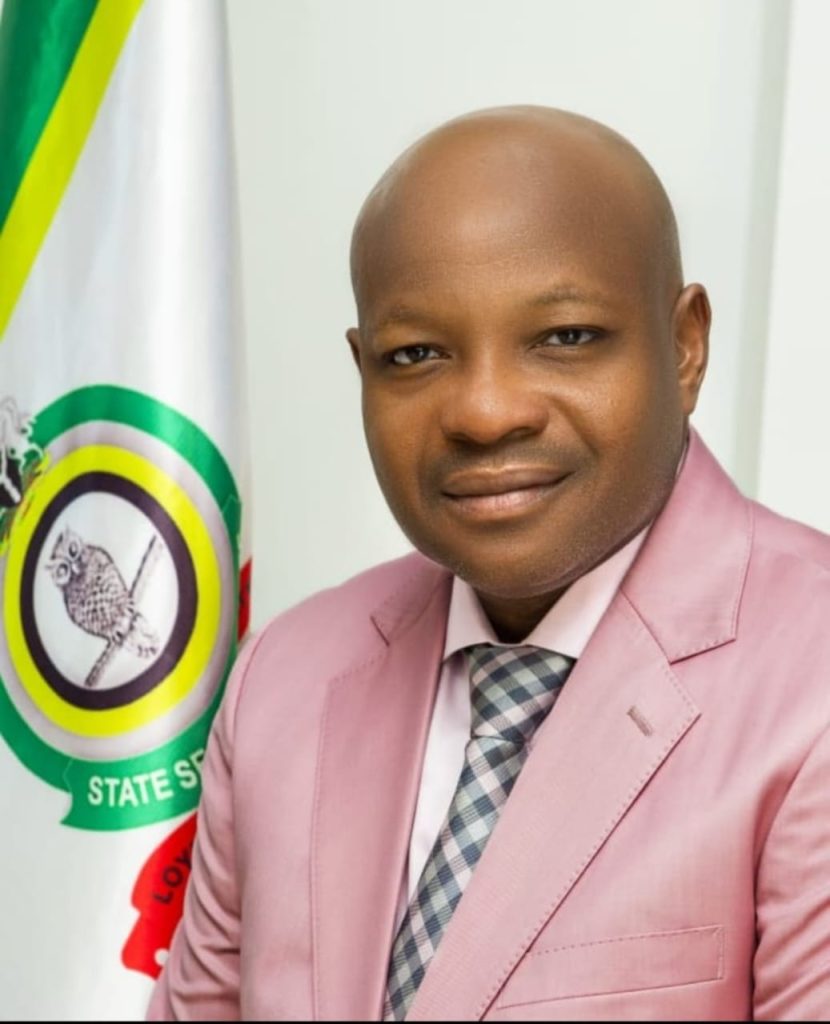
By Simon Reef
The appointment of Mr. Oluwatosin Adeola Ajayi as the Director-General of the Department of State Services (DSS) in August 2024 marked the beginning of a new era for the secret police, which members of the public then saw as operating beyond the rule of law. As the successor to Alhaji Yusuf Bichi, who led the DSS for six years under the administration of President Muhammadu Buhari, Ajayi’s appointment was seen as a square peg in a square hole, poised to align the agency’s operations with the imperatives of the nation’s democratic setting. Nearly two years since he became the DG, Ajayi has focused on operational shifts, including implementing institutional changes. Ajayi has turned the DSS into a security agency that has prioritised intelligence operations, with the secret police becoming more focused on intelligence-led operations, including building stronger ties with members of civil society to realise new essentials of a reformed security outfit.
Tackling The Past
Under the human rights reform policy introduced by the DSS boss, the agency publicly approved financial compensation for at least 13 people who were victims of wrongful detention, mistaken identity, or operational errors. Among those compensated was a Sokoto-based trader who was erroneously shot during a 2016 gunrunning raid in Jos. He was awarded ₦20 million, comprising ₦10 million court damages plus an additional ₦10 million goodwill payout, alongside lifetime free DSS healthcare.
An Abuja-based businesswoman, wrongfully arrested on oil bunkering suspicions during a raid, got compensated with the sum of N10 million. Five other individuals who were co-detained over the same oil bunkering investigation were awarded ₦10 million to share among themselves. In approving these rewards to compensate for wrongful treatment by the agency in the past, Ajayi was owning up to past mistakes and assuring Nigerians of the agency’s new resolve never to allow such mistakes to recur. In the past, the secret police were a metaphor for unconcealed coercion for the violation of human rights. The Ajayi-led DSS now operates within the confines of the law as it should be under a democratic setting.
Civil Relations
The DSS does not operate in exclusion of society. For the Service to succeed, encouraging collaborative relations with members of the public in the performance of its job is critical. Religion is becoming one of the nation’s fault lines, thereby widening the gulf of negative partisanship working against the country’s growth and unity among citizens. When Ajayi, the son of a Christian cleric, last year donated an Islamic school named Darul Ilm Centre for Islamic Studies, discordant tunes ripped through the airwaves, arguing that the DSS boss had no business donating Islamic schools to religious groups.
The centre, which provides a hybrid curriculum on Islamic knowledge, Western education, and vocational skills, is in the Danbushiya community, Millennium City of Chikun Local Government Area. With the support of Ajayi’s friends and allies, the school was built by the secret police boss to cater to orphans and other vulnerable people. Since the Islamic school was donated by the DSS boss, who is a Christian, the project was celebrated as an act of religious tolerance, peace-building, and national unity.
The secret police boss was not done, as he further donated a school named Kaduna Christian Academy, Sabon Tasha in Chikun LGA. Governor Uba Sani described the Academy as the best of ‘Non-Kinetic Warfare’, made possible through investing in a safe environment for youth education. The essence of the donated schools, according to Sani, is to counter the root causes of radicalisation and violent crime in violence-prone areas. The Minister of Defence, Gen. Christopher Musa (retd), who commissioned the project last month at the Kaduna Christian Academy, designated the academy as a “critical military asset without a single rifle”.
For an agency that once evoked fear on account of its past, the institutionalisation of periodic humanitarian outreaches to orphanages by Ajayi across the 36 states has gone a long way to engendering community-level intelligence gathering. Within less than two years of assuming headship of the agency, Ajayi ensured the recruitment of 27 orphans and other less-privileged members, providing them with the platforms to contribute their quota in the service of Nigeria.
More than anything, the DSS DG has transformed the traditionally strained relationship between it and the media. This singular feat has earned the DSS boss the ‘Man of the Year’ award from the Nigeria Union of Journalists (NUJ) in June 2026; Press Freedom Commendation by the International Press Institute (IPI), as well as the award of ‘Friend of the Media’ by the Broadcasting Organisations of Nigeria (BON), among other awards.
More On Prevention
In nearly two years as boss of the secret police, Ajayi has spearheaded a strategic shift that harps on intelligence-led and preventive security measures. Instead of turning the force into a retroactive force, the DSS is focused on neutralising perpetrators of violent crimes before they strike. Inter-agency collaboration has expanded tactical cooperation between the DSS, the Nigerian Armed Forces, and the Office of the National Security Adviser (ONSA). The fallouts of these collaborative endeavours, recently leading to the rescue of abductees in Oyo State, are linked to the intelligence framework built under Ajayi’s leadership.
Unlike in the past, when the DSS was too preoccupied with blowing its trumpet and making more noise than doing its job of securing the country, the DSS boss has closed the information directorate and only responds to issues when necessary. With vast field experience in the Niger Delta and many states in the North, Ajayi’s leadership of the secret police is intensifying efforts at combating economic saboteurs engaged in crude oil theft, pipeline vandalism, and activities of terrorists. Ajayi has refused to embrace the old style of indefinite detention, but has now resorted to legal fireworks for adjudication on matters handled by his agency’s investigators.
Nigeria is yet to defeat its many security challenges, but Ajayi’s headship of the secret police has largely succeeded in turning the tables on negative perceptions that the DSS is incapable of being reformed. More than any security agency in the country, Nigeria’s secret police has become friendlier, devoid of the excessive intimidation it was famed for in the past. That is the legacy of Ajayi, whose headship of the secret police, in collaboration with the nation’s armed forces, is leaving no stone unturned to smoke out perpetrators of terror from their hidden caves and make them face the full wrath of the law.
News
24 Bandits Killed As Army, DSS, Vigilantes Foil Mass Kidnap in Katsina Community, Rescue Victims
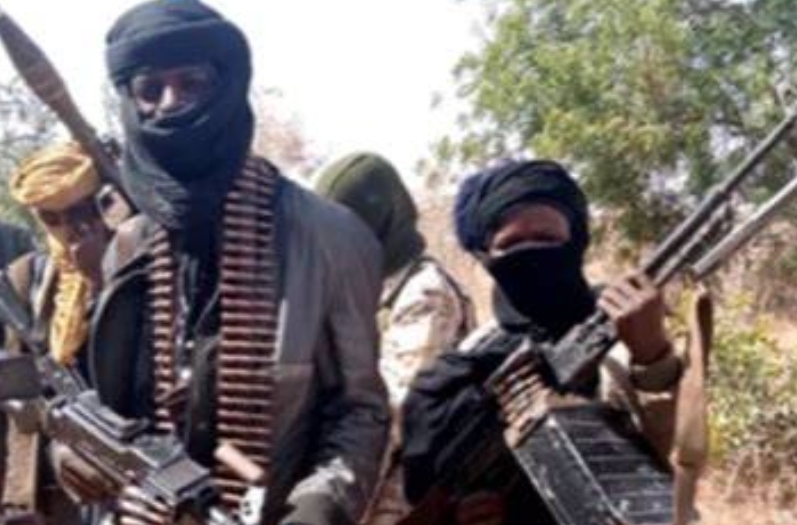
At least 24 bandits were killed on Tuesday after soldiers of the Nigerian Army, operatives of the Department of State Services (DSS), Katsina Community Watch Corps foiled an attempt to mass-kidnap persons in Gidan Bawa village, Kandarawa Ward, Bakori Local Government Area of the state.
According to a security source, the operation followed sustained intelligence which uncovered plans by about 40 gunmen loyal to notorious bandit kingpin, Isiya Kwashen Garwa, to invade the village and abduct many residents, especially women and children.
The plot, sources said, was intended to replicate the mass abduction of residents of Woro community in Kwara State, ostensibly to embarrass the government.
Acting swiftly on the intelligence, DSS operatives mobilised the Community Watch Corps, and the Civilian Joint Task Force (CJTF) from Guga camp, and ambushed the bandits.
The source disclosed that the joint security operatives neutralised 24 bandits and rescued the abducted villagers.
Security operatives also recovered 19 stolen cattle from the community during the raid.
The source added that there were ongoing efforts to track down the fleeing bandits.
Stephen Olufemi Oni, Ilorin
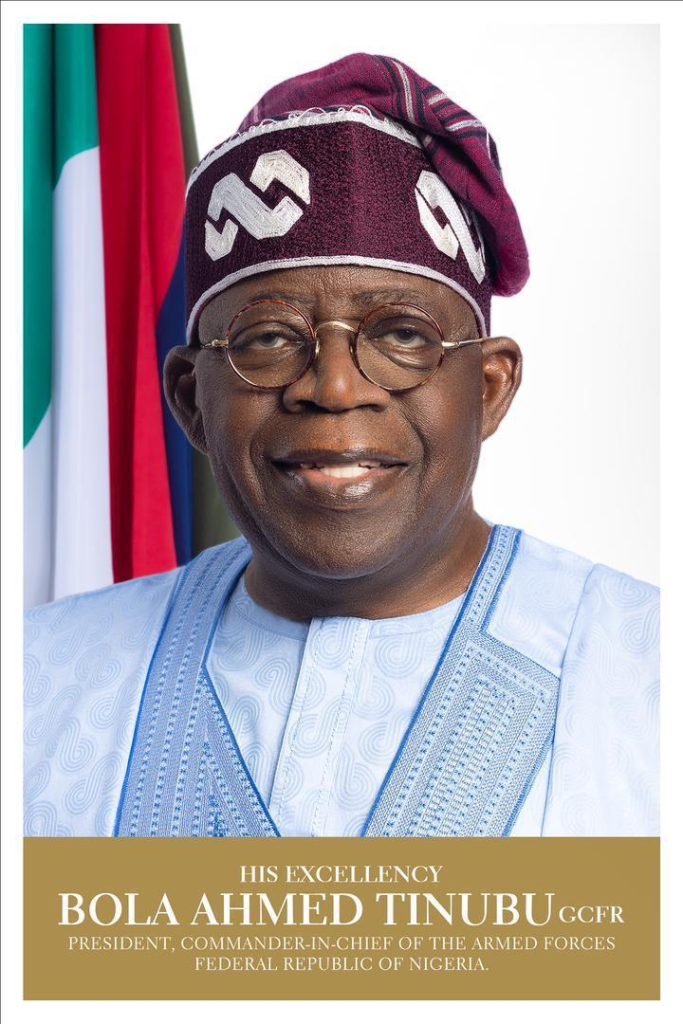
President Bola Ahmed Tinubu has charged Nigerian universities to move beyond the traditional focus on awarding degrees and reposition themselves as centres of innovation, practical skills, research and national development.
The President gave the charge on Tuesday in Ilorin, Kwara State, while declaring open the 37th Annual Conference and General Assembly of the Committee of Vice-Chancellors of Nigerian Universities (CVCNU), held at the University of Ilorin.
Represented by the Minister of State for Education, Professor Suwaibat Saidu Ahmad, President Tinubu said the country could not achieve sustainable economic transformation without corresponding investment in human capital.
He described universities as critical partners in the Federal Government’s development agenda, stressing that they must produce graduates capable of responding to the realities of a rapidly changing global economy.
“Universities are more than institutions where degrees are awarded. They are centres of knowledge creation, innovation, critical thinking, entrepreneurship, cultural development and national transformation,” he said.
According to him, Nigerian universities must produce graduates who are not only academically sound but also innovative, ethical, digitally competent, entrepreneurial, adaptable and capable of solving real-world problems.
He challenged university authorities to reconsider the quality and relevance of graduates being produced, particularly in an era dominated by artificial intelligence, automation, biotechnology, data science, renewable energy and advanced manufacturing.
“The question before us is no longer simply whether our universities are producing graduates. The more foundational question is: what kind of graduates are we producing? How effectively are our universities preparing them to contribute to Nigeria’s economic and social transformation?” he asked.
Tinubu said his administration was pursuing reforms aimed at improving the quality, relevance, accessibility, affordability and accountability of tertiary education.
He explained that the Federal Ministry of Education was implementing the Nigerian Education Sector Renewal Initiative, with particular attention to institutional governance, quality assurance, research and innovation, digital transformation, skills development and stronger university-industry linkages.
The President also called for stronger practical training in Nigerian universities, noting that academic knowledge must be complemented by hands-on experience.
He disclosed that the government had begun reviewing curricula, particularly in agriculture, to shift the emphasis from theory to practical training.
“We are moving away from 70 per cent theory and 30 per cent practical to a robust 80 per cent practical and 20 per cent theory,” he said.
He added that accreditation requirements would now compel universities, faculties and departments of agriculture to establish partnerships with relevant industries, while students would be expected to undertake industrial attachments throughout their academic programmes.
According to him, the same approach would gradually be extended to other disciplines through the review of the Core Curriculum and Minimum Academic Standards (CCMAS).
Tinubu further urged vice-chancellors to strengthen research partnerships with government, industry, development partners and communities so that research findings could be transformed into products, services, policies, technologies and practical solutions to national challenges.
“Nigeria cannot become a globally competitive economy by relying primarily on the consumption of knowledge generated elsewhere,” he said.
“Our universities must become powerful engines of research, innovation, technology development and entrepreneurship.”
The President also emphasised the importance of effective university governance, urging vice-chancellors to strengthen accountability, improve institutional planning and deploy public resources prudently.
He noted that vice-chancellors were not only academic leaders but also managers, employers, financial stewards, community leaders and strategic partners in national development.
“Leadership, vice-chancellorship, is not about research. It is about administrative skills. It is about the ability to manage both research and humans at the same time,” he said.
On graduate employability, Tinubu said universities must ensure that their curricula reflected the changing demands of the labour market.
He urged institutions to strengthen internships, entrepreneurship programmes, work-based learning and university-industry partnerships, saying graduates should leave university not merely as job seekers but as value creators, innovators, entrepreneurs, professionals, researchers and responsible citizens.
The President also highlighted student welfare and access to education, saying government interventions, including the Nigerian Education Loan Fund, were designed to reduce financial barriers and expand access to tertiary education.
He, however, stressed that financial support must be accompanied by quality academic programmes, adequate infrastructure, effective student services and safe and inclusive learning environments.
Tinubu called for collective action among government, universities, students, academics, the private sector, development partners, professional bodies, regulators, alumni and communities to transform the nation’s university system.
He said the 37th CVCNU conference presented an opportunity for university leaders to move beyond identifying challenges and develop practical solutions capable of strengthening Nigeria’s higher education system.
The President commended the CVCNU for sustaining the annual platform for dialogue and collaboration and congratulated the University of Ilorin for hosting the conference.
He declared the conference officially open, urging participants to use the gathering to build a more competitive, innovative, inclusive and responsible university system.
Meanwhile, the Kwara State Government called for university reforms that would produce tangible benefits for communities rather than recommendations that would remain on government and institutional shelves.
Representing Governor AbdulRahman AbdulRazaq at the conference, the Commissioner for Education and Human Capital Development and Supervising Commissioner for Tertiary Education, Dr Lawal Olohungbebe, welcomed the vice-chancellors to Kwara State and described the University of Ilorin as one of the state’s greatest educational assets.
He said the state government recognised the importance of tertiary education but stressed that meaningful reform must begin from the basic education level.
Olohungbebe said the state introduced the KwaraLEARN programme to strengthen supervision and improve teaching and learning in public primary schools, particularly in rural communities.
“With KwaraLEARN, we are able to supervise every teacher in the class. Who is in the class, who is not in the class, and not just being in the class. What are you doing in the class?” he said.
According to him, strengthening basic education would help prepare children before they eventually enter universities.
He also praised the University of Ilorin for hosting the conference, describing the gathering of vice-chancellors as a major opportunity for knowledge-sharing and policy development.
Olohungbebe said the experience represented by the university leaders in attendance was enormous, noting that their collective years of experience could be deployed to address Nigeria’s educational challenges.
He urged participants to ensure that the outcomes of the conference translated into practical interventions that would have direct impact on communities.
“We look forward to having fruitful deliberations, and not just the ones that will end up on the shelves, but the ones that will end up in our communities, making a local impact and international relevance,” he said.
The 37th CVCNU conference brings together vice-chancellors and other stakeholders in Nigeria’s university system to deliberate on the future of tertiary education and strategies for strengthening the sector amid rapid technological, economic and social changes.
Uncategorized
Cristiano Ronaldo’s Comment on Lionel Messi’s Tribute to His Dad Becomes Most-Liked Instagram Comment

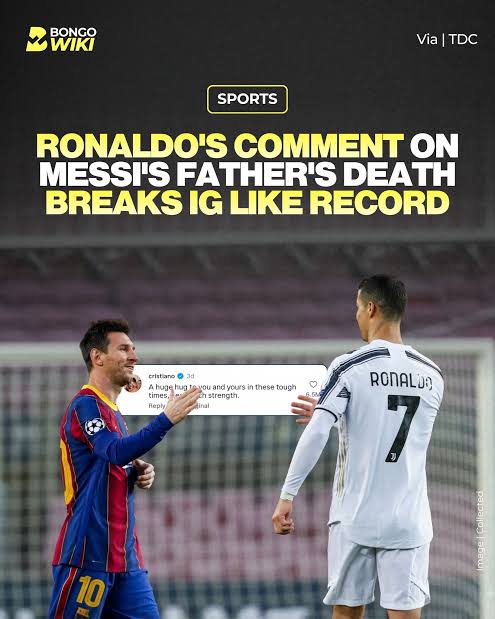
Cristiano Ronaldo’s heartfelt message to Lionel Messi following the death of his father, Jorge Messi, has reportedly become the most-liked comment in Instagram history.
Jorge Messi died on August 7 in Rosario, Argentina, aged 68. Five days later, Messi paid tribute to his late father in an emotional Instagram post featuring a photo of the pair.
In the post, Messi wrote, “Te amo, pa” — meaning “I love you, Dad” — alongside a lengthy tribute reflecting on his father’s influence and the pain of losing him.
Among the many reactions from fans, celebrities and fellow footballers was a message from Ronaldo.
“Un abrazo enorme para ti y los tuyos en estos duros momentos, Leo. Mucha fuerza,” Ronaldo wrote, which translates to: “A huge hug to you and yours in these tough times, Leo. Much strength.”
Ronaldo’s comment reportedly attracted more than 6.86 million likes and over 86,000 comments, making it the most-liked comment on Instagram.
The previous record was also held by Ronaldo, whose comment on Kylian Mbappé’s announcement of his move to Real Madrid reportedly received more than five million likes.
Other football stars also expressed their condolences to Messi. Neymar Jr.’s message, translated as “Much strength for you and your family. Big hug,” reportedly received more than 1.6 million likes, while David Beckham’s comment expressing support for Messi and his family attracted more than 300,000 likes.
In his tribute, Messi described his father’s death as difficult to comprehend, saying he struggled to accept that he would no longer see or speak with him.
Messi also recalled how his father had encouraged him to play at the 2026 World Cup despite his deteriorating health. He said his father had hoped to watch him compete and had planned to travel if his condition improved.
According to Messi, he had promised his father that Argentina would reach the final so he could be there. Although Argentina reached the final, his father was unable to attend.
Reflecting on the loss, Messi said he had wanted to win the tournament and bring the trophy to his father but ultimately struggled physically during the competition.
The emotional tribute highlighted the close bond between Messi and his father and the profound impact of his loss on the football superstar.

24 Bandits Killed As Army, DSS, Vigilantes Foil Mass Kidnap in Katsina Community, Rescue Victims
KADSG Faults ADC Guber Candidate’s Criticism, Defends Sani’s Education Funding Records

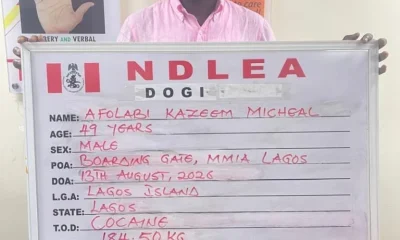
NDLEA Arrests Alleged Cocaine Trafficking Kingpin at Lagos Airport
-
 News10 hours ago
BUDGET OFFICE OF THE FEDERATIONRESPONSE TO THE 2026 U.S. DEPARTMENT OF STATE FISCAL TRANSPARENCY REPORT ON NIGERIA
-

 News12 hours ago
Beyond the ECOWAS–AES Divide: Rethinking Regional Cooperation, Peace and Security in West Africa
-
 News12 hours ago
Tinubu Committed to Transforming Nigeria’s Electricity Sector, Says Power Minister
-
 News12 hours ago
Mangu Killings: ADC Governorship Candidate Calls for Immediate Security Action
-
 Crime8 hours ago
NDLEA Arrests Alleged Cocaine Trafficking Kingpin at Lagos Airport
-
 News12 hours ago
Tinubu Urges Politicians to Avoid Divisive Politics Ahead of 2027 Elections
-
 News12 hours ago
Delta to Train 1,000 Youths in Agribusiness to Boost Agriculture
-
 News12 hours ago
24 Killed, Three Injured in Fresh Attack on Plateau Community
You must be logged in to post a comment Login