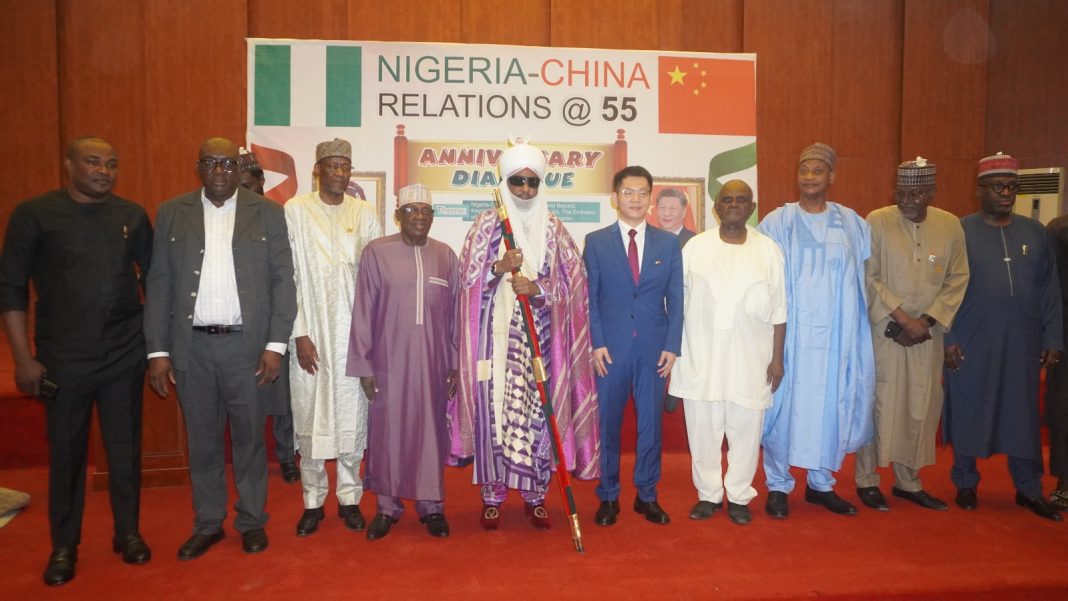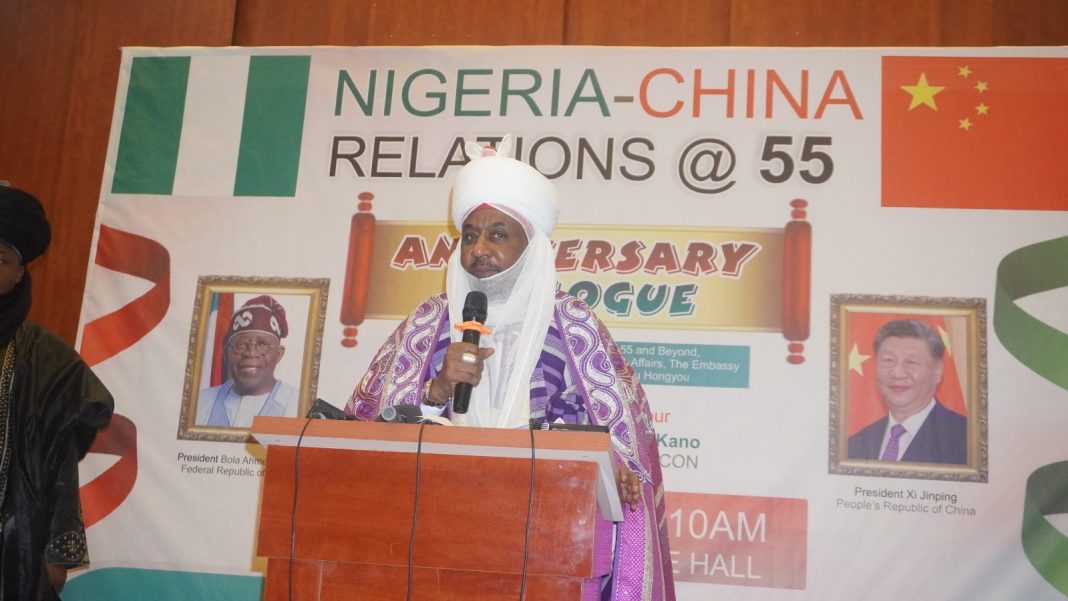

The Emir of Kano, Muhammadu Sanusi II, has called on Nigerian authorities to rethink the country’s economic engagement with China, urging a stronger emphasis on industrial development and manufacturing as both nations commemorate 55 years of diplomatic relations.
He made the appeal in Abuja at a policy dialogue titled “Nigeria/China at 55 and Beyond,” organised by the Centre for China Studies in partnership with the Institute for Peace and Conflict Resolution (IPCR). The forum brought together diplomats, government officials, scholars and members of the diplomatic community to examine the future of bilateral cooperation.
In his remarks, Sanusi recalled that his late father, Ambassador Aminu Sanusi, was appointed Nigeria’s first envoy to China in 1971, at a time when the Asian nation was still grappling with poverty and the aftermath of the Cultural Revolution.
Drawing a contrast with present-day China, the Emir described the country’s transformation over the past five decades as remarkable. He cited the large-scale reduction in poverty and the expansion of higher education as examples of what sustained planning and strategic focus can achieve within a generation.
Sanusi also revisited his time as Governor of the Central Bank of Nigeria, noting that Nigeria was among the early African adopters of the Chinese renminbi in its foreign reserves. He said the move reflected an assessment that China’s growing influence in global trade and production would inevitably shape the international monetary system. Diversifying Nigeria’s reserve holdings, he added, was part of a broader effort to reduce reliance on a single dominant currency.
Turning to present economic realities, the Emir acknowledged the role of Chinese-backed infrastructure projects in Nigeria, including rail lines, airports and power facilities. However, he argued that infrastructure alone is insufficient if the country remains largely dependent on imported goods.
According to him, Nigeria must position itself as a destination for manufacturing investment, particularly as Chinese firms seek new production bases outside their home country due to rising labour costs. He warned that other African nations, including Ethiopia and Ghana, have moved more quickly to attract such investments, despite Nigeria’s larger market size.
Sanusi cautioned that without a clear and coordinated industrial policy, Nigeria risks becoming primarily a consumer market even within the framework of the African Continental Free Trade Area (AfCFTA). He noted that neighbouring countries could serve as production centres for goods ultimately sold to Nigerian consumers if proactive steps are not taken.
Emphasising Nigeria’s demographic and market advantages, he argued that the country should aspire to become West Africa’s manufacturing hub, supported by deliberate economic policies and strategic diplomacy.
Describing Nigeria–China relations as evolving, Sanusi suggested that aspects of the partnership remain incomplete and require renewed focus. He placed the bilateral engagement within the broader context of shifting global power dynamics, urging policymakers to anticipate trends and align Nigeria’s economic strategy accordingly.
Despite his concerns, the Emir expressed confidence in the potential of deeper collaboration between the two countries, particularly if cooperation is anchored on production, technology transfer and job creation.
Also speaking, the Chargé d’Affaires of the Chinese Embassy in Nigeria, Zhou Hongyou, reaffirmed Beijing’s commitment to expanding ties with Abuja. He recalled that diplomatic relations were formally established on February 10, 1971, and have since advanced to a Comprehensive Strategic Partnership.
Zhou said cooperation now spans sectors such as infrastructure, energy, mining, health and education, while trade between the two countries has grown steadily. He highlighted major joint initiatives, including the Lekki Deep Sea Port, the Zungeru Hydropower Plant, the Ajaokuta–Kaduna–Kano Gas Pipeline and railway modernisation projects.
Looking ahead, he identified key priorities for the next stage of engagement, including deeper political trust, closer alignment of Belt and Road projects with Nigeria’s development objectives, stronger coordination in multilateral platforms such as the United Nations and BRICS, and expanded exchanges in education, culture and youth development.
Participants at the dialogue agreed that as Nigeria and China reflect on more than five decades of relations, the focus must shift toward building a partnership capable of delivering sustainable economic growth and long-term competitiveness.