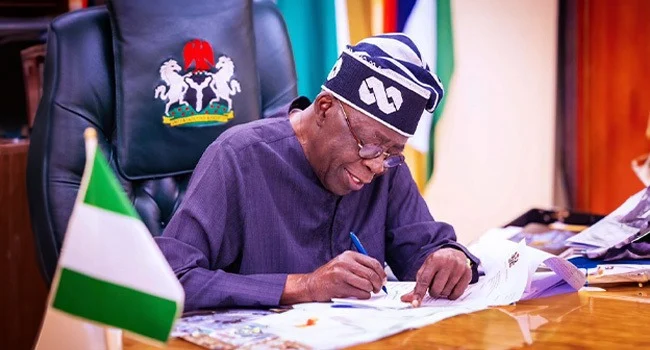
The Federal Government has proposed total revenue of N50.74tn for 2026 and projected economic growth of 4.68%, even as its planned deficit for the year has climbed to a level that exceeds the entire 2022 national budget by N2.78tn, The Press reports.
The development signals a tougher fiscal year ahead, with analysts warning that the combination of rising deficits, growing debt obligations and an overstretched budget calendar could intensify economic pressures on households and businesses in 2026.
The figures are contained in the 2026–2028 Medium-Term Expenditure Framework and Fiscal Strategy Paper, approved by the Federal Executive Council on Wednesday. Minister of Budget and Economic Planning, Atiku Bagudu, told State House correspondents that the document would be submitted to the National Assembly on Monday.
Key Assumptions
Bagudu explained that the 2026 draft budget is based on:
- Oil price benchmark: $64.85 per barrel
- Exchange rate: ₦1,512/$
- Dual crude production targets:
- Industry projection: 2.06 million bpd
- Budget benchmark: 1.8 million bpd
He said the conservative benchmark provides a 12.6% safety buffer against output volatility.
The minister warned that spending linked to the 2026 pre-election cycle could heighten pressure on the naira, saying, “Election activity spending can typically affect the exchange rate.”
Revenue and Expenditure Breakdown
Federation revenue for 2026 is projected at N50.74tn, to be shared as follows:
- Federal Government: N22.60tn
- States: N16.30tn
- Local governments: N11.85tn
The Federal Government expects N34.33tn from all revenue sources, including N4.98tn from government-owned enterprises — a figure Bagudu says is 16% lower than projected earnings in 2025.
Major spending items include:
- Statutory transfers: ~N3tn
- Non-debt recurrent expenditure: N15.27tn
- Debt service: N15.91tn
With a total proposed spending envelope of N54.43tn, debt service will account for 29.2% of the entire budget — nearly three out of every 10 naira spent next year.
The deficit of N20.10tn represents 36.9% of total expenditure, meaning Nigeria plans to borrow more than one-third of its 2026 spending.
For comparison:
- 2025 budget: N54.99tn
- Deficit: N9.22tn
- Debt service: N14.32tn
- 2022 budget: N17.32tn
- Debt service: N3.98tn
The 2026 debt service figure is 299% higher than in 2022.
Economists Raise Alarm
Experts say the deficit threatens macroeconomic stability.
Dr. Muda Yusuf, CEO of the Centre for the Promotion of Private Enterprise, said Nigeria risks derailing its recent economic progress:
“High deficits and high debt levels can choke fiscal space and trigger a vicious cycle of debt.”
He warned that fragile gains in stabilising inflation and the exchange rate could be lost if deficit spending is not curbed.
Prof. Sheriffdeen Tella of Olabisi Onabanjo University criticised the timing of the budget proposal, arguing that the 2026 plan lacks credibility since implementation of the 2025 budget is only just beginning.
He faulted the government for preparing a fresh budget without evaluating the performance of the existing one, saying, “They just cook up figures… which is wrong.”
NES President, Prof. Adeola Adenikinju, said the delayed budget cycle undermines predictability:
“We are running two or three budgets in the same year… the process is very disorganised.”
He warned that borrowing beyond the Fiscal Responsibility Act’s recommended 3% of GDP would breach the law and risk crowding out private-sector borrowing, leading to higher interest rates and reduced investment.
Government’s Position
Bagudu said the framework includes inputs from the economic management team, ministries, civil society groups and the private sector. He added that President Tinubu has secured National Economic Council support for tighter coordination between fiscal and monetary policy, increased security spending, and stronger oversight to curb revenue leakages in the oil, gas and solid minerals sectors.
The MTEF/FSP will guide the formulation of the 2026 Appropriation Bill, setting key budget parameters including revenue targets, spending priorities and deficit limits.