
By Francis Wilfred
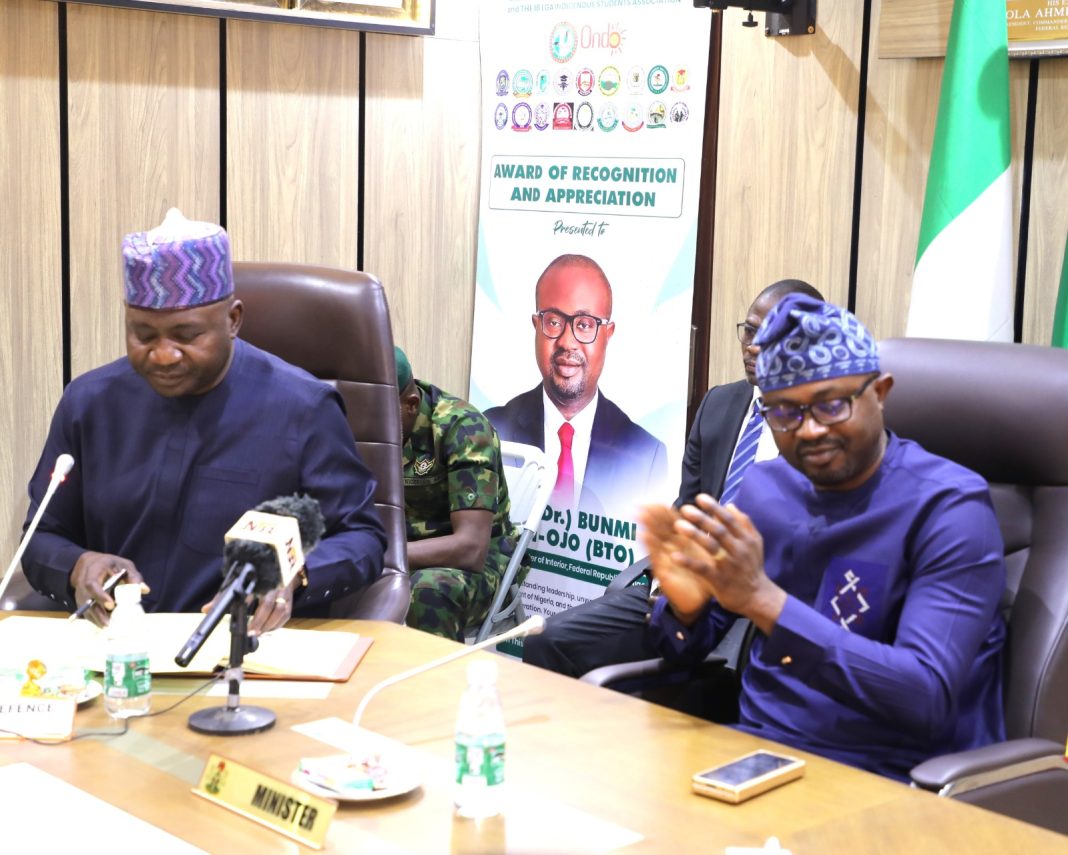
The Federal Government has reiterated its commitment to strengthening Nigeria’s national security architecture through deeper collaboration between the Ministries of Interior and Defence. The call was made on Friday in Abuja during a courtesy visit that underscored the need for seamless cooperation between military and paramilitary institutions.
Speaking during the visit, the Minister of Interior, Dr. Olubunmi Tunji-Ojo, said effective national security depends on coordinated action across intelligence, internal security, and defence institutions. He stressed that fragmentation and rivalry among security agencies undermine national safety.“Our national security architecture stands on a tripod of intelligence, internal security, and defence. If one leg is weak, the entire structure is threatened,” Tunji-Ojo said.
In a press release signed by the Head of Press and Public Relations at the Ministry of Interior, Mary Ali, Tunji-Ojo thanked the Minister of Defence for the visit and acknowledged the confidence President Bola Ahmed Tinubu has placed in both ministries to drive security reforms.The Interior Minister warned against territorialism among security agencies, noting that citizens are more concerned about safety outcomes than institutional boundaries. He emphasized border security as a key area requiring joint action, particularly through the Nigerian Immigration Service.“
No country can guarantee the safety of its citizens without securing its borders,” he said, adding that intelligence-sharing and coordinated border management were essential to national stability.Tunji-Ojo also clarified the mandate of the Nigeria Security and Civil Defence Corps (NSCDC), stating that it was not intended to operate as a “police version 2.0.” Instead, he said the corps is tasked with protecting critical national assets, including schools, oil and gas facilities, solid minerals, telecommunications infrastructure, and power installations.
He described attacks on these assets as acts of economic terrorism, stressing that their protection requires military-grade training and close cooperation with the armed forces. The minister also commended senior officials and heads of security agencies from both ministries for their contributions to national stability.In his remarks, the Minister of Defence, General Christopher Gwabin Musa (Rtd.), praised Tunji-Ojo’s leadership and reforms across agencies under the Ministry of Interior. These include the Nigerian Immigration Service, NSCDC, Nigerian Correctional Service, and the Federal Fire Service.Musa called for deeper synergy between the two ministries, describing them as “two sides of the same national security coin.” He noted that modern security threats such as terrorism, insurgency, banditry, and cross-border crimes have blurred the distinction between internal and external security.“The line between internal and external security is no longer clear. These threats require synergy, intelligence sharing, and coordinated operations if we are to succeed,” Musa said.
He emphasized the need for intelligence-driven, whole-of-government responses, proposing a strengthened joint intelligence fusion framework involving the Defence Intelligence Agency and Interior agencies. He also advocated secure technology platforms for real-time information sharing, regular joint simulations, and clear protocols for joint operations.The Defence Minister assured that his ministry would continue to support internal security agencies through specialized training in counterterrorism, intelligence gathering, and crisis response, alongside logistical and technical assistance.
Responding, Tunji-Ojo agreed that weaknesses in internal security inevitably overstretch the military. He said strengthening paramilitary institutions would allow the armed forces to focus on their core defence mandate.Both ministers also highlighted the importance of integrated data management, agreeing that Interior Ministry databases should serve as critical inputs for defence planning and national security decision-making.
They announced plans to activate an inter-ministerial technical committee to meet regularly, review progress, address operational bottlenecks, and institutionalize cooperation at both strategic and operational levels.Expressing confidence in sustained collaboration, Musa and Tunji-Ojo said enhanced synergy between their ministries would strengthen national security, improve public trust, and deliver a safer Nigeria.“We must do things differently. Working together is the only way Nigeria can win,” Musa said.