
By Charles Onunaiju
As the eventful year of 2025 draws to a close, it has delivered some vital and practical outcomes in the bilateral cooperation between Nigeria and China. A key flagship of the cooperation between the two sides especially under the iconic Belt and Road framework of International cooperation, is the Lekki Deep Seaport in Lagos. Reported to be re-shaping the landscape of Nigeria’s maritime trade and re-positioning the country as regional maritime hub, the latest trade data showed that, it is the country second most crucial port by the values, it delivered in trade, just three years after it began operations.
Recent figures showed the meteoric expansion. Between 1st and 3rd quarters of the year, the Nigeria’s youngest port handled an estimated 13.46 trillion naira in total trade in both imports and exports, signaling a structural shift in the performance of the economy with a more balanced outlook of imports at 7.39 trillion naira, while exports stood at 6.07 trillion naira. The Belt and Road Initiative (BRI) is a flagship China project of the century and the largest international public goods with more than 150 countries, regions and international organizations as partners, with Africa as the region with largest number of countries as partners of the BRI.
The first half of 2025 witnessed the highest BRI engagement ever for any 6-month period with 66.2 billion U.S Dollars in construction contracts and about 57.1 billion USD in investments. Nigeria’s 20 billion U.S dollar Ogidigbon Gas Revolution park in Delta state on the roll out for construction, underlines the practical outcomes in the Nigeria-China bilateral cooperation under the Belt and Road framework.
For an incredible year of intense joint strivings to translate many mutual understanding into practical outcomes and advance the progress made in many sectors, the meeting of President Ahmed Bola Tinubu and the Chinese Ambassador Yu Dunhai earlier, this month at the Presidential Villa possibly to exchange views on the rapidly evolving and bourgeoning cooperation between the two sides is a fitting tribute to a year of productive engagement.
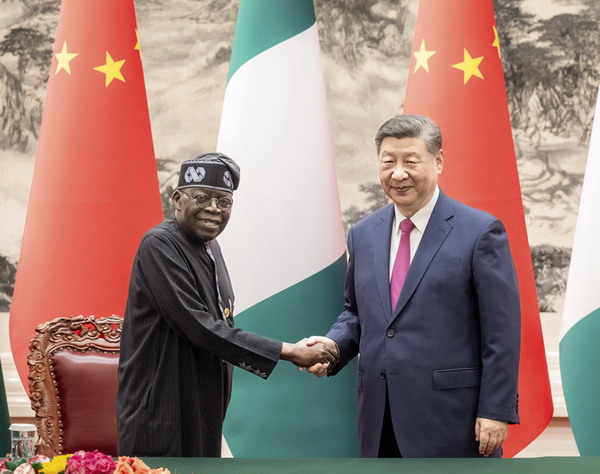
Following President Tinubu’s successful State visit to China last year and his attendance of the Summit of the Forum on China-Africa Cooperation (FOCAC), makes 2025 very pivotal in the implementation of the various understandings. In the joint statement following the successful State visit, the two sides agreed to establish “a comprehensive strategic partnership and build a high level China-Nigeria community with a shared future, pledging to consolidate mutual trust, expand cooperation and strengthen coordination. These commitments built on the reaffirmation of the two sides to firmly support each other on issues related to their respective core interests and major concerns, particularly on sovereignty and territorial integrity” has evolved and consolidated as the bedrock of the bilateral cooperation.
Occasional distractions by the “Taipei Trade Office” in Lagos and their external cohorts have not shaken the firm root of Nigeria-China strategic partnership and the meeting of the President and the Chinese Ambassador in a framework of obvious introspections on the outgoing year signaled the deep root of the relations between the two sides.
In the joint statement during the President Tinubu vist , the Chinese side would firmly support the Renewed Hope Agenda of Nigeria and the efforts made by the country in maintaining national unity, peace and social stability as well as promoting economic development and improving people’s welfare, while the Nigeria side would further uphold the integrity of her “One-China Policy” by firmly adhering to the One-China principle, acknowledges that there is only one China in the world and the government of the People’s Republic of China is the sole legitimate government representing the whole of China and Taiwan is an alienable part of China’s territory.
These important reaffirmation and further commitments to deepen relations were neither subterfuge nor mere rhetoric. President Tinubu followed his successful State visit to China and his first participation at the Summit of the Forum on China-Africa Cooperation (FOCAC) with the establishment of a special directorate in the Presidency, Nigeria-China Strategic Partnership to follow-up, outline and benchmark critical issues in the evolving trajectories of the cooperation between the two sides and deliver nimble policy approach to engaging the opportunities of the relationship.
And within the period of the new historical starting point in the relations between Nigeria and China, the 15th Chinese Ambassador to Nigeria, Mr. Yu Dunhai arrived to help in shaping and steering the pivotal moment in the two countries engagement. With both sides ready to tap into the opportunities of their mutual engagements, the outgoing year of 2025 was fruitful not only in maintaining the momentum of their bilateral cooperation, but in the crucial expansions in both the opportunities and remarkable fruitful outcomes, it has delivered so far.
The Chinese Ambassador, Mr. Yu Dunhai and his colleagues have significantly raised the bar in elaborating, clarifying and providing outlines to the context of the bilateral cooperation, thereby giving effect to the ever broadening scope and the increasing depth in the two countries relations.
The outgoing year of 2025, been the first in the three-year period of the implementation of the Ten Partnership Action Plans of the last year FOCAC Summit has been quite a defining moment for Nigeria and China. Mutual learnings and sharing of governance experiences have further been mainstreamed through the mechanism of Nigeria-China inter-governmental dialogue, where range of issues for clarification and mutual cooperation are fostered. Outside the governmental circle, China’s vigorous pubic diplomacy, encompassing cultural, Think Tank, Media, political party dialogues have opened fresh vistas and added more impetus in developing and consolidating the strand of value exchanges and sharings between the societies of both sides.
In June, during the 4th edition of the China-Africa Economic and Trade Expo held in the Chinese Province of Hunan, dedicated exclusively to exposing Africa’s business and products to China, Beijing offered the 100% tariff free entry of nearly all products from all African countries, including Nigeria to the Chinese huge market of 1.4 billion people. The gesture at a time of heightened trade frictions and tariff walls erected primarily by Washington and subtlety followed by its other Western partners, could not come at a more opportune time for Nigeria and the rest of Africa.
With a longstanding concern to diversify her trade beyond the dominant crude oil and gas, the Chinese market with a concessional access for Nigeria would fill the gap in the country’s foreign exchange receipt, thereby ameliorating the challenge in the stability of the local currency. When fully tapped, access to China’s huge market have broader implications for structural shift in Nigeria’s economic outlook, in favor of increased productivity, employment and the emergence of important economic and trade corridors while evolving an economy of scale that is both integrated and resilient.
While the outgoing year of 2025 have consolidated the Nigeria-China bilateral cooperation as significant fabric in the outlooks of both countries, the opportunities of the future trajectories have even greater prospects. Just as anything in its form hardly translates to opportunities and advantages, except deliberately and consciously worked to yield such outcomes of mutual benefits, the future prospects especially in the coming year of 2026 and beyond would depend on how the two sides further exert themselves.
More crucially, Nigeria would have to step up in engaging the opportunities especially of the concessional market access, which if properly tapped would drain the swamp of poverty across the country through agricultural revitalization and a boost in related non-oil exports which would help to solve some of the issues at the root of the Nigeria’s contemporary challenges with security, stability and social inclusion.
Mr. Onunaiju is a research director of an Abuja-based Think Tank.