
By Joyce Remi-Babayeju
The Federal Ministry of Health and Social Welfare has taken its fight against Noma, an oral health disease to the grassroots through the integration of the mouth disease into the primary healthcare facilities, particularly in grassroots communities across Nigeria.
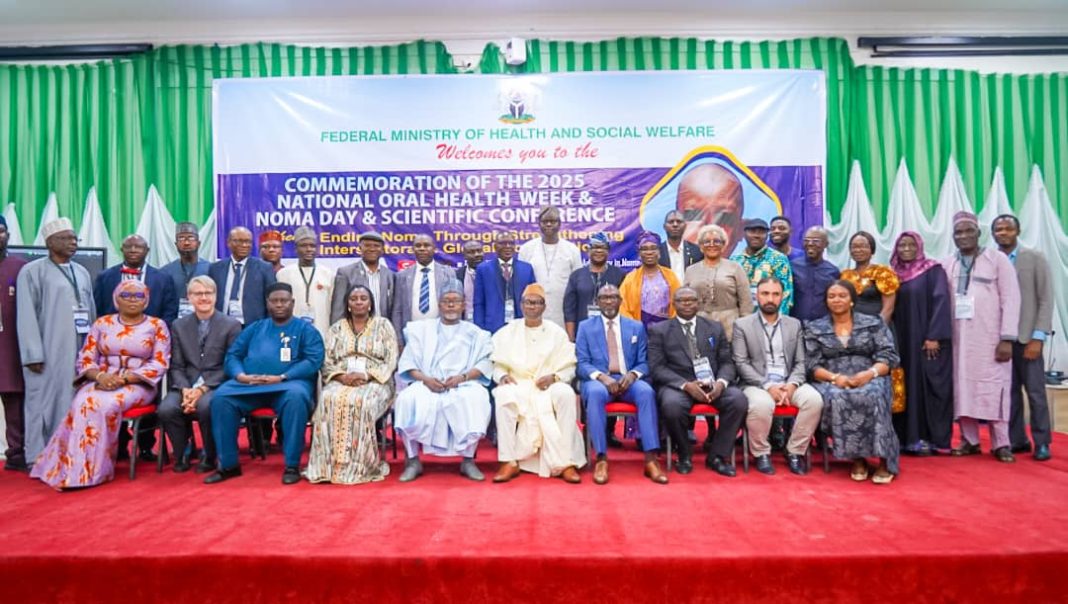
The Minister of State for the Federal Ministry of Health and Social Welfare, Dr. Iziaq Salako revealed this on Tuesday in Abuja at the commemoration of the 2025 National Oral Health Week, Noma Awareness Day, and Scientific Workshop.
This is to be achieved by mandating PHCs to give oral hygiene education, counseling, essential diagnostics, fluoride treatment, restorative services, and referrals where necessary, he said.
The minister also hinted that the reorganization and expansion of the Basic Health Care Provision Fund (BHCPF) as an addendum will make more funds available to improve access to oral healthcare, especially for vulnerable populations.
Referring to the theme of the 2025 Noma Day: “Ending Noma through Strengthening Intersectoral and Global Cooperation”, Dr. Salako stressed that oral health is a fundamental component of overall well-being, citing World Health Organization’s position that “there is no health without oral health.”
He noted that millions of Nigerians, particularly children and the elderly, continue to suffer from preventable oral conditions such as dental caries, periodontal disease, and oral cancers, undermining dignity, productivity, and quality of life.
He highlighted the devastating impact of noma, as a rapidly progressing gangrenous disease that mostly affects malnourished children living in extreme poverty and poor sanitary conditions.
Meanwhile, the minister has stated that Nigeria falls within the noma belt in sub-Saharan Africa, with the Northwest region bearing a heavy burden due to poverty, malnutrition, poor oral hygiene, and weak surveillance systems leading to late diagnosis and avoidable deaths.
Furthermore, he disclosed that there would be an upgrade in the equipping of dental facilities across the country, with the employment of more dental professionals at the primary care level. According to the minister, community health workers, primary healthcare staff, and traditional birth attendants are being trained to identify and refer cases of oral diseases, including noma, cleft lip, and cleft palate, for comprehensive and often free treatment.
He also underscored the federal government’s commitment under President Bola Ahmed Tinubu with the establishment of the Noma Centre in Abuja and the Noma Children’s Hospital in Sokoto State, where patients are treated and rehabilitated at no cost.
He called for a collective society approach involving investments in nutrition, water and sanitation, housing, immunization, and maternal and child health, stressing that “noma is not just a medical failure, but a societal inadequacy.”
Earlier, Permanent Secretary, Federal Ministry of Health and Social Welfare, Daju Kachollom, described Noma as one of the most devastating but preventable diseases.
She said the 2025 theme, “Ending Noma through Strengthening Intersectoral and Global Cooperation,” underscores the need for coordinated efforts across sectors such as nutrition, WASH, education, social protection, and community development to tackle the oral disease.
The Permanent Secretary noted that Nigeria’s contribution towards the recognition of Noma as a Neglected Tropical Disease (NTD) by the WHO in 2023—a milestone that has helped to mobilize global attention, funding, and research.
She reaffirmed the ministry’s commitment to integrating oral health into primary healthcare, expanding workforce capacity, and ensuring that services remain accessible, affordable, and sustainable for all Nigerians.
Speaking on behalf of the Noma Aid Nigeria Initiative (NANI), its Chairman, Mr. Mathis Winkler, revealed that over 200 Noma patients have received treatment at the Noma treatment centre in Abuja, many of them requiring complex microvascular surgery due to severe facial disfigurement.
Country representative of Médecins Sans Frontières (MSF) and Frontier Medicine, Dr. Somba Tirima disclosed that since 2014, more than 1,600 reconstructive surgeries have been carried out for over 1,000 patients through multiple surgical missions, with 99 surgeries performed on 89 patients in 2025 alone.
He noted that MSF had also trained 28 Nigerian surgeons and 14 anesthesiologists, building sustainable local capacity to manage noma cases.
He emphasized the importance of strengthening community awareness, early screening, frontline worker training, and integrating Noma surveillance into both public and private healthcare systems, while calling for increased domestic and international funding to sustain progress.
Also speaking, the president of the Nigeria Dental Association (NDA), Dr. Elias Emedom further advocated for the full integration of the National Oral Health Policy into primary healthcare and improved working conditions for health professionals to curb brain drain in the sector.
End