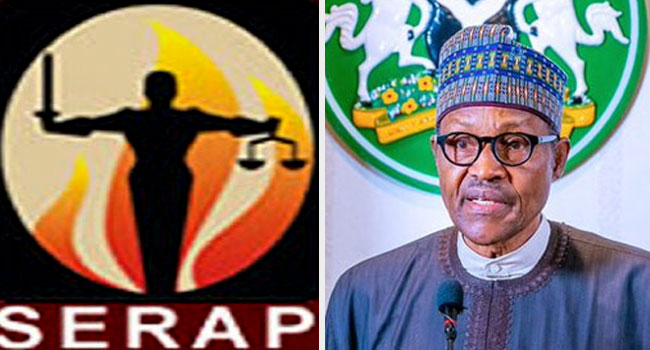

Socio-Economic Rights and Accountability Project (SERAP) has filed a lawsuit against President Muhammadu Buhari “over his failure to probe allegations that over N1.48 trillion reportedly spent on maintaining the country’s four refineries between 2015 and 2020 may have been stolen, mismanaged or diverted into private pockets.”
The government reportedly spent N10.23 billion in June 2020 on three refineries that processed zero crude. Also in 2021, the government approved $1.5 billion (about N600 billion) to repair the Port Harcourt refinery. Despite the huge spending, the refineries are still not working while fuel scarcity persists.
In the suit number FHC/L/CS/806/2022 filed last week at the Federal High Court, Lagos, SERAP is seeking “an order of mandamus to direct and compel President Buhari to investigate the spending on Nigeria’s refineries, and alleged mismanagement of public funds budgeted for maintaining the refineries since 1999.”
SERAP is also seeking “an order of mandamus to compel President Buhari to ensure the prosecution of anyone suspected to be responsible for the importation and distribution of dirty fuel into Nigeria and to identify and ensure access to justice and effective remedies to affected victims.
SERAP is arguing that “It is in the public interest to ensure justice and accountability for alleged corruption and mismanagement in the oil sector, which has resulted in the importation and distribution of dirty fuel and protracted fuel scarcity in the country.”
According to SERAP, “Nigerian Constitution 1999 [as amended], and international standards impose clear obligations on the Buhari administration to take effective accountability measures to weed out, expose, and punish allegations of corruption in the oil sector, and to ensure effective remedies for victims.”
SERAP is also arguing that “Ensuring justice and accountability in the spending of public funds on refineries would improve the availability of petrol and the enjoyment by Nigerians of their right to natural wealth and resources.”
“Impunity for alleged corruption in the oil sector has contributed to the importation and distribution of bad fuel, violating the human rights of many users, including to a safe, clean, healthy and sustainable environment.
“The Buhari administration has legal obligations under Section 15(5) of the Nigerian Constitution to abolish all corrupt practices and abuse of power, and article 26 of the UN Convention against Corruption to ensure effective prosecution of allegations of corruption.
“Alleged corruption and mismanagement in the oil sector and the importation and distribution of dirty fuel have continued to deprive Nigerians of economic opportunities, subjecting them to cruel and degrading treatment.”
The commission is seeking “an order of mandamus to direct and compel President Buhari to instruct appropriate anti-corruption agencies to jointly track and monitor the spending of public funds to rehabilitate, operate, and maintain Nigeria’s refineries.”
Joined in the suit as Respondent is Mr Abubakar Malami, SAN, Attorney General of the Federation and Minister of Justice.
The suit filed on behalf of SERAP by its lawyers Kolawole Oluwadare and Ms Adelanke Aremo, read in part: “Nigeria has made legally binding commitments under the UN Convention against Corruption to ensure accountability in the management of public resources. These commitments ought to be fully upheld and respected.”
“Directing and compelling President Buhari to probe allegations of corruption and mismanagement of the money meant to repair the country’s refineries would advance the rights of victims of corruption to restitution, compensation and guarantee of non-repetition.”
“Combating the corruption epidemic in the oil sector would alleviate poverty, improve access of Nigerians to basic public goods and services, and enhance the ability of the government to meet its human rights and anti-corruption obligations.”
“Despite the country’s enormous oil wealth, ordinary Nigerians have derived very little benefit from their own natural wealth and resources, primarily because of widespread grand corruption, and the impunity of perpetrators.”
“High-ranking public officials, including officers of the Nigerian National Petroleum Company Limited suspected of complicity in the allegations of corruption and mismanagement in the oil sector, and the importation and distribution of adulterated fuel have continued to enjoy impunity.”
“Under Section 16(1) of the Constitution, the government has a responsibility to ‘secure the maximum welfare, freedom and happiness of every citizen on the basis of social justice and equality of status and opportunity.’ Section 16(2) further provides that, ‘the material resources of the nation are harnessed and distributed as best as possible to serve the common good.’”
“Under article 24 of the African Charter on Human and Peoples’ Rights, Nigerians have the ‘right to a general satisfactory environment favourable to their development.’”
“According to reports, petroleum products with methanol quantities above Nigeria’s specification were recently imported into the country.”
“The Nigerian National Petroleum Corporation (NNPC) reportedly stated that the methanol-blended petrol was imported into the country by a few suppliers through four premium motor spirit cargoes under its Direct Sales Direct Purchase (DSDP) arrangement.”
According to further reports, for every 200 litres of the adulterated product, 800 litres of petrol with good quality would be required for the blending to be done.
“The government spends over N264 billion annually to operate and maintain the country’s refineries. Successive governments have reportedly spent trillions of Naira to rehabilitate, operate and maintain the refineries that have produced little or no fuel.”
“The government reportedly spent $396 million for maintenance of the country’s refineries between 2015 and 2020 alone. Despite this huge spending, millions of Nigerians continue to lack access to a full and unhindered supply of fuel.”
“About N82.82 billion was reportedly spent in 2015; N78.95 billion in 2016; N604.127 billion in 2017; N426.66 billion in 2019; N218.18 billion in 2019, and N64.534 billion expenditure was recorded from January to June 2020.”
A date for the hearing of the suit is yet to be fixed.