
News
Taraba Unveils Five-Year Plan to Raise IGR, Cut Reliance on Federal Allocations

By Aga Samuel Imoter
The Taraba State Government has unveiled a five-year strategic revenue plan aimed at increasing internally generated revenue (IGR), improving fiscal sustainability and reducing dependence on federal allocations.
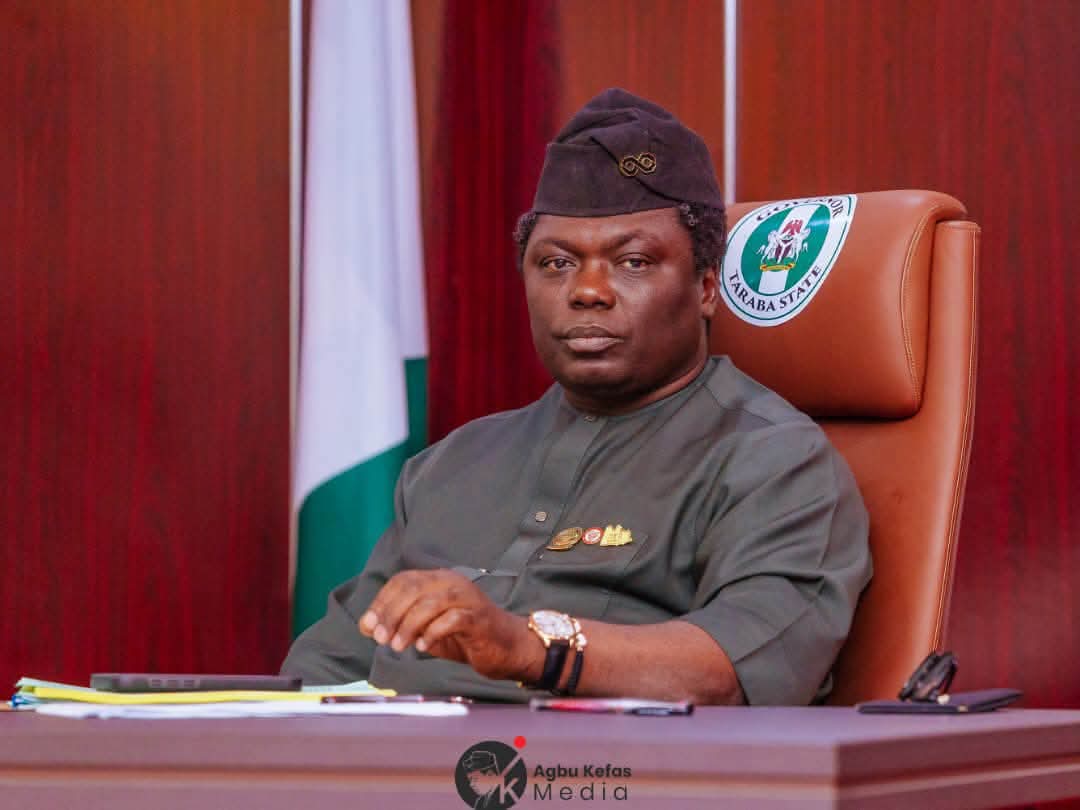
The plan was presented on Thursday during the State Executive Council meeting chaired by Governor Agbu Kefas at the Executive Council Chamber, TY Danjuma House, Jalingo.
Presenting the strategy, Chairman of the Taraba State Internal Revenue Service (TIRS), retired Gen. Jeremiah Faransa, said the reforms would focus on digitalising revenue administration, reducing leakages, improving tax compliance and expanding the state’s revenue base.
Governor Kefas said a stronger IGR system was necessary to sustain government investments in education, healthcare, infrastructure, agriculture and security. He directed the Commissioner for Finance to provide TIRS with the resources and institutional support required to implement the plan. The governor also stressed the importance of transparency and accountability in strengthening public confidence and attracting investment.
Faransa said TIRS had undertaken reforms since the current board assumed office, including the elimination of multiple and unauthorised revenue collection channels, blocking revenue leakages and implementing the Treasury Single Account (TSA).
He said the measures had contributed to an improvement in the state’s monthly internally generated revenue.The Director of the TIRS Board, Japhet Theophilus, said the five-year strategy includes institutional restructuring, digital transformation and stronger compliance mechanisms to broaden the tax base and improve revenue administration.
The government said the plan is expected to strengthen fiscal stability and provide more sustainable funding for public services and development projects across Taraba State.








News
Alia Mismanaged Benue’s Rising Revenue, Left State Stranded? Financial Expert Questions N11bn Loan


A financial expert, James Ayati, has questioned the Benue State Government’s decision to obtain an N11 billion commercial loan for infrastructure projects despite a reported N55.92 billion in unspent capital receipts at the end of June 2026.
Ayati raised questions over the state’s financial position under Governor Hyacinth Alia, particularly against the backdrop of increased government revenue and a reported decline in the state’s domestic debt.
In an analysis, Ayati asked whether Benue was financially constrained despite the state government’s own financial reports indicating that significant funds remained unspent as of June 2026.
He also questioned why the administration opted to borrow N11 billion instead of deploying part of the reported N55.92 billion available for capital expenditure.
Ayati further queried why additional debt was being placed on Benue taxpayers if the state had sufficient funds to finance infrastructure projects.
He said the questions became more significant because, according to his analysis, the N11 billion loan was obtained with a cash-backed collateral of N54 billion in a government account that remained unused.
According to Ayati, the Alia administration owes the people of Benue an explanation for borrowing N11 billion from a commercial bank for infrastructure when the state’s financial reports showed N55.92 billion in unspent capital receipts at the end of June 2026.
He said his analysis was based on figures contained in financial reports published by the Benue State Government.
Ayati noted that at the end of the 2025 financial year, Benue State had N44.74 billion in unspent capital receipts, citing the Benue State 2025 Audited Financial Statement.
He said the state’s financial position changed further in the first quarter of 2026.
According to the Benue State Budget Implementation Report (BIR) for Q1 2026, the state recorded N128.17 billion in earned revenue between January and March 2026, while total expenditure stood at N82.28 billion.
Ayati said the figures left N45.89 billion in unspent capital receipts at the end of March 2026.
He further cited the Benue State BIR for Q2 2026, which he said showed that the state earned another N94.26 billion in statutory revenue between April and June 2026.
According to his calculation, when the N45.89 billion balance carried forward from Q1 was added to the revenue recorded in Q2, the reported capital receipts available amounted to N140.15 billion.
He said the state recorded N84.23 billion in actual expenditure during the second quarter, leaving N55.92 billion in unspent capital receipts at the end of June 2026.
Ayati said the figures raised broader questions about the state’s financial planning and debt management, particularly as Benue’s revenue has reportedly increased substantially in recent years.
He noted that the state’s annual actual revenue rose from about N100 billion in 2022 to approximately N148 billion in 2023, N328 billion in 2024 and N443 billion in 2025.
At the same time, he said Benue’s domestic debt reportedly declined by nearly 40 per cent, from about N188 billion in the first quarter of 2023 to N113 billion, citing reports from the State Debt Management Office.
Ayati further claimed that since 2023, the state had paid about 15 per cent of its actual total revenue towards debt servicing, amounting to approximately N171 billion.
Against that background, he questioned why the state needed to contract another N11 billion commercial loan for infrastructure despite its reported increase in revenue and reduction in domestic debt.
He described the issue as one of financial planning, cash management and value for money rather than simply whether the state had money available on paper.
“If the state had N55.92 billion in unspent capital receipts at the end of June 2026, why was an additional N11 billion commercial loan needed for infrastructure — an amount equivalent to only about one-fifth of the reported unspent balance?” Ayati asked.
He also questioned whether the existing funds could have been deployed before resorting to commercial borrowing and whether there were legal, contractual or other restrictions preventing the use of the reported funds.
“If the N55.92 billion was genuinely available for capital spending, why borrow at a cost to taxpayers when significant funds remained unspent?” he asked.
Ayati stressed that the questions were legitimate for any government entrusted with the management of public resources.
“The figures come from the government’s own financial reports. The issue, therefore, is not whether Benue has money on paper,” he concluded.


By Israel Admau, Jos
JOS – A man reportedly on his way to church has been shot dead by suspected gunmen at Fann community in Barkin Ladi Local Government Area of Plateau State.
The incident, according to residents, occurred at about 8 a.m. on Sunday, throwing the community into panic and tension.
A resident of the area, Erica Dung, who confirmed the incident, expressed sadness over the killing, describing it as another painful attack on innocent residents.
Dung lamented that residents were becoming increasingly worried over the spate of attacks and killings in communities across the local government area.
The latest incident came amid renewed concerns over the security situation in parts of Barkin Ladi and neighbouring communities, with residents continuing to appeal for stronger security measures.
Also reacting, the Publicity Secretary of Berom Youth Moulders, Rwang Tengwong, condemned the attack, describing the killing as unacceptable and calling for urgent action to protect residents.
Tengwong urged security agencies to intensify surveillance and patrols in vulnerable communities.
He appealed to the Plateau State Government and security agencies to ensure that the perpetrators are identified and brought to justice, while urging residents to remain vigilant and promptly report suspicious movements to the appropriate authorities.
Efforts to get the reaction of security operatives to the incident were unsuccessful as of the time of filing this report.

By Israel Adamu;Jos
Governor Peter Mbah of Enugu State has approved the allocation of land in the state capital for the establishment of a Digital Fabrication Centre by the Industrial Training Fund, ITF.
This was contained in a statement signed by Thomas Ngor, Director, Press and Public Relations, and made available to journalists in Jos at the weekend.
According to the statement, Mbah disclosed the approval when he received a delegation from the ITF, led by its Director-General, Dr Afiz Oluwatoyin Ogun, on a courtesy visit to the Government House, Enugu.
The governor described the proposed centre as timely and in line with his administration’s vision of transforming Enugu into a leading destination for investment, innovation and technology-driven industrial development.
Mbah said the future of economic prosperity depended on deliberate investments in human capital and emerging technologies, noting that his administration had continued to create an enabling environment for innovation, enterprise and sustainable growth.
He explained that the state government had made technical education compulsory in its basic education system, with emphasis on digital literacy, robotics and mechatronics to prepare young people for the future of work.
According to him, many traditional trades are now increasingly driven by digital technologies, making it imperative to equip young people with relevant technical competencies that would enable them to compete globally.
The governor also disclosed that his administration had built smart schools across the state, equipped with robotics centres, mechatronics laboratories and other modern learning facilities.
He said the establishment of the ITF Digital Fabrication Centre would strengthen the state’s efforts to build a knowledge-based economy, promote innovation and local manufacturing, as well as create employment opportunities for the growing youth population.
Earlier, the ITF Director-General, Ogun, said he was mandated by President Bola Ahmed Tinubu to upskill Nigerian artisans to international standards following his appointment as head of the Fund.
He said the ITF had repositioned its technical and vocational skills development programmes through initiatives such as the Skill-Up Artisans, SUPA, programme, which is designed to train, certify and license Nigerian artisans to international standards.
Ogun disclosed that the Fund had already established a Digital Fabrication Centre in Ikeja, Lagos, with the capacity to produce more than 400 different products.
He therefore requested the allocation of land in Enugu State for the establishment of a similar centre, saying the initiative would promote industrialisation, reduce dependence on imports and prepare Nigerians for opportunities in the Fourth Industrial Revolution.
The ITF boss also reaffirmed the Fund’s readiness to enter into Public-Private Partnerships, PPPs, to transform Nigeria’s artisanal ecosystem.
He noted that digital technologies, including artificial intelligence, robotics and computer-aided manufacturing, were rapidly transforming the global economy, stressing the need for Nigeria to deliberately invest in upskilling its workforce to remain globally competitive.
The statement added that the ITF delegation later embarked on a guided tour of facilities at one of the smart schools established by the Enugu State Government.


You must be logged in to post a comment Login