
News
WHAT PAID LEARNED THE HARD WAY, BENUE’S CONTRACTORS MUST LEARN NOW

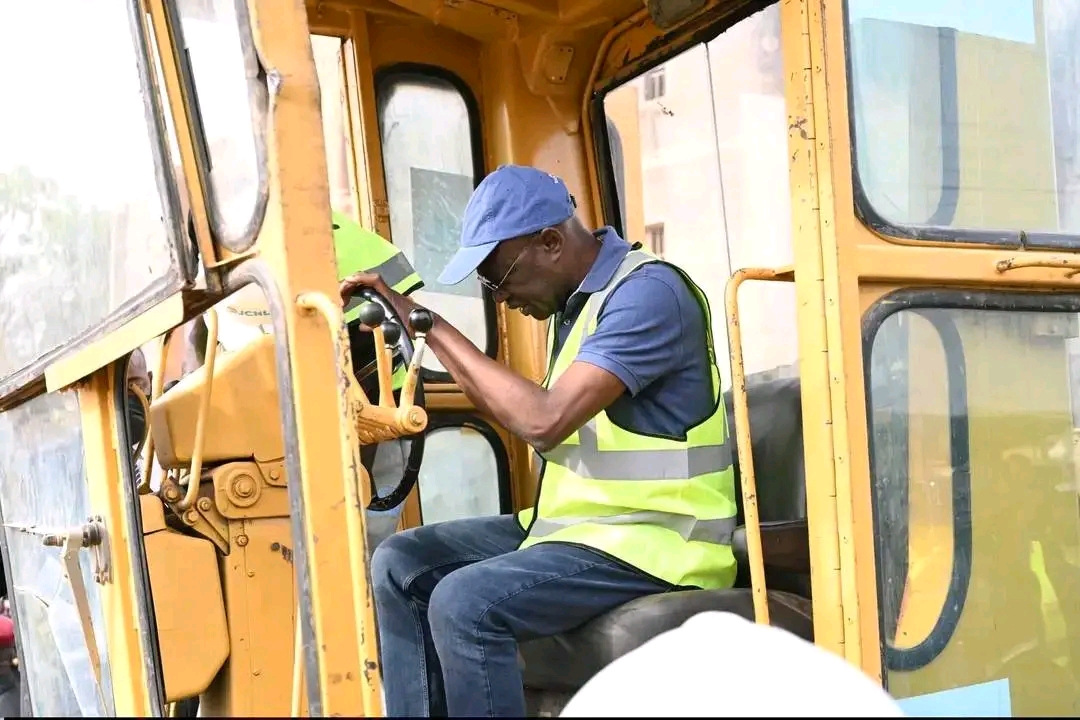
By: Aondoakaa Tersugh Daniel | 10/06/2026
There are moments in a nation’s legal history that pass without the public fully grasping how close the edge was. Nigeria stood at one such edge, staring down an $11 billion liability that could have triggered a financial catastrophe of generational proportions. That it did not happen is not accidental. It is, in very large part, the story of one lawyer, one former Attorney General of the Federation, who refused to let Nigeria be robbed in a suit and tie.
The case in question is the P&ID dispute, arguably the most dangerous legal and financial threat Nigeria has faced in its post-independence history. Process and Industrial Developments Limited, a company floated by two Irish businessmen, anchored its claim on a Gas Supply and Processing Agreement signed in 2010. The terms were straightforward on paper: Nigeria would supply wet gas, P&ID would build and operate a processing plant in Calabar, Cross River State. Nigeria allegedly failed to supply the gas. But there was no site to make the supply in the first place, because no construction had been done anywhere in Calabar for such purposes. P&ID went to arbitration, won, and the award ballooned from approximately $6.6 billion to nearly $11 billion with accumulated interest. For context, that figure at the time represented a significant fraction of Nigeria’s foreign reserves. A judgment of that magnitude, enforced against Nigerian assets abroad, would have been a national catastrophe.
Chief Michael Kaase Aondoakaa SAN was Attorney General of the Federation when that agreement was allegedly signed in 2010 under the late President Umaru Musa Yar’Adua. When the crisis matured into a full legal emergency years later, he stepped forward and made the argument that unravelled the entire arrangement. His position was precise and prosecutorial: the contract was never subjected to Federal Executive Council approval as required by law, the deal bore the fingerprints of fraud from inception, and a coalition of Nigerian officials and foreign actors had conspired to engineer a liability that the Nigerian people would be made to pay. The office of the Attorney General and Ministry of Justice was not consulted on the contract. Neither was the Infrastructure Regulatory Commission. That argument gave Nigeria the legal and moral ground to fight back. It is on record that his intervention was central to turning the tide of a case that had appeared already lost. It was a case of fraud. Aondoakaa was drafted into the legal team to defend Nigeria. Nigeria won.
That history is not being recalled here for sentiment. It is being recalled because it is directly relevant to what is happening in Benue State today under the Alia administration.
The questions surrounding how contracts have been awarded under Governor Hyacinth Iormen Alia, why projects sit stalled at mobilisation stage, why garnishee orders are freezing state accounts, and why a N68 billion road looks more like an excavation exhibition than a construction site, all of these questions bear an uncomfortable structural resemblance to the P&ID anatomy. Inflated figures. Questionable approvals. Mobilisation paid, work abandoned. The public left staring at broken earth. It is alleged that some of these contracts have been padded by as much as 140% above their legitimate value. If that allegation has any substance, it means Benue State is carrying a fiscal weight that was artificially manufactured to benefit a few people at the top of the food chain.
And it does not stop at the major contracts. It is also alleged that the Governor has directed council chairmen across all 23 local government areas of Benue State to award N5 billion road contracts covering five kilometres in each area, at a flat rate of N1 billion per kilometre. That flat rate is applied uniformly without any regard to the varying soil types and topographic conditions across these 23 local government areas, factors that any competent engineer or quantity surveyor would insist must reasonably and necessarily affect cost from one location to another. A road through the hilly terrain of one local government area does not cost the same as a road across the flatter landscapes of another. When a government ignores that basic reality and fixes a uniform price across the entire state, the question is not whether padding exists. The question is how much and who is collecting it. Across 23 local government areas, a flat and unjustifiable rate of N1 billion per kilometre has the potential to manufacture billions in artificial expenditure, all of it traceable to a single directive from the top.
There is approximately one year left in the Alia administration. That window may not be enough to complete what has been deliberately left incomplete. Any contractor banking on the continuation of the current arrangement to escape scrutiny should now begin to think differently. When Chief Michael Kaase Aondoakaa SAN becomes Governor of Benue State, he will not be arriving as a newcomer to the business of unravelling fraudulent contracts. He arrives as a man who has already done it at the level of an $11 billion international arbitration dispute. He saved Nigeria from that exposure. The question that should now keep contractors and their accomplices awake at night is this: what would he do to a local contract padded at 140% in a state he is coming to govern?
The answer is not difficult to find. An Aondoakaa administration would conduct a full reevaluation of every contract awarded under the current dispensation. Projects found uncompleted would face fresh scrutiny on their terms, their award processes, and their payment histories. Projects completed but with outstanding payment claims would be examined against their original contract sums and the going market rates for similar work. Where padding is established, the demand would not be for sympathy. It would be for refunds.
Contractors who chose to participate in a system where mobilisation funds were allegedly siphoned before work could begin are not entirely blameless actors. They signed contracts. They collected funds. They broke ground to create the appearance of work, and then they stopped. A state that has had its accounts frozen by garnishee orders because of those arrangements deserves a government that will trace every naira back to its source and account for where it went.
It should be clearly understood that money has DNA and its end users can be traced. This is where the Tiv adage finds full expression: when you pull the tail, the head comes along. Alia is setting himself up for what many may be persuaded to call a witch-hunt when his four years are over, but the questionable contracts are a problem the masses are not seeing now. Those who are potential accomplices should take note. When the time of reckoning comes, the office of the Attorney General of the state would be dragged into it. The procurement office would be dragged into it. All contractors would be dragged into it. All local government chairmen would be dragged into it. At the end, Alia himself would be brought to question. Make no mistake, Alia already has a place in the prison and is only waiting for the time the pronouncement would come. The case of Suswam is far more tolerable than what Alia is currently doing.
Chief Aondoakaa rebuilt his national reputation on exactly that kind of reckoning. Benue is a smaller theatre but the stakes for its people are no less real. The man who defended a nation against an $11 billion fraud is more than equipped to defend a state against its own internal version of the same disease.
The P&ID case taught Nigeria that fraudulent contracts, no matter how cleverly dressed in legal language, can be unwound when the right person is willing to stand up and pull the thread. Benue’s contracts are waiting for that same hand. It is coming.
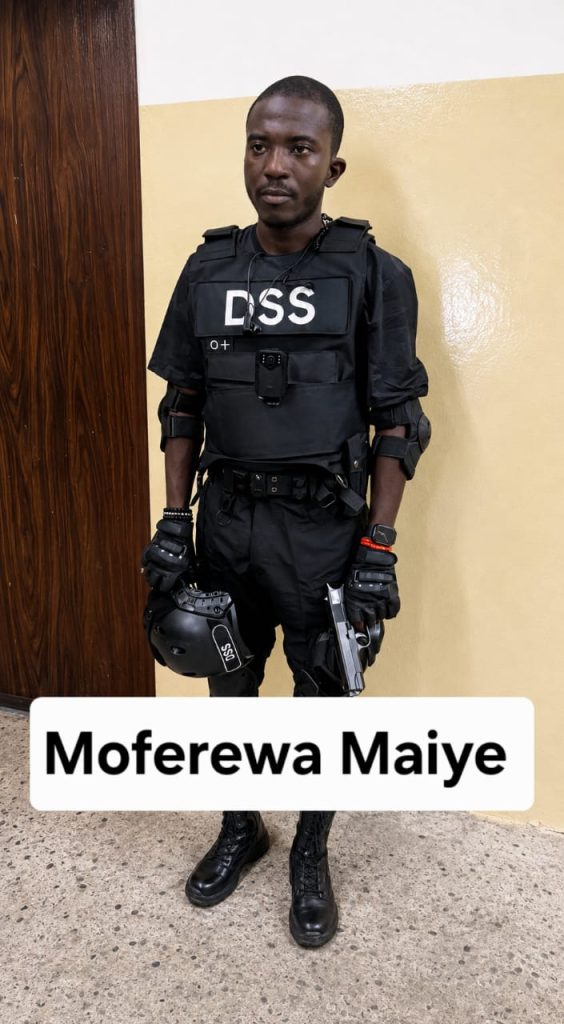
*Arrested in tactical uniform, with fake pistol, allegedly extorting motorists
The Department of State Services (DSS) late on Wednesday in Abuja arrested a man identified as Moferewa Maiye, discovered to be impersonating a personnel of the Service.
Maiye, who claimed to hail from Agbajojun Village, Mopamuro Local Government Area of Kogi State, was trailed and arrested by DSS officers in his hideout around the NITEL Junction, along Adetokunbo Ademola Way, Wuse II, Abuja.
At the time of his arrest, Maiye was in DSS tactical uniform and armed with a fake pistol.
According to a security source, the Secret police acted on credible intelligence that Maiye was using the uniform and the fake weapon to intimidate commuters and motorists, extorting money from them.
During interrogation, added the source, the suspect reportedly claimed that his brother was a DSS personnel who died years ago.
He identified the brother as Monday Maiye, stressing that the DSS kit in his possession was his late brother’s.
The suspect is currently being interrogated as security operatives, the source stated, adding that the Service was investigating how he came about the DSS uniform and kit.
“Investigators are also trying to establish how long the suspect has been involved in similar acts of impersonation and extortion.
“The arrest underscores growing concerns by the Service over the activities of individuals who impersonate security personnel to intimidate members of the public and commit criminality,” the source declared.
News
24 Bandits Killed As Army, DSS, Vigilantes Foil Mass Kidnap in Katsina Community, Rescue Victims

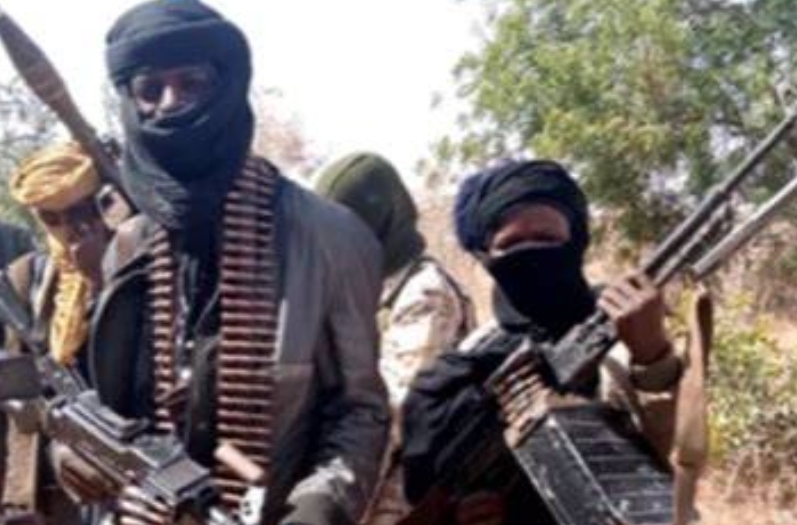
At least 24 bandits were killed on Tuesday after soldiers of the Nigerian Army, operatives of the Department of State Services (DSS), Katsina Community Watch Corps foiled an attempt to mass-kidnap persons in Gidan Bawa village, Kandarawa Ward, Bakori Local Government Area of the state.
According to a security source, the operation followed sustained intelligence which uncovered plans by about 40 gunmen loyal to notorious bandit kingpin, Isiya Kwashen Garwa, to invade the village and abduct many residents, especially women and children.
The plot, sources said, was intended to replicate the mass abduction of residents of Woro community in Kwara State, ostensibly to embarrass the government.
Acting swiftly on the intelligence, DSS operatives mobilised the Community Watch Corps, and the Civilian Joint Task Force (CJTF) from Guga camp, and ambushed the bandits.
The source disclosed that the joint security operatives neutralised 24 bandits and rescued the abducted villagers.
Security operatives also recovered 19 stolen cattle from the community during the raid.
The source added that there were ongoing efforts to track down the fleeing bandits.

…Says 25% of budget spent on education in three years
…Says Ashiru needs lesson in education funding
By Achadu Gabriel, Kaduna
The Kaduna State Government has faulted African Democratic Congress (ADC) governorship candidate Alhaji Isa Mohammed Ashiru over his criticism of Governor Uba Sani’s commitment to education, insisting the state has consistently surpassed global funding benchmarks.
Commissioner for Information and Culture, Malam Ahmed Maiyaki, said in a statement on Wednesday that while Ashiru is entitled to criticise, his claims on education funding were inaccurate.
“Mr. Ashiru is entitled to criticise the government. But when an aspirant to the highest office in the state gets basic facts about education funding wrongly, a little lesson becomes necessary,” he said.
Maiyaki faulted Ashiru’s claim that UNESCO recommends 15 to 20 per cent budgetary allocation to education. He explained that the Education 2030 Framework for Action recommends at least 4 to 6 per cent of Gross Domestic Product (GDP) or 25 per cent of total public expenditure.
According to the commissioner, Kaduna State allocated 25 per cent of its budget to education in 2024, 26.14 per cent in 2025, and another 25 per cent of its N985.9 billion 2026 budget, amounting to about N246.5 billion.
“For three consecutive years, therefore, Governor Uba Sani has committed about one-quarter of Kaduna State’s annual budget to education,” Maiyaki disclosed.
Investment yields results
The commissioner said the investment has yielded results across basic, tertiary and skills education. He noted that the National Board for Technical Education recognised the three Skills Development and Vocational Training Centres established by the governor as the best-equipped in Nigeria.
Maiyaki added that out-of-school children in the state dropped from over 550,000 to 187,719 within three years through enrolment drives and infrastructure upgrades. “The Federal Government has also drawn from the Kaduna model” for national interventions, he said.
KASU interventions
On Kaduna State University (KASU), Maiyaki listed interventions including over N800 million for staff welfare, N146 million for withheld salaries and SIWES obligations, and a N50 million monthly standing intervention.
The government also provided more than N200 million in overhead support in 2026 alone, and over N300 million for accreditation of 57 academic programmes and resource verification for 60 postgraduate programmes. These, he said, led to full accreditation of seven professional programmes and the university’s Digital Learning Centre.
Maiyaki further disclosed that more than N1.6 billion has been committed to scholarships and student support, alongside a 50 per cent reduction in tuition fees across state-owned tertiary institutions.
“These interventions are hardly the actions of a government that is ‘lukewarm’ towards education,” the statement added.
Challenge on professor resignations
On allegations that about 200 professors resigned from KASU due to poor conditions, the commissioner challenged critics to provide names, dates and reasons.
“Repetition does not turn an unverified allegation into fact,” he said.
Maiyaki also acknowledged ASUU-KASU’s role in advocating for members and said the administration remains committed to constructive engagement. However, he noted that domesticating Federal Government-ASUU agreements in state universities requires “serious legal, financial and institutional consideration, not political grandstanding.”

DSS Trails, Nabs Man Impersonating Personnel in Abuja
24 Bandits Killed As Army, DSS, Vigilantes Foil Mass Kidnap in Katsina Community, Rescue Victims
KADSG Faults ADC Guber Candidate’s Criticism, Defends Sani’s Education Funding Records
-
 News14 hours ago
BUDGET OFFICE OF THE FEDERATIONRESPONSE TO THE 2026 U.S. DEPARTMENT OF STATE FISCAL TRANSPARENCY REPORT ON NIGERIA
-
 News16 hours ago
Beyond the ECOWAS–AES Divide: Rethinking Regional Cooperation, Peace and Security in West Africa
-
 Crime13 hours ago
NDLEA Arrests Alleged Cocaine Trafficking Kingpin at Lagos Airport
-
 News17 hours ago
Tinubu Committed to Transforming Nigeria’s Electricity Sector, Says Power Minister
-
 News17 hours ago
Mangu Killings: ADC Governorship Candidate Calls for Immediate Security Action
-
 News17 hours ago
Tinubu Urges Politicians to Avoid Divisive Politics Ahead of 2027 Elections
-
 News17 hours ago
Delta to Train 1,000 Youths in Agribusiness to Boost Agriculture
-
 News17 hours ago
24 Killed, Three Injured in Fresh Attack on Plateau Community
You must be logged in to post a comment Login