
News
Zulum Raises Concerns Over Management of Federal College of Education Gwoza

By Achadu Gabriel, Kaduna
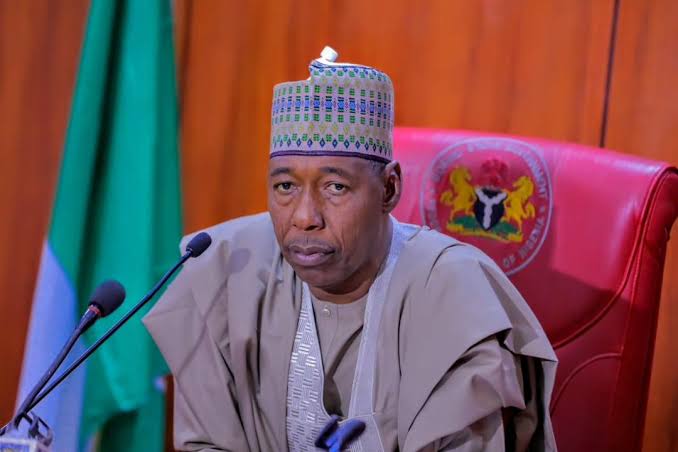
Borno State Governor, Professor Babagana Umara Zulum, has expressed concern over the management of the Federal College of Education (FCE), Gwoza, saying the institution has yet to commence full academic activities despite significant support from the state government.
In a statement issued by his media aide, Abdulrahman Bundi, Governor Zulum said the Borno State Government had provided more than ₦200 million as a take-off grant and completed extensive rehabilitation of the college’s facilities.
According to the governor, the institution, formerly owned by the Borno State Government, has been upgraded with more than 100 renovated classrooms, modern laboratories, administrative offices and staff quarters. The state also constructed a housing estate with 12 two-bedroom units and additional accommodation for academic staff.
Zulum said he was disappointed by what he described as the slow pace of preparations for the commencement of academic programmes. “I am not happy because this college was established about three years ago, yet there has not been sufficient progress towards making it fully operational,” the governor said.
He added that the state government would forward its observations to the Federal Ministry of Education for consideration, including recommendations on measures to facilitate the commencement of academic activities.The governor reaffirmed the state’s commitment to supporting the institution and said the government would continue to work with relevant authorities to ensure the college becomes fully operational.The management of the Federal College of Education, Gwoza, had not publicly responded to the governor’s remarks at the time of publication.


News
BUDGET OFFICE OF THE FEDERATIONRESPONSE TO THE 2026 U.S. DEPARTMENT OF STATE FISCAL TRANSPARENCY REPORT ON NIGERIA

- Introduction
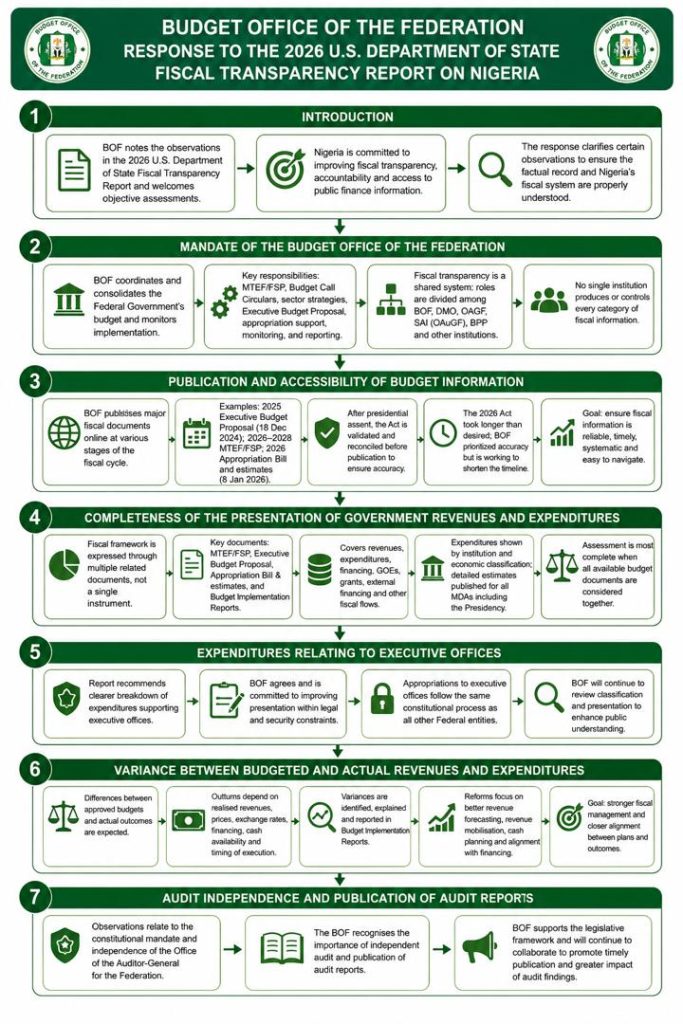
The Budget Office of the Federation (BOF) notes the observations on Nigeria contained in the 2026 Fiscal Transparency Report of the United States Department of State. The Federal Government welcomes objective assessments of its public financial management system and remains committed to the continuous improvement of fiscal transparency, accountability and access to public finance information.
The Report acknowledges important areas in which Nigeria meets fiscal transparency requirements, including the public availability of the enacted budget and end-of-year fiscal information; the disclosure of debt obligations, including major state-owned enterprise debt; the legal and disclosure framework governing the sovereign wealth fund; and the existence and application of statutory procedures governing natural-resource extraction contracts and licences.
Other observations in the Report require clarification when considered in the context of Nigeria’s institutional allocation of responsibilities and the range of budgetary and fiscal information already in the public domain. The purpose of this response is therefore not to dispute the value of external scrutiny, but to ensure that the factual record and the structure of Nigeria’s fiscal system are properly understood. - Mandate of the Budget Office of the Federation
The BOF is responsible for coordinating the preparation and consolidation of the Federal Government’s budget, and for monitoring and reporting on its implementation within the framework established by law and government fiscal policy.
Its responsibilities include coordinating the preparation of the Medium-Term Expenditure Framework and Fiscal Strategy Paper (MTEF/FSP); issuing Budget Call Circulars; coordinating the preparation of Medium-Term Sector Strategies; coordinating the preparation and consolidation of the Executive Budget Proposal; supporting the appropriation process; monitoring budget implementation; and producing periodic Budget Implementation Reports.
These responsibilities form part of a wider public financial management system in which different institutions perform duties assigned to them by the Constitution and by statute. Debt recording and management fall principally within the remit of the Debt Management Office; government accounting, treasury and cash-management functions reside principally in the Office of the Accountant-General of the Federation; external audit is constitutionally assigned to the Office of the Auditor-General for the Federation; while federal procurement operates within the statutory framework administered by the Bureau of Public Procurement and individual procuring entities.
The observations in the Report are therefore best considered in the context of this institutional division of responsibility. Fiscal transparency is the product of an interconnected system; no single institution produces or controls every category of information on which an assessment of the entire system must depend. - Publication and Accessibility of Budget Information
The Report recommends that Nigeria make its Executive Budget Proposal widely and easily accessible to the public, including online. The BOF respectfully notes that the online publication of the Executive Budget Proposal and other major budget documents has, for several years, formed part of the Federal Government’s established budget process.
The BOF routinely publishes major documents produced at successive stages of the fiscal cycle. These include the MTEF/FSP, the Executive Budget Proposal and detailed estimates, Appropriation Acts, implementation guidelines, and periodic Budget Implementation Reports.
For example, the 2025 Executive Budget Proposal was published on the BOF website on 18 December 2024 alongside the 2025 Appropriation Bill. The 2026-2028 MTEF/FSP was similarly published, while the 2026 Appropriation Bill and its detailed estimates were placed on the BOF website on 8 January 2026.
The purpose of continuing reform, therefore, is not to create a practice of publication where none exists, but to make an established practice more timely, systematic and easier for users to navigate. Fiscal information is useful not merely because it exists, but because it is published at the appropriate time, clearly identified and readily connected to the other documents needed to understand the fiscal picture.
Following presidential assent to an Appropriation Act, the signed instrument is subjected to validation and line-by-line reconciliation against the version passed by the National Assembly before the final budget details are reflected on the Government’s financial management platform and released for public use. This process is intended to ensure that the figures, codes and statutory references placed before the public correspond with the instrument that has become law.
For the 2026 Appropriation Act, this process took longer than would ordinarily be desirable. The Budget Office considered it preferable to complete the necessary validation before publication rather than place in the public domain figures that might later require correction. That choice protected the integrity of the published record, but the delay also demonstrates the need to shorten the interval between presidential assent and public availability.
The lesson is therefore twofold: published fiscal information must be reliable, but that reliability must increasingly be achieved without sacrificing timeliness. The BOF is reviewing its internal sequencing, validation and publication arrangements with that objective in mind. - Completeness of the Presentation of Government Revenues and Expenditures
The Report recommends that the budget provide a substantially complete picture of government revenues and expenditures. Nigeria’s fiscal framework is expressed through several related documents rather than through a single instrument. The MTEF/FSP establishes the macroeconomic and fiscal assumptions underlying the annual budget. The Executive Budget Proposal, Appropriation Bill and detailed estimates set out proposed expenditure allocations, revenue assumptions and the financing framework. Budget Implementation Reports subsequently show performance against approved benchmarks.
Taken together, these documents contain extensive information on projected revenues, expenditure proposals, financing and the operations of Government-Owned Enterprises. The budget documentation also provides information on grants, external financing and other material fiscal flows within the Federal Government’s reporting framework.
Expenditure is presented through institutional and economic classifications, including allocations to ministries, departments and agencies. The Government also publishes detailed estimates relating to the Presidency and other institutions of government, subject always to the legitimate requirements of law, national security and operational confidentiality.
The BOF therefore considers that an assessment of Nigeria’s fiscal transparency is most complete when it examines the available budget documents as a body, rather than treating any one document as though it were intended to contain the entire fiscal account.
This does not remove the need for improvement. Citizens, investors and other users of fiscal information should be able to understand the broad relationship among revenue, expenditure, financing and fiscal risks without having to reconstruct the fiscal picture from numerous documents. The Office will therefore continue to improve consolidation, cross-referencing and presentation so that information already disclosed across different fiscal documents can be more readily understood as a coherent whole. - Expenditures Relating to Executive Offices
The Report recommends a clearer breakdown of expenditures supporting executive offices. The BOF agrees with the transparency objective underlying this recommendation.
Appropriations to offices and institutions within the Executive are subject to the same constitutional appropriation process that applies to other Federal Government entities. Detailed estimates are already published within the budget documentation. Where expenditures are currently aggregated within broader administrative, personnel or service-wide classifications, there remains scope to improve their presentation without compromising legitimate security, statutory or operational considerations.
The BOF will accordingly continue to examine the classification and presentation of such expenditures with a view to improving public understanding within the applicable legal and security framework. - Variance Between Budgeted and Actual Revenues and Expenditures
The Report observes that actual revenues and expenditures did not reasonably correspond with the enacted budget. The BOF considers that this observation would benefit from greater precision regarding the standard against which such correspondence is being assessed.
An appropriation is an authority to spend; it is not, in every circumstance, a guarantee that the entire amount appropriated will become available in cash. Actual fiscal outcomes depend on realised revenues, oil production and prices, tax collections, exchange rates, financing conditions, cash availability and the timing of expenditure execution. A difference between an approved budget and the eventual outturn must therefore be interpreted rather than merely observed.
The central transparency question is whether material deviations are identified, explained and reported. This is one of the purposes of the Budget Implementation Reports produced by the BOF, which compare revenue and expenditure performance against approved benchmarks and explain significant departures from the fiscal plan.
At the same time, persistent or unusually large differences between appropriations and outturns can weaken the usefulness of the budget as an instrument of economic management. The Government’s continuing reforms therefore place greater emphasis on realistic revenue forecasting, improved revenue mobilisation, stronger commitment controls, better cash planning and closer alignment between appropriations and available financing. - Audit Independence and Publication of Audit Reports
The observations concerning the independence of the Supreme Audit Institution and the publication of audit reports relate principally to the constitutional and statutory mandate of the Office of the Auditor-General for the Federation and to the wider legislative framework governing public audit.
The BOF supports a strong and independent external audit function as an essential component of fiscal accountability. It will continue to provide the budgetary and implementation information required within its mandate and to cooperate with the Office of the Auditor-General for the Federation and other oversight institutions.
Institutional or legislative questions concerning the independence, powers and publication obligations of the Supreme Audit Institution are, however, appropriately addressed in conjunction with the Office of the Auditor-General for the Federation, the National Assembly and other authorities responsible for the applicable legal framework. - Public Procurement Information
Federal procurement is governed by the Public Procurement Act and the institutional framework administered by the Bureau of Public Procurement, while procurement transactions are undertaken by individual procuring entities. The recommendation concerning the publication of accessible information on procurement contracts should therefore be addressed principally through that framework.
The BOF nevertheless recognises the close relationship among appropriation, procurement, commitment and payment. Greater interoperability among budget, procurement and treasury information systems would materially improve the public’s ability to follow expenditure from appropriation through procurement to eventual payment and delivery. The Office supports the continued development of such integrated public financial management arrangements. - Timeliness, Institutional Capacity and the Fiscal Responsibility Framework
Fiscal transparency should be treated as a continuing institutional obligation, not as an exercise undertaken solely in response to an external assessment. The experience of producing statutory fiscal reports has, however, brought into sharper focus a question that warrants attention beyond administrative improvement alone.
Fiscal reports are assembled from numerous sources across government. Their reliability depends on the timely submission of information, reconciliation among institutions, resolution of discrepancies and verification before publication. Where these processes repeatedly require more time than the statutory reporting period permits, the response should not simply be to normalise lateness.
Government must first improve the processes that can be improved: clearer responsibility for source data, earlier submission, greater automation, greater interoperability among systems and stricter reporting discipline.
However, where experience over time demonstrates that a statutory deadline no longer reasonably accommodates the number of institutions, datasets and verification steps required to produce a reliable report, there is also a legitimate case for reviewing the law itself.
The purpose of the Fiscal Responsibility Act is to strengthen fiscal discipline, accountability and transparency. Its reporting provisions should therefore impose deadlines that are demanding enough to compel administrative discipline, but sufficiently realistic to permit the publication of information whose accuracy can be defended.
The Federal Government should accordingly consider, through the appropriate legislative process, whether aspects of the reporting timetable under the Fiscal Responsibility Act require amendment in the light of experience since its enactment. Such a review should not weaken reporting obligations. Its purpose should be the opposite: to establish timelines that are credible, enforceable and capable of producing reports that are both timely and reliable. - Institutional Engagement and Continuing Improvement
The Fiscal Transparency Report can also serve as a basis for constructive technical engagement. The BOF considers it useful to deepen dialogue with the United States Government and other development partners on the methodology used in fiscal transparency assessments, particularly the treatment of multiple publicly available fiscal documents, the measurement of budget credibility, and the standards applied to timeliness and accessibility.
Such engagement should be approached as an opportunity for clarification and institutional learning rather than as a dispute over the assessment. The Office may also explore appropriate technical assistance arrangements to strengthen its capacity in fiscal reporting, information management, digital publication, interoperability and public accessibility. Any such cooperation should complement Nigeria’s own reforms and operate within the Government’s legal, institutional and information-security framework. - Conclusion
Nigeria accepts the principle at the heart of fiscal transparency: citizens and other stakeholders should be able, without unnecessary difficulty, to know what the Government intends to raise and spend, what the legislature has authorised, what was eventually received and spent, and how public resources were accounted for and audited.
Nigeria has already built a substantial architecture for making this information public. The question before us is therefore not whether disclosure exists, but how to make the existing system faster, clearer, more complete and easier to understand.
There are areas in which Government must improve its own processes. There are areas in which fiscal information already exists but must be assembled and presented more coherently. There are responsibilities that belong to institutions other than the Budget Office. There may also now be statutory reporting timelines whose continued practicality deserves examination in the light of experience.
A mature system should be able to acknowledge all four points without defensiveness.
The Budget Office therefore welcomes external assessments that assist Nigeria in strengthening its institutions. It also considers it important that such assessments take account of the full range of fiscal documents made publicly available and of the constitutional and statutory division of responsibilities among institutions.
The Federal Government remains committed to a budget system in which fiscal decisions are not only lawful and disciplined, but are also increasingly transparent, accessible, intelligible and capable of independent public scrutiny.
Tanimu Yakubu
Director-General
Budget Office of the Federation
Abuja
18 August 2026
News
Beyond the ECOWAS–AES Divide: Rethinking Regional Cooperation, Peace and Security in West Africa
By Salihu Abdulhamid
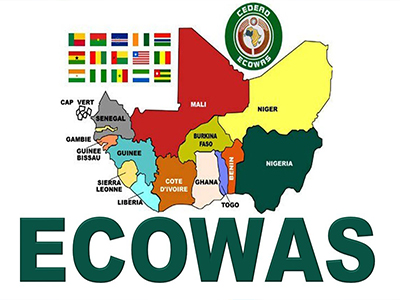
West Africa is undergoing significant political, economic and security changes, with the growing divide between the Economic Community of West African States (ECOWAS) and the Alliance of Sahel States (AES)—comprising Mali, Burkina Faso and Niger—raising questions about the future of regional integration and cooperation. The withdrawal of the three Sahelian countries from ECOWAS has added another layer to existing challenges in a region already affected by violent extremism, political instability, poverty, weak governance and humanitarian crises.
The emergence of the AES reflects the three countries’ desire for greater control over their political and security affairs. Their decision to strengthen defence cooperation and reduce reliance on external partners may reinforce their sense of political autonomy, but it also presents challenges for regional coordination. A major point of disagreement has been political governance. ECOWAS has traditionally defended constitutional democracy and opposed military takeovers.
Following coups in Mali, Burkina Faso and Niger, the bloc imposed sanctions and demanded a return to constitutional rule. The military-led governments, however, viewed some of the measures as undue pressure and interference. The resulting tensions have made dialogue more important, not less. ECOWAS faces the challenge of upholding democratic principles while maintaining diplomatic channels with the AES countries.
Security cooperation is another critical concern. Terrorism and violent extremism do not respect national borders, while arms trafficking, displacement and the movement of armed groups can affect neighbouring countries. Intelligence sharing, border management and humanitarian responses therefore require cooperation among states.The economic consequences are equally significant.
ECOWAS has facilitated the movement of people, goods and services across West Africa, supporting millions of livelihoods. Political disagreements that disrupt cross-border trade can consequently affect ordinary citizens.The current crisis also provides an opportunity to rethink regional integration. Cooperation should deliver tangible benefits in security, employment, trade, education and freedom of movement.
A sustainable regional security strategy must also address the underlying drivers of instability, including poverty, unemployment, weak institutions, political exclusion and inadequate public services. Military responses alone are unlikely to provide lasting solutions.
The ECOWAS–AES divide should not become a permanent fracture in West Africa. Despite political differences, the region remains connected by geography, history, trade, communities and shared security challenges.
Rebuilding trust will require sustained dialogue, diplomacy and practical cooperation where common interests exist. West Africa’s security and development challenges ultimately require regional solutions.
Salihu Abdulhamid holds a BSc in International Relations from Bayero University Kano and is a Corps Member serving with the Institute for Peace and Conflict Resolution (IPCR), Abuja. He can be reached at salihuabdulhamid11@yahoo.com
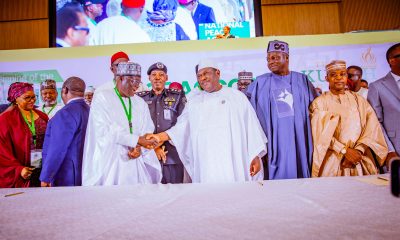
By Francis Wilfred
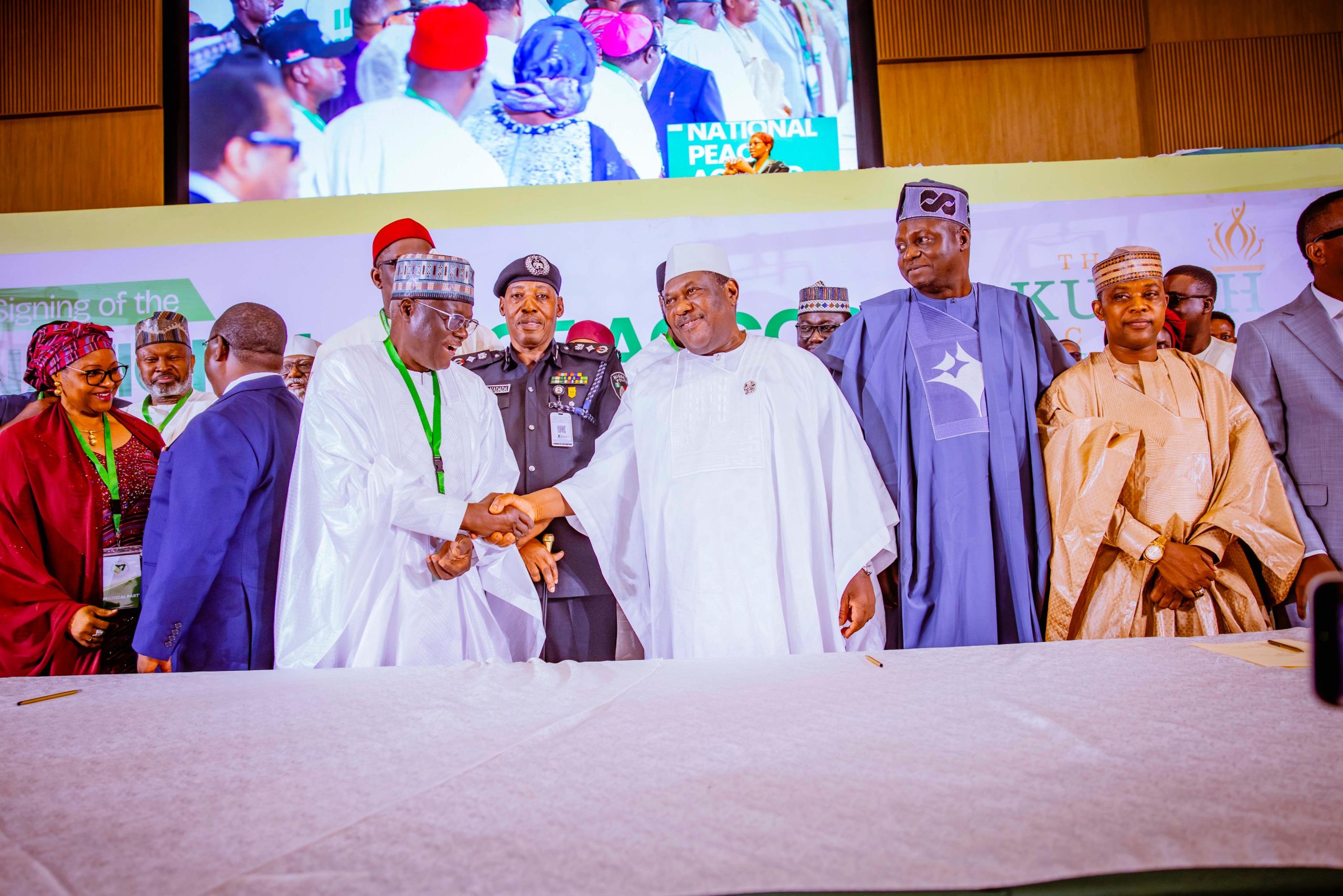
President Bola Ahmed Tinubu has urged political parties, candidates and their supporters to avoid ethnic, religious and other divisive sentiments as Nigeria prepares for the 2027 general elections.
Tinubu made the call on Tuesday in Abuja during the signing of the Peace Accord ahead of the 2027 presidential election. He was represented at the event by the Secretary to the Government of the Federation, Senator George Akume.
According to a statement by Yomi Odunuga, the President said political competition was a legitimate part of democracy but should not undermine national unity or social cohesion. He urged political actors to focus their campaigns on ideas, policies and programmes capable of improving the lives of Nigerians and advancing national development.
Tinubu also reaffirmed his commitment, and that of the All Progressives Congress (APC), to the Peace Accord, saying the party would conduct its campaigns peacefully and transparently. He condemned violence, hate speech, misinformation and incitement, including the misuse of artificial intelligence and social media to manipulate public opinion or heighten tensions.
The President commended the National Peace Committee, led by former Head of State General Abdulsalami Abubakar, for its role in promoting peaceful elections.He expressed confidence that adherence to the accord would support peaceful campaigns, credible elections and continued democratic progress.


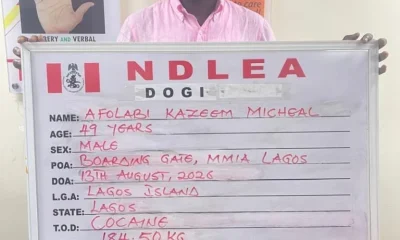
NDLEA Arrests Alleged Cocaine Trafficking Kingpin at Lagos Airport

APC Sets August 22 for Legislative Primary Elections

BUDGET OFFICE OF THE FEDERATIONRESPONSE TO THE 2026 U.S. DEPARTMENT OF STATE FISCAL TRANSPARENCY REPORT ON NIGERIA
-

 News23 hours ago
NITAD: Nigeria Risks Losing Workforce Without Investment in Local Talent
-
News24 hours ago
36,477 Women Benefit from IOM/GIFA Medical Outreach in A’Ibom
-
 News7 hours ago
BUDGET OFFICE OF THE FEDERATIONRESPONSE TO THE 2026 U.S. DEPARTMENT OF STATE FISCAL TRANSPARENCY REPORT ON NIGERIA
-
 News10 hours ago
Beyond the ECOWAS–AES Divide: Rethinking Regional Cooperation, Peace and Security in West Africa
-

 News10 hours ago
Tinubu Committed to Transforming Nigeria’s Electricity Sector, Says Power Minister
-

 News10 hours ago
Mangu Killings: ADC Governorship Candidate Calls for Immediate Security Action
-
 Crime6 hours ago
NDLEA Arrests Alleged Cocaine Trafficking Kingpin at Lagos Airport
-
 News10 hours ago
Tinubu Urges Politicians to Avoid Divisive Politics Ahead of 2027 Elections
You must be logged in to post a comment Login