
By Prof Sheriff Ghali Ibrahim
A rationalist idea of an observatory international system by any entity is the wisdom of peaceful co-existence and avoidance of war. A country like China is only interested in building national, regional and international peace. This, as an ideology has not made China fight wars or invade nations for its self-gratification or expansionist strategy. The question of Taiwan is clear and the world has come to internalise where it belongs, which is part of the territorial prerogative of China with the reality that Taiwan has been part of China and is still part of China. This has been acknowledged by the United Nations Organization and the United States.
The cuncurrent international realities justify the danger of overdepending on the United States, which if critically viewed, can be described as ‘Military Imperialism’ used in ensuring perpetual domination of the world through geopolitical strategy and constant unipolarization of the international system. This trend is naturally changing and the world is gradually accepting the reality that the United States cannot continue to impose on the world its ideals in this era of multilateralism and growing quest for peace.
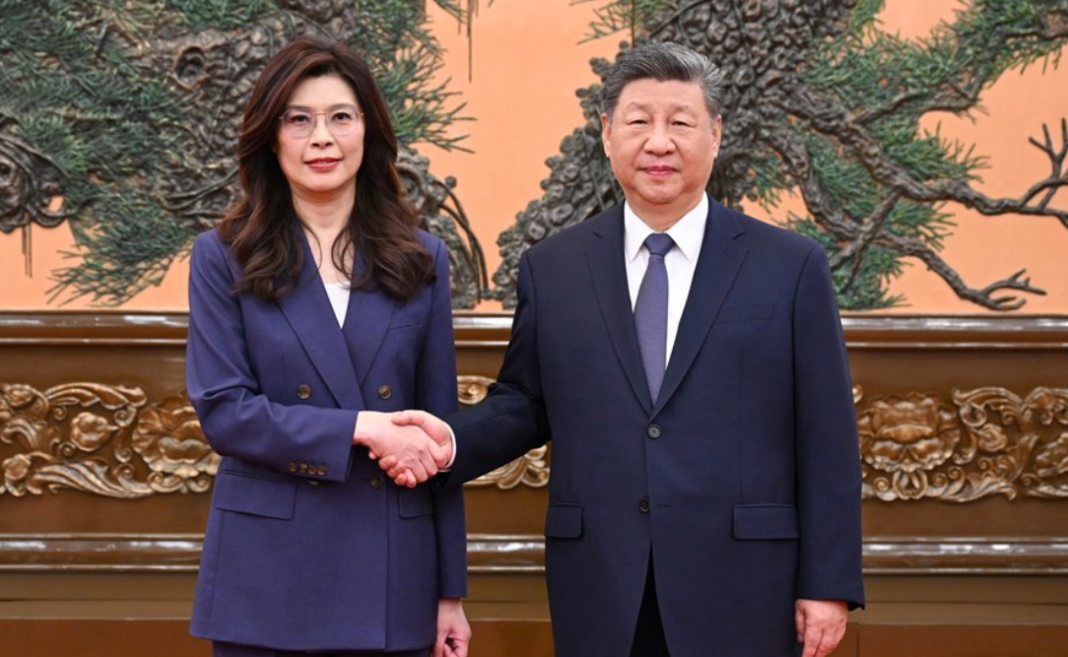
The Kuomingtan leader Cheng Li Wun of Taiwan, can be described as a rationalist leader, an intelligent and humanist leader for her resilient and fearless reunificationist diplomatic journey that she took to China, in a bid to re-ignite the reunificationist dream of both China and Taiwan, against the seperatist vision of continuous cecession. It is in line with this that Cheng Li called her journey to Beijing as a journey of peace, and argued that “through the unremitting efforts of our two parties, we hope the Taiwan Strait will no longer become a potential flashpoint of conflict, nor a chessboard for external powers…it should become a strait that connects family ties, civilisation and hope – a symbol of peace jointly safeguarded by Chinese people on both sides.”
In Taiwan-China reunificationist diplomacy, President Xi has identified some key elements of why such reunification is inevitable. One major factor is that, Taiwan and China share history and culture and “people of all ethnic groups, including Taiwanese compatriots,” had “jointly written the glorious history of China.” According to President Xi, “All sons and daughters of China share the same Chinese roots and the same Chinese spirit. This originates from blood ties and is deeply embedded in our history – it cannot be forgotten and cannot be erased.”
The second most important element of reunificationist diplomacy is avoidance of external meddlers. Both leaders said they oppose “foreign meddling” in Taiwan-China relations, where the United States has continued to gravitate Taiwan into massive military and defence build-up presumably to contain China’s influence. In this journey of peace, Cheng Li posited that, “what should fly in the sky are birds, not missiles; what should swim in the water are fish, not warships.” what she in inferred in her journey of peace regarding China and Taiwan is that, “we may not have been able to give our ancestors peace, but we can certainly still give peace to the people of today and the people of the future.”
President Xi has recognized the fact that “transformation unseen in a century is accelerating across the world,” especially with patience, resilience and tenacity, where we see the United States crumbling to dust by its own self-desctruction, where rational-thinking people see it clearly that it should no longer determine the faith of the world, human relations, alliances and or global economic development. It was to this effect that President Xi concluded in his thought on reunificationist diplomacy that, “no matter how the international landscape, and the situation across the Taiwan Strait may evolve, the overall direction of human development and progress will not change. The overarching trend towards the great rejuvenation of the Chinese nation will not change, and the prevailing moment for the Chinese on both sides of the strait to come together will not change. This is historical inevitability, and we are fully confident about it.”
In conclusion, reunificationist diplomacy is a driver to final integration between the ‘Main-Land’ and the Taiwan Strait, which the peace-loving people of the world wish to see happen soon. It can be described as a drive to prosperity, national rejuvenation and ultimately the Chinese dream of “One Country, Two Systems.”
Professor Sheriff Ghali Ibrahim is Provost, Anti-Corruption Academy of Nigeria and Head of Contemporary China-Africa Research.