
By Prof Sheriff Ghali Ibrahim
It is a diplomatic mantra and a slogan of Nigeria’s foreign policy posture, to see Africa as a point of depaerture since 1960’s. This was summoned by the impediments of the attainment of nationhood, sovereignty and self-governance which most African territories cherished but lacked, due to colonial rule and imperialist conquest.
Nigeria adopted this foreign policy posture to aid African countries first get independence, free them from mutual, regional and political conflicts that if not checked, could have devastated the entire continent and made Nigeria gullible. To this effect, Nigeria adopted the foreign policy of Africanness, peace, unity and good neighborliness.
It is from the general principles of China’s foreign policy that mutual respect for each other’s territorial integrity and sovereignty, mutual non aggression, mutual non-interference in each other’s internal affairs, equality and co-operation for mutual benefit are adopted. In this, China does not discriminate, but applies to the general framework of its diplomatice engagement.
It is imperative to note that, Africa only enjoys these foreign policy principles from China and other sister states in international relations. The American leaders do not pay such respect to Africa, European leaders, their constitutions and foreign policies do not treat Africa same way the Chinese foreign policy does. This suffices a commentary to be enveloped by the fact that the annual first foreign visitation by a Chinese foreign Minister to the world, is to Africa. This is the 36th consecutive year Africa serves as the first overseas destination for China’s Foreign Minister.
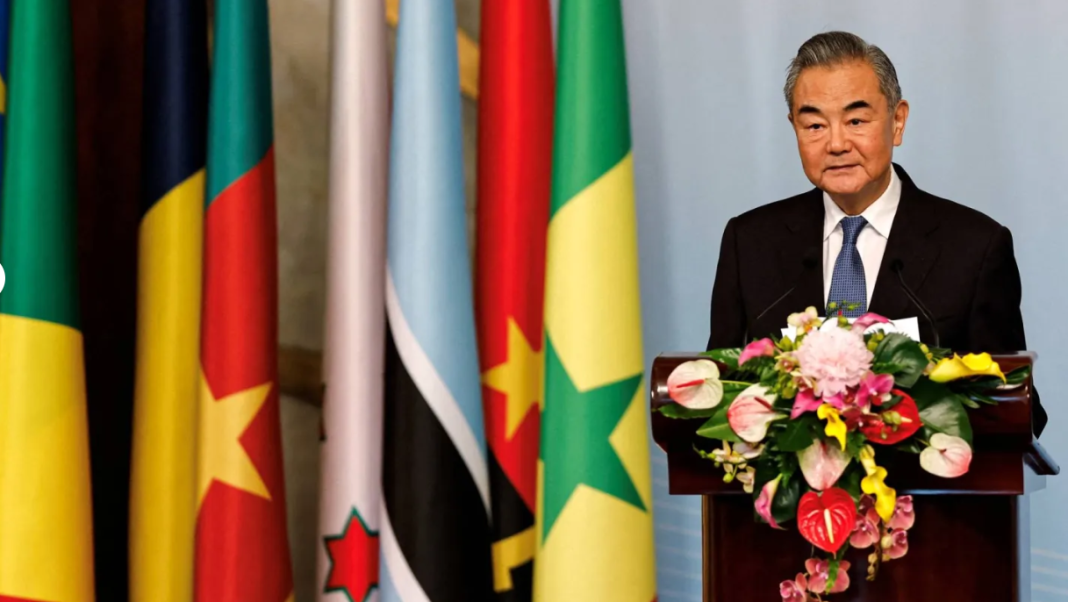
It is ideal to recollect Wang Yi’s visit to Nigeria on 9th January, 2025, where the following events unfolded: first, the bilateral relationship was elevated to a comprehensive strategic partnership. Second, a new platform for solidarity and cooperation has been established.
The successful convening of the first plenary session of the China-Nigeria Intergovernmental Committee has upgraded and synergized bilateral cooperation. Third, international collaboration has reached new heights. The two sides have closely coordinated on international and regional affairs, working together to advance the collective rise and development revitalization of the “Global South”.
It is practical to reemphasise China’s Foreign Policy posture as it relates to Africa. Wang Yi noted, in his visit to Nigeria in 2025 that over half a century since establishing diplomatic ties, China and Nigeria have consistently deepened friendship and practical cooperation based on “mutual respect” and “equality,” regardless of changes in the international landscape.
The relationship stands as a successful model of South-South cooperation and a benchmark for China-Africa collaboration. Issues have been discussed on clean energy, critical minerals, finance, and other emerging fields. China and Nigeria have also agreed to expand the “comprehensive dimension” to promoting coordinated development across trade, agriculture, culture, defense, technology, space, and more.
It is being reported between January 7 to 12, 2025, the visit of Chinese Foreign Minister Wang Yi to Ethiopia, Somalia, Tanzania and Lesotho at the invitation of the respective governments. During the trip, Wang will also attend the China-Africa Year of People-to-People Exchanges launch ceremony at the headquarters of the African Union in Addis Ababa, Ethiopia. Since early 2025, Rwandan chili peppers, Ethiopian coffee beans, and Tanzanian cashews have gained wider markets in China.
This is supported by new trade measures from the FOCAC Coordinators’ Meeting, including fast-track customs clearance and mutual recognition of food safety standards. The true breakthrough lies beyond tariff elimination. China is actively encouraging enterprises to invest in agricultural processing zones across Africa, helping local producers capture more value, leveraging the Silk Road E-commerce to connect African small and medium-sized enterprises (SMEs) directly with Chinese consumers, and strengthening key digital infrastructure, including logistics and payment systems.
It is axiomatic that China-Africa relations transcend the boundaries of ordinary intercontinentalism, far beyond African relationship with any other state, any nation and any continent on earth. It defines the tenets of mutual benefits, mutual respect and win-win cooperation. Development cooperation defined by mutual assistance, inter-civilizational exchanges and envisaging shared future in an all-weather China-Africa relations. The Forum on China-Africa Cooperation (FOCAC) has canceled RMB10.9 billion of debts for 31 African countries, set up an African Human Resources Development Fund, trained nearly 7,000 African professionals and provided special funds to support and encourage investment by Chinese enterprises in African countries. The forum has signed 382 assistance agreements with African countries, trained 12,600 African professionals, provided zero-tariff treatment to exports from 28 least developed countries in Africa under 190 tariff items, gave 17 African countries the Approved Destination Status for Chinese tourists.
It is pertinent to recall that China doubled its assistance to Africa on the 2006 basis, provided African countries with US$3 billion in concessional loans and US$2 billion in preferential export buyer’s credit, established China-Africa Development Fund which invested more than US$500 million in 27 projects and cancelled 154 debts owed by 33 African countries. It succeeded in increasing the number of export items to China enjoying zero-tariff treatment from the least developed countries in Africa to 478, started the construction of six economic and trade cooperation zones in African countries, trained 15,000 personnel for African countries, built 96 schools, increased the number of Chinese government scholarships for African students to 4,000, sent 104 senior agro-technology experts to Africa, started the construction of 10 agro-technology demonstration center, built 28 new hospitals, opened 30 malaria prevention and treatment centers.
It is in a vivid record that China sent 1,200 medical workers and 300 Chinese youth volunteers to work in Africa, provided African countries with over US$10 billion in concessional loans and the China Development Bank, through its special loan for African SMEs, committed US$966 million for 38 African SME projects. China through the FOCAC mechanisms has cancelled debts owed by heavily indebted poor countries and the least developed countries in Africa having diplomatic relations with China due the end of 2009. All the least developed countries in Africa having diplomatic ties with China enjoyed zero-tariff treatment for 60% of their exports to China. China implemented 105 clean energy projects in Africa, built five new agro-technology demonstration centers, sent 50 agro-technology teams to African countries,
provided medical equipment, materials and medicines to 30 hospitals and 30 malaria prevention and treatment centers, built 19 new schools and provided supplies to 42 schools in Africa.
It is also embracing the fact China trained 24,000 professionals for Africa, including 1,500 headmasters and teachers, 3,000 agricultural experts and 3, 000 medical workers, offered 5,710 and 6,316 government scholarships in 2010 and 2011 respectively, implemented 88 China-Africa joint research and demonstration projects and hosted 42 African research personnel for post-doctoral studies in China under the China-Africa Science and Technology Partnership Program, carried out 28 projects by Chinese and African academic institutions, supported 14 international seminars in China and Africa, and sponsored 500 Chinese and African scholars for academic exchanges and visits under the framework of the China-Africa Joint Research and Exchange Program. China implemented the “African Talents Program” to train 30,000 personnel in various sectors for Africa, offering 18,000 government scholarships, building cultural and vocational skills training facilities in African countries, sending 1,500 medical personnel to Africa, carrying out the “Brightness Action” activities in Africa to provide free treatment for cataract patients as it has been doing, helping African countries enhance capacity building in meteorological infrastructure and forest protection and management.
It is satisfying to mention that, China has carried out more well-drilling and water supply projects in Africa to provide safe drinking water for the African people. It launched the “Initiative on China-Africa Cooperative Partnership for Peace and Security,” deepening cooperation with the AU and African countries in peace and security in Africa, providing financial support for the AU peace-keeping missions in Africa and the development of the African Standby Force, and training more AU peace-keepers and officials in peace and security affairs for Africa, among many other things.
It is generally believed that the future relations between China and Africa will be fruitful, prosperous and more promising. From 2026, China-Africa relations are fixated on further expansion. Wang Yi has pointed out that the two sides will mark the 70th anniversary of China-Africa diplomatic relations and the China-Africa Year of People-to-People Exchanges through joint events. The 18th FOCAC Senior Officials’ Meeting will also be held, accelerating the mid-term implementation of outcomes from the Beijing Summit. According to the Concept Paper of 2026 China-Africa Year of People-to-People Exchanges, China and Africa will carry out wide-ranging activities throughout the year, covering education, culture, tourism, publishing, sports, science and technology, people’s livelihoods and green development, pooling the strengths of youth, women, media and think tanks, and mobilizing resources at sub-national and non-governmental levels.
It is indispensable to recommend that China-Nigeria and China-Africa relations can be strengthened through: more commitments to mutual security, poverty reduction, litercacy, Africa’s industrial production, diversification of African economy, anti-corruption campaign, scientific and technological knowledge, digital economy, modernization and massive infrastructure build-up, improved living standards and improved export economy. These can be achieved through China-Africa cooperation, co-production and mutual assistance.
It is unequivocal to conclude that China-Africa coupling is unprecedented, historically cemented and gradually thriving. The outcome of such mutual relations is manifest and hinged on the shared future between the two significant partners.
Prof Ghali is the provost, Anti-Corruption Academy of Nigeria, and Head of Contemporary China-Africa Research in Nigeria.