

By Wang Jingyue, People’s Daily Overseas Edition
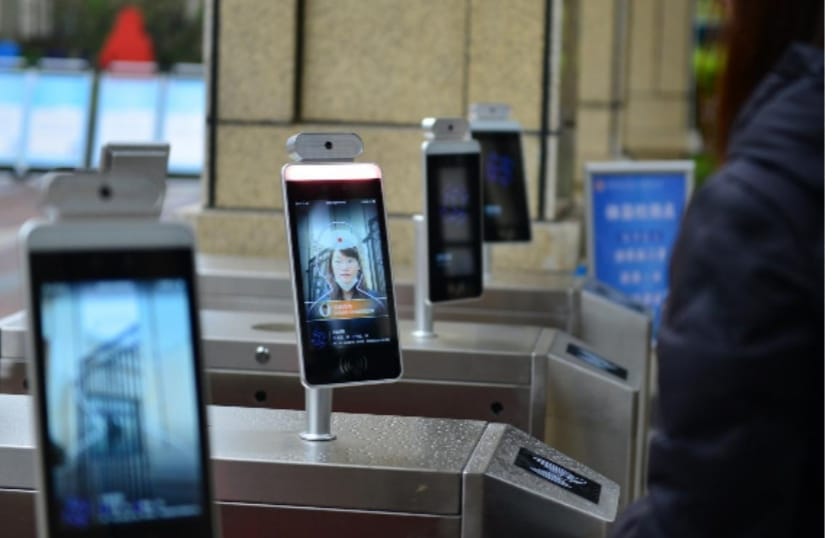
China has enhanced efforts to ensure data security in facial recognition as the technology has raised increasing concerns over users’ privacy and information leakage while being more and more widely used in Chinese people’s life and work, including such scenarios as unlocking mobile phones, verifying identity, and clocking in.
The procuratorate in Cixi city, east China’s Zhejiang province, recently received a tip-off that some real estate businesses installed cameras that support facial recognition at their sales offices to secretly capture and store the facial features of buyers without giving explicit indication of the information collecting behavior.
According to a survey report jointly released by China’s National Information Security Standardization Technical Committee and other institutions last October, more than 90 percent of the respondents have used facial recognition systems, and over 60 percent of them believe that the technology seems to become overused and is frequently faced with problems such as forced use and illegal collection of users’ information.
Experts pointed out that some people are vigilant against facial recognition because in the era of the Internet, they attach more importance to protecting their privacy like personal data, and compared with other biometric information, facial features can be more easily collected before people realize it.
Besides, unlike other personal data that can be easily changed, such as user name, mobile phone number and e-mail address, facial information is unique and can’t be changed. Once their face data is collected by companies, there’s no way consumers can know if these companies will guarantee long-term and secure data management and prevent illegal use of the data, explained experts.
Therefore, it is of great significance to use facial recognition systems properly and store safely people’s face data with their consent.
In fact, facial recognition has played a positive role in fields like public service. During the prevention and control of the COVID-19 epidemic, contactless facial recognition devices, which can accurately and efficiently identify people’s faces and take their temperature, have been widely applied in shopping malls, restaurants and office buildings, actively contributing to the containment of the virus.
With the development of facial recognition technology, some devices can effectively identify people even with their facial masks on. In a huge face database with 300,000 images, such devices can have an accuracy rate of as much as 90 percent in identifying people with their masks on, suggested a research report initiated by China National Information Technology Standardization Technical Committee and jointly compiled by many companies and organizations in December 2020.
Obviously, it is inadvisable to neglect the advantages of facial recognition and simply abandon the technology.
To ensure data security, the Legislative Affairs Commission of the Standing Committee of the National People’s Congress of China issued a draft law on personal information protection in October 2020, formulating provisions on the installation of facial recognition equipment in public places.
The draft law specified that image capturing and ID recognition equipment installed in public places should suit the need for safeguarding public security, comply with relevant regulations, and be accompanied by noticeable marks to remind users.
The images and personal information collected by the equipment can only be used for safeguarding public security and never be made public or available for other people, said the draft law.
Various areas of China have launched policies to regulate the collection of personal information via means including facial recognition.
In October last year, Hangzhou, east China’s Zhejiang province, revised its property management regulation, stipulating that property service providers are not allowed to force proprietors to use public facilities and devices and share their bio-information such as fingerprints and facial features.
North China’s Tianjin municipality implemented a social credit regulation on Jan. 1, which made Tianjin the first Chinese city to publicly ban the collection of facial recognition information.
Experts believe that as relevant laws, regulations and standards gradually improve, the application of facial recognition technology is expected to be brought under good control, and continue to play an active role on the premise that people’s privacy and personal data are kept safe.