
By Wang Zheng, People’s Daily
Recently, a video clip of a self-driving test for a vehicle backed by Huawei solution went viral on the internet. In the video, a car is cruising on the roads of Shanghai’s Pudong New District, switching lanes, turning and giving way to pedestrians without any intervention from the safety supervisor sitting in it.
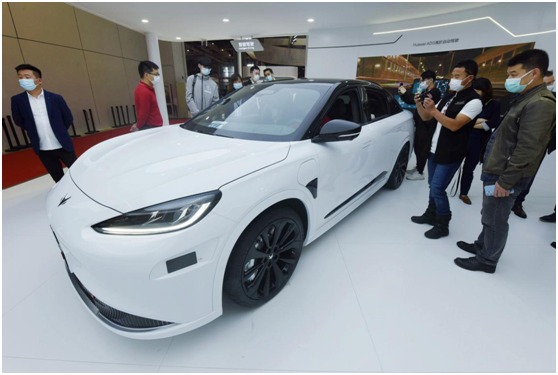
The vehicle is the Polar Fox Alpha S Huawei HI (Huawei Inside) Edition, which is equipped with Huawei’s autopilot system. It officially debuted on April 21, a few days ahead of the 19th Shanghai International Automobile Industry Exhibition (Auto Shanghai 2021). The model was ordered by over 1,000 customers in just four days after it hit the market.
At the Auto Shanghai 2021, smart electric vehicles were not exhibited in concept models. Almost all participating foreign and Chinese automakers have launched production smart vehicles at the event.
Given this trend, the sales volume of new energy vehicles (NEVs) in China might exceed two million, and even 2.5 million units, said an expert at the Auto Shanghai 2021.
According to the China Association of Automobile Manufacturers (CAAM), a total of 515,000 NEVs were sold in China in the first quarter of this year, including 433,000 pure electric vehicles, 2.8 times and 3.1 times of those from a year ago, respectively.
“The outstanding Q1 figure well explains that the Chinese electric vehicle industry has preliminarily transited from policy-driven to market-driven,” said Lei Xin, chief brand officer of Voyah, a premium electric vehicle brand launched by Chinese automaker Dongfeng Motor. This has laid a user base foundation for the development of smart electric vehicles, he added.
“It’s a vast blue ocean market,” said Yang Xiaodong, vice president of Chinese auto giant SAIC Motor and general manager of SAIC Motor’s passenger vehicle branch.
“Five to six million passenger vehicles priced between 200,000 yuan ($31,008) and 500,000 yuan are sold in China each year, most of which are traditional vehicles. Many of them will be gradually replaced by smart electric vehicles,” Yang said.
Apart from market acceptance, core technologies and maturity of industrial chain also have an influence over the development of smart vehicles.
“Augmented reality head-up display, laser radars, 4D millimeter wave radars and chips of more than 400TOPS were usually concepts. But now, they are in mass production,” Liu Changdong, executive president of Dongfeng Sokon Motor. Intelligent network technologies, such as smart voice control, smart cabin and driver-assistance systems have become standard option for smart electric vehicles.
As of the end of 2022, at least 30 models around the world will have been equipped with laser radars, half of which will be from China, said Hu Xiaobo, chairman of board and chief executive officer of Leishen Intelligent System, a global leading provider in LiDAR and application solutions based in Shenzhen, south China’s Guangdong province. The process is three years ahead of what was expected, he added. Along with the market expansion is a drop of laser radar price, which will hit $500 per unit or even lower, Hu noted.
“Emerging technologies in the auto industry, as well as the changes in the use of energy, are renewing auto technologies, and will also give rise to new models and new brands,” said Wang Jun, president of Changan Automobile.
According to him, the company will invest 150 billion yuan in building three major platforms for pure electric vehicles, and roll out 26 brand-new smart electric cars in the following five years.
Leading enterprises in consumer electronics, information communication, internet, and even real estate industries are now joining a new wave of auto making in China.
On March 30, Chinese multinational electronics company Xiaomi declared to invest $10 billion in the next 10 years to build a wholly-owned electric car brand. The firm will initially invest 10 billion yuan.
Prior to that, automaker Geely and tech giant Baidu also started cooperation to plough 50 billion yuan into producing smart cars over the next five years.
Huawei is working with Beijing Automotive Group Co., Ltd., Changan and Guangzhou Automobile Group Co., Ltd. to build three subsidiary brands with its “Huawei Inside” system.
Real estate titan Evergrande also started its automotive business. Investing 40 billion yuan and cooperating with 15 top designers, it has developed nine models, which were all exhibited at the Auto Shanghai 2021.
Policy support, industrial evolution, and users’ acceptance further reinforced the resolution and confidence of market players to join the sector, said Xia Yiping, chief executive officer of Jidu Auto, a joint venture between Geely and Baidu.