
…Over 700,000 children recieved Malaria
By Joyce Remi-Babayeju
The Federal Government has unveiled a new National Malaria Strategic Plan (2026–2030) aimed at reducing malaria prevalence and deaths in Nigeria by 50 per cent by year 2030.
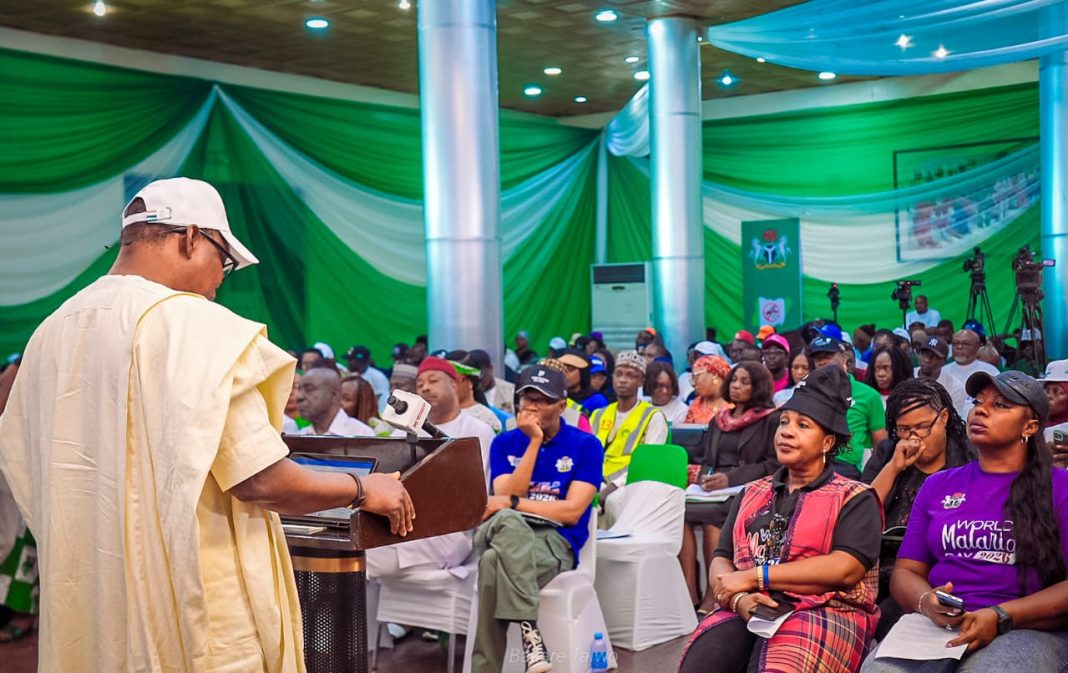
The Minister of State for Health and Social Welfare, Dr. Iziaq Adekunle Salako, disclosed this during the 2026 World Malaria Day commemoration in Abuja.
Dr. Salako said the new strategy aligns with the Renewed Hope Agenda of President Bola Ahmed Tinubu and is designed to strengthen Nigeria’s response to malaria through sub-national interventions in states and communities.
As part of the malaria intervention, the minister
disclosed that over 500 million insecticide-treated nets have been distributed nationwide since 2015, adding that distribution would be expanded this year to 11 states, including the Federal Capital Territory, Nasarawa, Kogi, Kwara, Bauchi, Borno, Abia, Adamawa, Kebbi, Akwa Ibom and Osun.
The Minister disclosed that over 500 million insecticide-treated nets have been distributed nationwide since 2015, adding that distribution would be expanded this year to 11 states, including the Federal Capital Territory, Nasarawa, Kogi, Kwara, Bauchi, Borno, Abia, Adamawa, Kebbi, Akwa Ibom and Osun.
Salako said the initiative demonstrates government’s commitment to protecting vulnerable groups, especially children and pregnant women.
The Minister also announced plans to pilot Larval Source Management in Abia, Borno, Ekiti, Lagos, Ondo and Rivers states as part of efforts to tackle mosquito breeding sites through environmental interventions.
However, him disclosed that malaria prevalence in Nigeria has declined significantly from 42 per cent in 2010 to 15 per cent in 2025, adding that government remains committed to completely eliminating the disease.
He explained that the 2026–2030 strategic plan is aligned with the National Health Sector Strategic Blueprint, the Sector-Wide Approach (SWAp), and the World Health Organization Global Technical Strategy.
Meanwhile, over 700,000 children between ages five and 23 months are already benefiting the malaria vaccination rollout in Kebbi and Bayelsa, Bauchi and Ondo states.
Salako acknowledged the support of development partners and stakeholders, stressing that malaria elimination requires a whole-of-society approach involving governments, health workers, civil society organisations, researchers, faith-based institutions, the private sector and the media.
Also speaking, Senator Nnaji Nwoko, representing Delta North Senatorial District, said that the National Assembly is working toward establishing an agency dedicated to mosquito and malaria elimination, noting that the proposed bill has passed several legislative stages.
The World Health Organization, represented by Dr. Mayer on behalf of Country Representative Dr. Parvel Ursa, said this year’s theme, “Driven to End Malaria: Now We Can, Now We Must,” reflects both urgency and hope that malaria elimination is achievable through sustained investment and leadership.
Earlier, Permanent Secretary of the health ministry, Daju Kachollom, represented by Dr. Kamil Shoretire, described malaria as a major threat to Nigeria’s health and economic productivity.
She therefore called for intensified collective action to end the disease as a public health burden in the country.
End