By Ji Fang, Sun Longfei, People’s Daily
China has achieved remarkable results in the construction of the venues for Beijing 2022 Winter Olympic and Paralympic Games, making incredible scientific and technological breakthroughs and innovations despite daunting challenges including a tight schedule, heavy tasks, strict requirements for professional expertise, and most importantly, impacts of the COVID-19 pandemic.
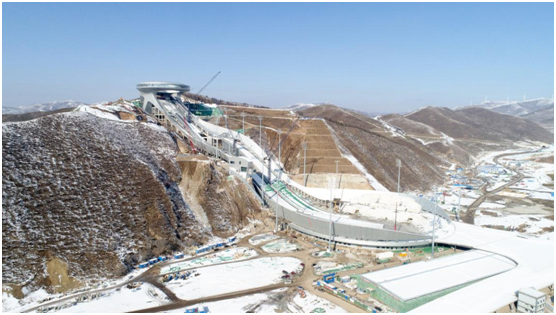
Within five years, the country turned Xiaohaituo Mountain in Yanqing district of Beijing from a barren mountain into an important site of venues for snow sports.
“The mountain had neither road nor access to electricity, water, or communication in the past,” recalled Liu Lifeng, director of the department of the construction of venues in Yanqing district under the Beijing Major Projects Construction Headquarters Office.
Today, the mountainis nicely decorated with seven meandering tracksof China’s National Alpine Skiing Center, a venue for the Beijing 2022 Olympic and Paralympic Winter Games.
At the bottom of the mountain, the 1.9-km-long track of the National Sliding Center, also a venue for the 2022 Winter Games,looks like a giant dragon lying still.
Liu felt a little worried when he was first assigned the construction tasks of venues for the Beijing 2022 Olympic and Paralympic Winter Games in Xiaohaituo Mountain, he said, disclosing that during the first half year of the surveyof the mountain, he and his colleagues needed climbing up and down the mountain for eight or nine hours every day.
It was by cutting down thistles and thorns that they opened roads in the mountain and finally drew planning maps for the construction work.
Liu is excited that the competition venues have been built successfully on the mountain roads he had walked along for so many times. “All the hard work over the years is all worth it,” he said.
As China’s top priority for hosting the Beijing 2022 Olympic and Paralympic Winter Games, the construction of competition venues has involved tens of thousands of builders, who have carried forward the hard-working spirit, raced against the clock, and overcomevarious difficulties, trying their best to implementin each link of the construction projects Chinese President Xi Jinping’s call for delivering an Olympics in 2022 with a “green, inclusive, open and clean” approach.
In the Yanqing competition zone and Zhangjiakou competition zone of the Beijing 2022 Olympic and Paralympic Winter Games, manymeteorological observationstations have been set up, with the forecast accuracybeing improved to minutelevel and 100-meter level.
In the Zhangjiakou competition zone, core areas for the event and major transportation facilities, such as the Beijing-Zhangjiakou intercity railway, have been effectively covered by 5G network.
Meeting the Olympic standards has been a consistent principle during the construction of various venues and supporting facilities, which have beencompleted one after another, helping provide stronger guarantee of high-quality services in such fields as transportation, medical care, power, and communications for the event.
Last year, the sudden COVID-19 outbreak posed great challenges to the preparations for the Beijing 2022 Olympic and Paralympic Winter Games.
However, the construction projects of the Games have maintained their original pace, goals and standards.
By the end of 2020, all competition venues for the 2022 Olympics and Paralympics and relevant infrastructure projects have been completed with high quality on schedule and met requirements for trial competitions.
The newly-built National Ski Jumping Center, which witnessed many technological breakthroughs, is the most complex and challenging project in the Zhangjiakou competition zone.
Unlike ski jumping venues in foreign countries that usually build the tracks on earthwork, the 168-meter-long track of China’s National Ski Jumping Center was built in the air, said Ma Long, deputy general manager of Zhangjiakou Olympic Sports Construction and Development Co., Ltd.
Supported by 87 pillars, the track looks like a graceful overpass from the side, Ma added.
Digital technologies have been used in the construction of all projects for the 2022 Winter Games, according to Yu Dequan, deputy head of Beijing Major Projects Construction Headquarters Office.
All projects from the 8,500 tons of steel structure in the National Speed Skating Hall to a piece of curtain wall of the extension project of the National Indoor Stadium have achieved precise design, factory production and convenient on-site assembly, thanks to digital technologies, Yu said.
Based on smart construction technologies, the National Speed Skating Hall adopted bold innovations in both the design and construction phases, Yu said, noting that the project has represented the highest level of China’s construction industry in terms of construction technology and speed.
Adhering to the idea of building green and sustainable venues from the very beginning, the country has made sure all newly-built andtransformedvenues and facilities for the Beijing Winter Olympics and Paralympics meet China’s assessment standard for green buildings, and set models forsaving resources, protecting environment, and treating waste and wastewater.
In this way, China has not only fulfilled its promise to host green Olympic Games, but enabled the sustainable use of the venues after the Games.
Taking full advantage of existing venues and facilitiesis one of the highlights of the preparations for theBeijing 2022 Winter Olympics and Paralympics.
Among 44 venues and facilities for the event, only seven, or 16 percent of the venues and facilities, have been newly built.
Venues that once amazed the world in the Beijing 2008 Summer Olympics, including the National Stadium, Wukesong Indoor Stadium, Capital Indoor Stadium,National Indoor Stadium and the National Aquatics Center, will also be used in the 2022 Winter Olympics and Paralympics after transformation.
As the first venue in the world that has been transformed from a “Water Cube” for water sports to an “Ice Cube” for ice sports, the National Aquatics Center has become a good example of comprehensive and sustainable utilization of Olympics venues.