
Joyce Babayeju
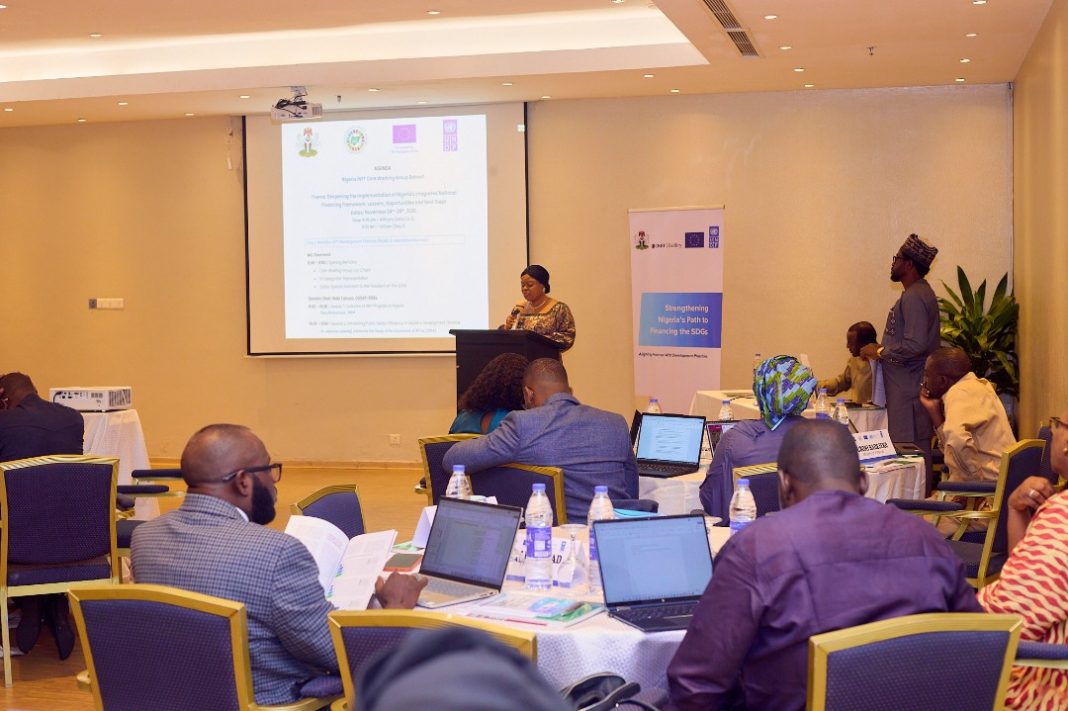
Nigeria’s push to strengthen the foundations of sustainable development financing received a major boost in Lagos as government leaders, development partners, private sector institutions, and civil society organisations converged for a three-day retreat dedicated to deepening the implementation of the Integrated National Financing Framework (INFF). Held from 24 to 26 November 2025, the retreat focused squarely on translating the INFF from a policy framework into a practical, results-driven instrument capable of mobilising resources for national priorities and accelerating progress on the SDGs.
Described as one of the most important meetings on Nigeria’s financing future in recent years, the retreat, themed: “Deepening the Implementation of Nigeria’s Integrated National Financing Framework (INFF): Lessons, Opportunities and Next Steps,” sought to chart a bold path for financing the nation’s Sustainable Development Goals (SDGs) and National Development Plan. It was to confront Nigeria’s persistent financing gaps and propose actionable solutions to strengthen domestic revenue, attract private investment, and improve coordination across federal and state levels. Participants agreed that Nigeria’s financing challenges cannot be solved through public resources alone and that the INFF must serve as a unifying structure for aligning public, private, domestic, and external financing. This guiding vision shaped all deliberations and produced a set of clear, practical outcomes.
According to a statement released by Desmond Utomwen, Special Assistant on Media, Publicity and Strategic Communications in OSSAP-SDGs, a key highlight was the strong call for sub-national integration. Participants noted that most development challenges—and opportunities—reside at the state level, yet financing strategies remain heavily federal-centric. The retreat therefore resolved that the INFF must embed tailored state-level approaches, improve FAAC utilisation, and support states with capacity, investment readiness, and project preparation.
Part of the outcomes includes the unanimous recommendation for establishing a National Project Preparation Facility to help states and MDAs convert ideas into bankable projects capable of attracting investors. This will ensure that good ideas do not die as a result of lack of structuring.
Participants also noted that political commitment at the highest level is essential to restore investor confidence, stressing that the National Steering Committee of the INFF must take a more visible, active role in driving reforms, especially around tax policy, investment alignment, and public finance restructuring. Development partners, including the European Union, noted that investors still question the tangible impact of the INFF and urged stronger government co-financing to demonstrate ownership.
The meeting, which was co-chaired by the OSSAP-SDGs, UNDP and the Ministry of Budget and Economic Planning also reaffirmed the need to scale innovative financing models such as blended finance, green bonds, impact investment, and Public Private Partnerships (PPPs) and underscored that improved transparency, efficient procurement systems, digitalised tax administration, and strengthened monitoring and evaluation are indispensable for expanding fiscal space and ensuring accountability.
The European Union delegation echoed this urgency. Representing the EU, Mr. Reuben Alba-Aguilera warned that Nigeria cannot rely solely on public revenue to meet its development needs. “While public finance remains fundamental, it cannot on its own bridge Nigeria’s widening financing gaps,” he said, adding that innovative partnerships, blended finance tools, and private sector mobilisation are now indispensable. He reaffirmed the EU’s commitment to governance, climate action, and public finance reforms, describing the INFF as a vital platform for aligning finance with national priorities.
Senior Special Assistant to the President on SDGs, Princess Adejoke Orelope-Adefulire, highlighted Nigeria’s progress in institutionalising the INFF, noting that Development Finance Assessments and national coordination structures are already in place. She described the framework as a roadmap for “mobilising resources more prudently, effectively and inclusively,” but admitted that challenges persist, especially in domestic resource mobilisation and aligning external finance with national needs.
Experts from UNDP, the Bank of Industry, CSEA, FIRS, and several private sector institutions delivered technical presentations that underscored Nigeria’s financing gaps but also illuminated promising opportunities. UNDP’s Tony Muhumuza emphasised the need for coherence in financing systems, while BOI Chairman, Dr. Mansur Mukhtar, stressed that public finance reforms are essential for building trust and catalysing investment.
Also speaking, the Co-Chair of the INFF Core Working Group, Mr. Felix Okonkwo described the INFF as the nation’s “strategic vehicle for orchestrating and mobilising resources across public and private quadrants.”
The retreat provided a rare opportunity for stakeholders to shift from theoretical discussions to problem-solving, with participants resolving to move from theory to practice and confront implementation bottlenecks head-on.