
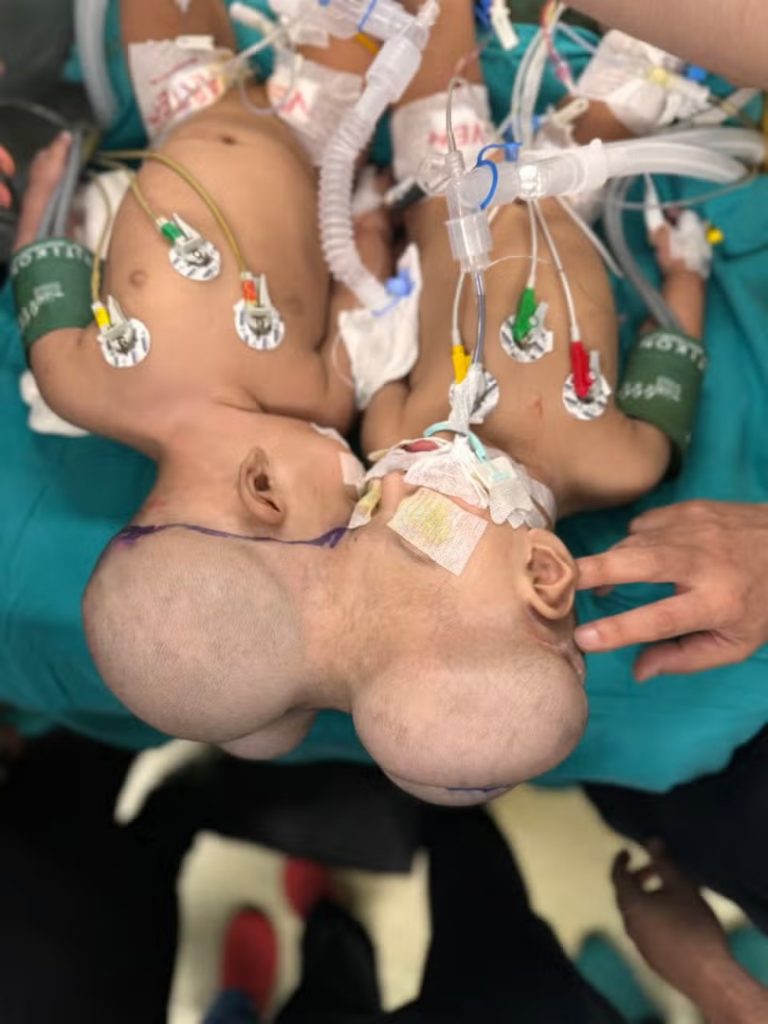

A London-based surgeon has expressed his immense joy after successfully completing the complex separation of one-year-old conjoined twin girls during a 14-hour operation.
Professor Noor ul Owase Jeelani, a consultant paediatric neurosurgeon at Great Ormond Street Hospital, led the intricate surgery in Turkey, according to the *Evening Standard*.
The twins, Minal and Mirha, born in Pakistan and conjoined at the head (craniopagus twins), shared vital blood vessels and brain tissue, making the procedure especially delicate. They are now recovering well and expected to make full recoveries.

Jeelani, who performed the surgery through his charity, Gemini Untwined, described the experience as deeply fulfilling. “It was a really wonderful feeling,” he said, adding that seeing the joy on the parents’ faces as their daughters began a new chapter in life was immensely rewarding.
The complex procedure, conducted at Ankara Bilkent City Hospital, spanned over three months and utilized cutting-edge mixed reality (MR) technology, which helped the surgical team precisely separate the twins’ shared brain tissue and blood vessels.
Jeelani explained the impact of the technology: “We used special goggles to view images of the brain and blood vessels superimposed onto the child’s head during surgery.” He credited MR technology for its precision, highlighting its potential to transform surgical planning.
The case was referred to Jeelani’s team in 2023, and with the support of Gemini Untwined and the Turkish government, the twins were transported from Pakistan for the life-saving operation. Reflecting on the success of the surgery, Jeelani remarked, “Against the odds, we managed to pull it off.”
**Rare and High-Risk Condition**
Conjoined twins are a rare occurrence, with just one in every 2.5 million births resulting in such a condition. The surgery’s success underscores Jeelani’s international reputation, having previously separated conjoined twins in countries like Brazil, Israel, and Pakistan.
Despite the operation taking place in Turkey, Jeelani emphasized the global standing of British medicine: “We are world leaders in delivering this kind of complex surgery.”
Minal and Mirha, born with a rare condition that caused their conjoined state, shared critical blood vessels, making the surgery exceptionally difficult. Speaking to *Sky News*, Jeelani shared positive news about their progress, stating, “They’re making an excellent recovery, really wonderful.”
He added that the twins should be able to return to Pakistan within a few weeks.
**Collaboration and Technology**
Jeelani’s charity, Gemini Untwined, focuses on improving surgical outcomes for children with craniopagus and other craniofacial conditions. Jeelani recounted how they sought assistance from the Turkish government after previously operating on Turkish boys in 2020. “It was logistically complex arranging the children to get to Turkey from Pakistan and to get our team over from the UK, but it went really well, and the Turkish team was fantastic,” he said.
The success of the operation was greatly enhanced by the use of MR technology, which merges 3D images with real-world environments to enhance surgical precision. “We used special goggles that gave us images of the brain, blood vessels, or any other anatomy, which could be superimposed onto the child’s head during surgery,” Jeelani explained.
He noted that MR technology not only assures that surgical planning is correct but sometimes reveals unexpected details. Jeelani believes this technology could become more common in routine surgeries within the next five years and hopes it will inspire young engineers and surgeons to further develop it.
**Conjoined Twins: A Rare Phenomenon**
Conjoined twins are an exceedingly rare occurrence, with only one in every 60,000 births affected, and only 5% of these are craniopagus twins. These twins result from the incomplete separation of a single fertilized egg during early development, with the degree of connection varying from twins joined at the chest or abdomen to those sharing more complex organs like the heart or liver.
According to Gemini Untwined, conjoined twins have a low life expectancy, with around 40% stillborn or dying during labor. However, those who survive often demonstrate remarkable resilience, forming a unique bond and adapting to shared experiences in life.
The successful separation of Minal and Mirha was completed in two surgical stages over three months, with the final 14-hour operation marking a significant medical achievement.