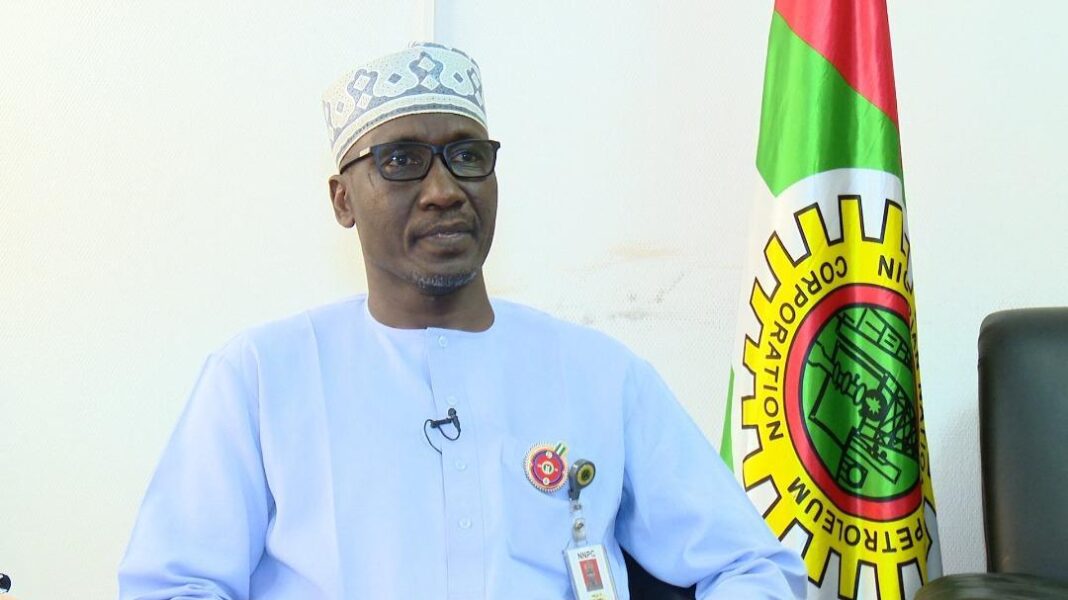

The Nigerian National Petroleum Company Limited (NNPC) has disclosed that with the subsidy removal policy now being fully implemented, the volume of petrol consumed daily in Nigeria may drop by 30 per cent.
The country has a history of unreliable fuel consumption data, even as the current figure is estimated to be currently between 66 million litres per day and 70 million litres per day. It is believed that many of the imported product is smuggled out of the country.
Speaking on a live television programme, the Group Chief Executive Officer of the national oil company, Mallam Mele Kyari, admitted that Nigeria has no accurate data on fuel consumption, adding however, that the country knows the actual volume evacuated from the depots.
“I don’t think there is any credible data on consumption, but there is credible data on evacuation from the depots. They are very distinct. So every truck that leaves the depots in this country is known – the truck number, the driver, and the destination of that product are known.
“We have numbers around this and those numbers are what we assume is our consumption. But we know that this may not be our consumption figure because we know that petroleum products are smuggled across the country,” he stated.
Kyari admitted that not all the petrol imported into Nigeria is consumed within the country, stressing that the arbitrage situation caused by the subsidy regime was to blame for the anomaly. “We’re actually subsidising everybody else in West Africa,” he added.
Explaining that even those who secure the Nigerian borders are “not angels,” Kyari argued that there was a huge incentive to smuggle the fuel because the gains are enormous.
Kyari also said that Nigeria’s neighbouring countries can now legitimately import fuel from Nigeria, rather than utilise the smuggling route.
According to him, to take advantage of the situation, Nigeria will now convert smuggling to a legitimate market because the objective is to be the supplier to West Africa and the surroundings.
“In a subsidy regime, in an arbitrage environment, which we have – wherever it is, you cannot eliminate fraud. Because it’s not possible.
“What this action of taking subsidy off has done is that it will bring down the evacuation from the depot because even when you round-trip, you go across the border, it is the market price, and therefore there’ll be no incentive for that. And I believe that 30 per cent of the volume that we see today will probably vanish,” he added.
Kyari lamented that it has been very difficult, if not practically impossible to transport petroleum products through the pipelines because of the activities of vandals around the country.
He said at one point, the NNPC and partners were losing about 34 per cent of products pumped into the pipelines, a development he said was unsustainable.
On the commencement of in-country refining by the NNPC, Kyari noted that it would only be possible from December, explaining that there were delays in bringing in equipment, which further extended the completion time of the refineries.
He said the plan was to get all the refineries within the country to start working from the first half of next year to complement the Dangote refinery, which will make Nigeria a net exporter of petrol to West African countries.
“It (Port Harcourt refinery) will come on stream by the end of the year. We had some supply chain issues, which is a global problem and I’ve explained this over and over.
“There is a crisis in the global marine sector. Getting these things to location is a huge challenge and we have had some delays in the delivery of some of our equipment, but the equipment has arrived, work is in progress, and will deliver on this,” he said.
The GCEO promised that by the end of July, Nigeria would be able to produce about 1.6 million barrels per day and thereafter hit the 1.8 million barrels per day allocated to the Organisation of Petroleum Exporting Countries (OPEC) quota.
He stated that the NNPC was working on the Atlas Cove facility and was proceeding to get back the line into Mosimi.
Kyari stressed that it had become so bad that in the last 17 years, the NNPC had not been able to pump products from Warri to even Benin, Edo State.