By Peng Xunwen, People’s Daily Overseas Edition
In recent years, countries participating in the Belt and Road Initiative (BRI) have constantly enhanced policy communication and coordinationto benefit cooperation in and sound developmentof e-commerce, with the number of countries that have established bilateral e-commerce cooperation mechanisms with China rising to 22, according to official data.
China is home to 26,000 cross-border e-commerce enterprises in business or in existence, among which 5,688 were newly registered in 2020 and 3,130 are from provinces and cities of countries participating in the BRI, revealed data from China’s Ministry of Commerce (MOC).
Since the outbreak of the COVID-19 pandemic, many European citizenschanged their way to commute from taking trains to cycling. The important shift gave Chinese bicycle brands, which had already joined cross-border e-commerce platforms for a long time, a great opportunity to promote sales.
Not long ago, a student of Ghent University in Belgium bought a bike of the Chinese brand Fenghuang via a cross-border e-commerce platform. The bike is not only stylish, but highly cost-effective, according to the student.
Chinese consumers have also shown increasingly growing enthusiasm for imports. Chen Tingting, a resident in Urumqi, capital of northwest China’s Xinjiang Uygur autonomous region, is used to buying cosmetics via a cross-border e-commerce platform.
“The platform sells authentic products of famous brands, and they can be delivered within one or two days. It’s very convenient,” Chen said. The platform’s WeChat mini-program now offers several thousand types of goods.
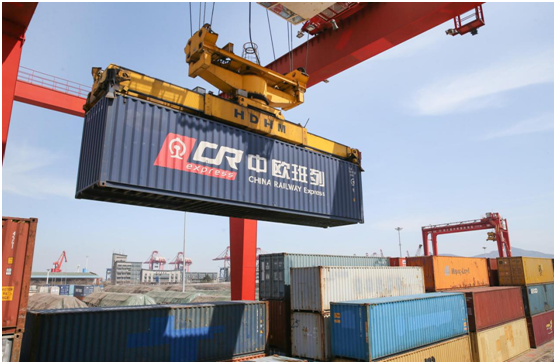
A China-Europe freight train fully loaded with furniture, auto parts, and daily necessities departed from Ganzhou International Land Port in Nankang district, Ganzhou, east China’s Jiangxi province, to countries including Hungary recently.
“In the past, Ganzhou didn’t have customs clearance channel for cross-border e-commerce, so we had togo to Shenzhen to submit export customs declarations. Now we can have our products cleared through customs at the Ganzhou International Land Port and directly transported to overseas warehouses by China-Europe freight trains,” said Hu Daofeng, an executive of a company based in Nankang district. Hu’s company has sent goods via China-Europe freight trains for five times this year.
“The prosperity of Silk Road e-commerce is the result of active win-win cooperation among countries participating in the BRI,” pointed out Wang Wen, executive dean of Chongyang Institute for Financial Studies, Renmin University of China.
As more and more countries join the construction of the BRI and digital infrastructure constantly improves, countries participating in the BRI have gained tangible dividends of development, Wang explained.
The sound development of Silk Road e-commerce has benefited from the online interactions between Chinese and foreign e-commerce platforms and the offline connectivity between logistics services providers represented by the China-Europe freight trains and industrial parks at home and abroad built under the framework of the BRI, according to Wang.
Domestic industrial structural transformation and upgrading and accelerated new infrastructure construction in China have facilitated the forming of international industrial systems across the country, with each having its own distinctive characteristics, Wang said.
Chinese e-commerce platforms, including JD.com, Suning, and Tencent, have intensified efforts to expand business in overseas markets in recent years.
Data suggest that Chinese e-commerce enterprises have taken up half of the market share of cross-border e-commerce business in Russia and scored eye-catching performance on top e-commerce platforms in Southeast Asia.
As the construction of Silk Road e-commerce is continuously advanced, it’s believed that more Chinese and foreign consumers will see how convenient it is to shop for products produced around the globe at home and Silk Road e-commerce is becoming quite a powerful new engine for economic and trade cooperation in BRI construction.
To continue to achieve solid progress in promoting Silk Road e-commerce, relevant countries participating in the BRI should reduce restrictions on cross-border e-commerce in such aspects as customs clearance, inspection, tax, and foreign exchange, establish and improve international rules for e-commerce in areas like data flow and settlement of dispute, and speed up the construction of integrated, efficient, and low-cost channels, and further deepen mutually beneficial cooperation mechanisms, experts pointed out.