

The United States has formally removed Sudan from its state sponsors of terrorism blacklist, its Khartoum embassy said Monday.
Sudan Celebrates ‘New Era’ as US Drops It From Terrorism
Less than two months after the East African nation pledged to normalise ties with Israel.
The move opens the way for aid, debt relief and investment to a country going though a rocky political transition and struggling under a severe economic crisis exacerbated by the Covid-19 pandemic.
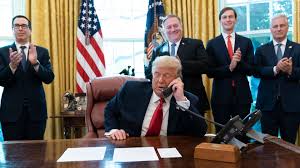
US President Donald Trump had announced in October that he was delisting Sudan, 27 years after Washington first put the country on its blacklist for harbouring Islamist militants.
“The congressional notification period of 45 days has lapsed and the Secretary of State has signed a notification stating rescission of Sudan’s State Sponsor of Terrorism designation,”
The US embassy said on Facebook, adding that the measure “is effective as of today”.
In response to the move, Sudan’s army chief General Abdel Fattah al-Burhan — who doubles as the head of the Sovereign Council, the country’s highest executive authority — offered his “congratulations to the Sudanese people”.
“It was a task accomplished… in the spirit of the December revolution”, he said on Twitter, referring to a landmark month in 2018 when protests erupted against dictator Omar al-Bashir.
Bashir was deposed by the military in April 2019, four months into the demonstrations against his iron-fisted rule and 30 years after an Islamist backed coup had brought him to power.
Sudan’s Prime Minister Abdalla Hamdok also welcomed Washington’s move in a post on Facebook, noting that it means “our beloved country… (is) relieved from the international and global siege” provoked by Bashir’s behaviour.
The removal of the designation “contributes to reforming the economy, attracting investments and remittances of our citizens abroad through official channels” and creates new job opportunities for youth, the premier said.
As part of a deal, Sudan agreed to pay $335 million to compensate survivors and victims’ families from the twin 1998 al-Qaeda attacks on US embassies in Kenya and Tanzania, and a 2000 attack by the jihadist group on the USS Cole off Yemen’s coast.
Those attacks were carried out after Bashir had allowed then al-Qaeda leader Osama Bin Laden sanctuary in Sudan.
Sudan in October became the third Arab country in as many months to pledge that it would normalise relations with Israel, after the United Arab Emirates and Bahrain.
The transitional government’s pledge came amid a concerted campaign by the Trump administration to persuade Arab nations to recognise the Jewish state, and it has been widely perceived as a quid pro quo for Washington removing Sudan from its terror blacklist.
But unlike the UAE and Bahrain, Sudan has yet to agree a formal deal with Israel, amid wrangling within the fractious transitional power structure over the move.
The first major evidence of engagement between Sudan’s interim authorities and Israel came in February, when Burhan met Israeli Prime Minister Benjamin Netanyahu in Uganda.
In late November, a spokesman for the Sovereign Council, comprised of military and civilian figures, confirmed that an Israeli delegation had visited Khartoum earlier in the month.
Seeking to downplay the visit, council spokesman Mohamed al-Faki Suleiman had said “we did not announce it at the time because it was not a major visit or of a political nature”.
Sudan’s transition has lately displayed signs of internal strain. Burhan last week blasted the transitional institutions, formed in August 2019 after months of further street protests demanding the post-Bashir military share power with civilians.
“The transitional council has failed to respond to the aspirations of the people and of the revolution,” Burhan charged while also lauding the integrity of the military.
Trump sent his notice to remove Sudan from the terror blacklist to Congress on October 26. Under US law, a country exits the list after 45 days unless Congress objects, which it has not.
Families of victims of the September 11, 2001 attacks had called on lawmakers to reject the State Department’s proposal, saying they want to pursue legal action against Sudan.