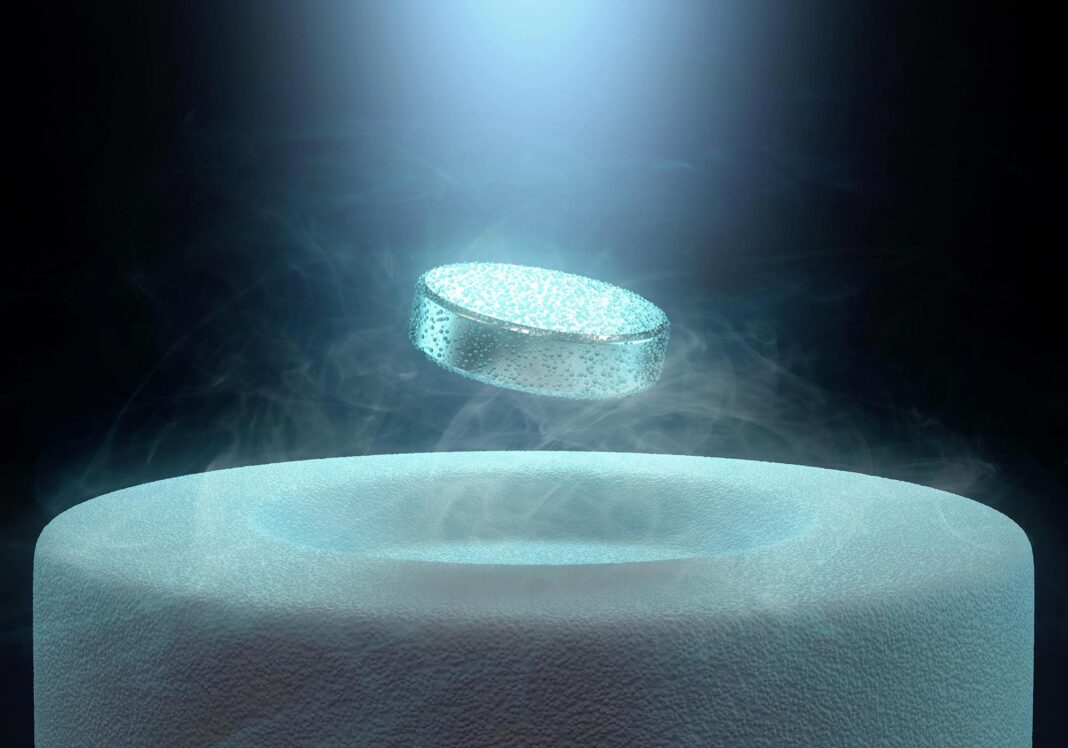

Three physicists in the Department of Physics and Astronomy at the University of Tennessee, Knoxville, together with their colleagues from the Southern University of Science and Technology and Sun Yat-sen University in China, have successfully modified a semiconductor to create a superconductor.
Professor and Department Head Hanno Weitering, Associate Professor Steve Johnston, and PhD candidate Tyler Smith were part of the team that made the breakthrough in fundamental research, which may lead to unforeseen advancements in technology.
Semiconductors are electrical insulators but conduct electrical currents under special circumstances. They are an essential component in many of the electronic circuits used in everyday items including mobile phones, digital cameras, televisions, and computers.
As technology has progressed, so has the development of semiconductors, allowing the fabrication of electronic devices that are smaller, faster, and more reliable.
Superconductors, first discovered in 1911, allow electrical charges to move without resistance, so current flows without any energy loss. Although scientists are still exploring practical applications, superconductors are currently used most widely in MRI machines.
Using a silicon semiconductor platform — which is the standard for nearly all electronic devices — Weitering and his colleagues used tin to create the superconductor.
“When you have a superconductor and you integrate it with a semiconductor, there are also new types of electronic devices that you can make,” Weitering stated.
Superconductors are typically discovered by accident; the development of this novel superconductor is the first example ever of intentionally creating an atomically thin superconductor on a conventional semiconductor template, exploiting the knowledge base of high-temperature superconductivity in doped ‘Mott insulating’ copper oxide materials.
“The entire approach — doping a Mott insulator, the tin on silicon — was a deliberate strategy. Then came proving we’re seeing the properties of a doped Mott insulator as opposed to anything else and ruling out other interpretations. The next logical step was demonstrating superconductivity, and lo and behold, it worked,” Weitering said.
“Discovery of new knowledge is a core mission of UT,” Weitering stated. “Although we don’t have an immediate application for our superconductor, we have established a proof of principle, which may lead to future practical applications.”