
News
FG Reaffirms Commitment to Public Sector Reforms, Improved Security Delivery

By Francis Wilfred
The Federal Government has reaffirmed its commitment to transformative reforms aimed at improving efficiency, strengthening internal security, and ensuring measurable results across public institutions.
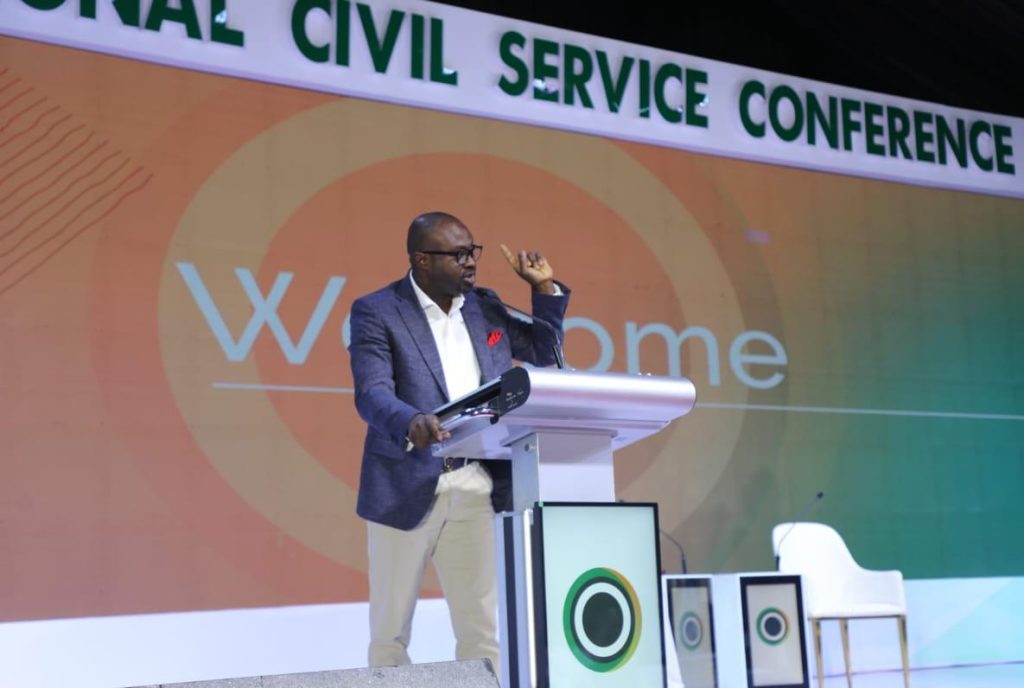
Minister of Interior, Dr. Olubunmi Tunji-Ojo, gave the assurance during a high-level session at the International Civil Service Conference themed “Reforms, Resilience and Results,” where he stressed the need for innovation, accountability, and strategic governance in public service.
According to a press release by Mrs Mary Ali, Head, Press and Public Relations stated that the minister identified excessive bureaucracy and redundant procedures as major obstacles to progress in the public sector, warning that overly complex systems continue to hinder efficiency and effective service delivery.
According to him, simplifying administrative processes is critical to unlocking innovation, improving institutional performance, and delivering better outcomes for Nigerians.
“Complexity is the enemy of progress,” Tunji-Ojo said, noting that public institutions must evolve to meet the demands of a rapidly changing world.
He stressed that in the 21st century, there is no room for outdated practices in governance, adding that citizens now expect visible and measurable results rather than repeated explanations.
The minister said public trust in government officials must be matched by transparency, accountability, and strong performance, emphasizing that reforms must translate into tangible benefits for the people.
He also commended civil servants in the Ministry of Interior for their dedication and professionalism, describing them as key contributors to the progress recorded within the ministry.
Speaking further on the conference theme, the minister outlined the ministry’s reform strategy, explaining that successful reforms begin with a clear understanding of existing challenges.
He said effective reform efforts must address three critical questions — understanding the present reality, defining the desired outcome, and mapping out the process of transition through structured interventions.
Tunji-Ojo warned that many reforms fail because of poor diagnosis of problems, which often leads to ineffective or misplaced solutions.
“You cannot solve a problem you do not understand,” he said, stressing the importance of data-driven analysis, practical knowledge, and strategic thinking in addressing governance and internal security challenges.
He also called for a shift in governance culture, urging public servants to move away from emotional attachment to outdated systems and embrace innovation as a pathway to improved public administration.
Reaffirming the Ministry of Interior’s role in protecting Nigeria’s internal security architecture, the minister assured Nigerians of continued efforts to strengthen institutional capacity, improve operational efficiency, and deliver impactful results in line with national priorities.


By Abigail David
The Chief of Army Staff, Lieutenant General Waidi Shaibu, has emphasised that citizens’ cooperation and support are essential to achieving Nigeria’s national security objectives.
Shaibu stated this on Sunday while inaugurating a renovated community primary and secondary school in Rumuomasi, Obio/Akpor Local Government Area of Rivers State, as part of the Nigerian Army’s Special Intervention Civil-Military Cooperation Projects for the 2026 Nigerian Army Day Celebration.
The intervention included the renovation of classroom blocks, provision of desks, construction of three toilet facilities, and distribution of writing materials, school uniforms and bags to pupils and students.
The Army Chief said similar projects are being executed across Rivers State, including the renovation of a community secondary school in Khana Local Government Area, a community town hall in Oyigbo Local Government Area and the installation of a solar-powered borehole in Degema Local Government Area.
According to him, the Nigerian Army has completed more than 250 intervention projects across the country’s six geopolitical zones to strengthen civil-military relations and encourage public support for security operations.
Shaibu said the trust, cooperation and active participation of citizens remain critical to the success of military operations, stressing that lasting security can only be achieved through collaboration among the Armed Forces, other security agencies and local communities.
He noted that the Army’s Civil-Military Cooperation Project scheme has delivered infrastructure such as schools, hospitals, community town halls, laboratories, roads, boreholes, solar lighting systems and Information and Communications Technology facilities to complement government development efforts.
The Chief of Army Staff commended community leaders for their support in delivering the project and urged residents to take ownership of the facilities by ensuring their proper maintenance.
Speaking at the event, the Chairman of Obio/Akpor Local Government Area, Gift Worlu, praised the Nigerian Army for the intervention and pledged that the renovated facilities would be adequately protected to support teaching and learning.

By Abigail David
Nigerians have expressed mixed reactions to the Federal Government’s decision to extend the National Youth Service Corps orientation course from three weeks to six weeks as part of broader reforms aimed at improving skills acquisition, career development and national service.
In separate interviews with the News Agency of Nigeria on Sunday, respondents acknowledged the potential benefits of the reforms but differed on whether the extended orientation programme was necessary.
A serving corps member, Victoria Oyerinde, said the additional three weeks could enhance skills training, entrepreneurship development and interaction among corps members if properly implemented. She, however, urged the government to improve camp facilities, ensure transparent postings and adequately fund the NYSC Skills Acquisition and Entrepreneurship Development programme to prevent additional financial strain on participants.
An undergraduate, Melody Addo, described the reforms as well-intentioned and called for effective implementation. She recommended integrating skills acquisition throughout the one-year service and placing greater emphasis on digital skills to boost graduates’ employability.
Teacher Kemisola Odejide criticised the extension as untimely, arguing that challenges relating to feeding, accommodation, healthcare and welfare should be addressed before increasing the orientation period. She, however, welcomed specialised career streams, saying they would provide corps members with relevant work experience. She also urged the government to retain the traditional khaki uniform.
A former corps member, Esther Oluwakomiyo, described the six-week orientation as excessive but supported career-based postings aligned with graduates’ academic backgrounds. She called for broader reforms in the education sector and improved employment opportunities for young graduates.
Entrepreneur Oluwasegun Sowunmi said extending the orientation programme should be accompanied by improved camp facilities, better feeding, enhanced security and increased allowances. He also suggested making the additional three weeks optional and ensuring specialised career streams translate into employment opportunities after service.
Another entrepreneur, David Edogun, maintained that the existing three-week orientation was sufficient but supported career-focused postings. He urged the government to prioritise security, improve camp infrastructure and review corps members’ monthly allowance.
Employer Ekemini Ido also questioned the need for a longer orientation programme, urging the government to focus instead on strengthening the education curriculum and expanding the impact of the NYSC Skills Acquisition and Entrepreneurship Development programme to improve graduates’ employability.
By Ogenyi Ogenyi, Uyo
A media aide to Akwa Ibom State Governor, , has alleged that coordinated media attacks against the governor are being sponsored by political opponents to undermine his administration ahead of the 2027 governorship election.
The governor’s Special Assistant on Media, , made the allegation in a post on his verified Facebook page, where he claimed that recent criticisms of the governor across social, electronic and print media were “neither accidental nor difficult to decipher.”
“As the 2027 election gradually draws near, the political atmosphere in Akwa Ibom State is becoming increasingly charged, with the remnants of the factional opposition party engaging in media war rather than constructive criticism,” he wrote.
According to Peters, the alleged campaign goes beyond legitimate opposition politics and is aimed at weakening public confidence in the governor rather than presenting alternative policies to the electorate.
“Rather than presenting superior ideas, alternative policies or a compelling vision capable of convincing the electorate, some fragments of the opposition appear to have settled for a coordinated media attack against Governor Umo Eno, using every channel at their disposal,” he stated.
He argued that the governor’s growing acceptance across political, religious and social divides had unsettled some political interests, claiming that the administration’s performance had continued to attract support beyond party affiliations.
Peters further alleged that the attacks had shifted from criticism of government policies to personal attacks on the governor.
“Every responsible democracy recognises a clear distinction between criticism and defamation. Citizens have every right to question government decisions and demand accountability.
“However, dragging families into political disputes, spreading unverified allegations and deliberately maligning personal reputations are neither democratic virtues nor legitimate opposition politics,” he said.
The governor’s aide cited infrastructure development, housing programmes, healthcare, education, agriculture, youth empowerment initiatives, payment of pension and gratuity obligations, as well as the introduction of Compressed Natural Gas (CNG) buses as evidence of the administration’s achievements.
He maintained that the projects had produced measurable benefits for residents across the state, insisting that “these are concrete achievements that cannot simply be erased through coordinated social media campaigns or sensational headlines.”
Peters also warned that persistent negative portrayals of Akwa Ibom could damage the state’s image among investors, development partners and tourists.
“It is fundamentally about protecting the integrity, reputation and developmental aspirations of Akwa Ibom State. Political competition should never become an excuse for tarnishing the image of the very state whose progress every stakeholder claims to desire,” he added.
He expressed confidence that Governor Eno would secure re-election in 2027, arguing that the people of the state were capable of distinguishing between “political propaganda and observable reality.”


Ray Emodi apologises to fans, says burnout prompted acting break

FG denies N8tn off-budget spending, says IMF report misinterpreted

Citizens’ support key to achieving national security goals, COAS says
-
 Crime15 hours ago
NDLEA arrests Nigerian-British grandmother with 13kg cocaine disguised as plantain at Lagos airport
-

 News17 hours ago
CSO Commends DSS, Security Agencies For Proactive Measures During 2026 Hajj.
-
 News15 hours ago
Citizens’ support key to achieving national security goals, COAS says
-
 News17 hours ago
CACOL Calls for Chief of Staff to Step Aside Over Alleged Fake Government Agency Scandal
-
News17 hours ago
Governor Sule Approves Five Mini Sports Complexes Across Nasarawa
-

 News15 hours ago
Mixed reactions greet six-week NYSC orientation, other reforms
-
 Entertainment14 hours ago
Ray Emodi apologises to fans, says burnout prompted acting break
-
 Business and Economy15 hours ago
FG denies N8tn off-budget spending, says IMF report misinterpreted
You must be logged in to post a comment Login