
News
Lessons in School Management from Zhejiang Normal University, China

By Dr. Austin Maho
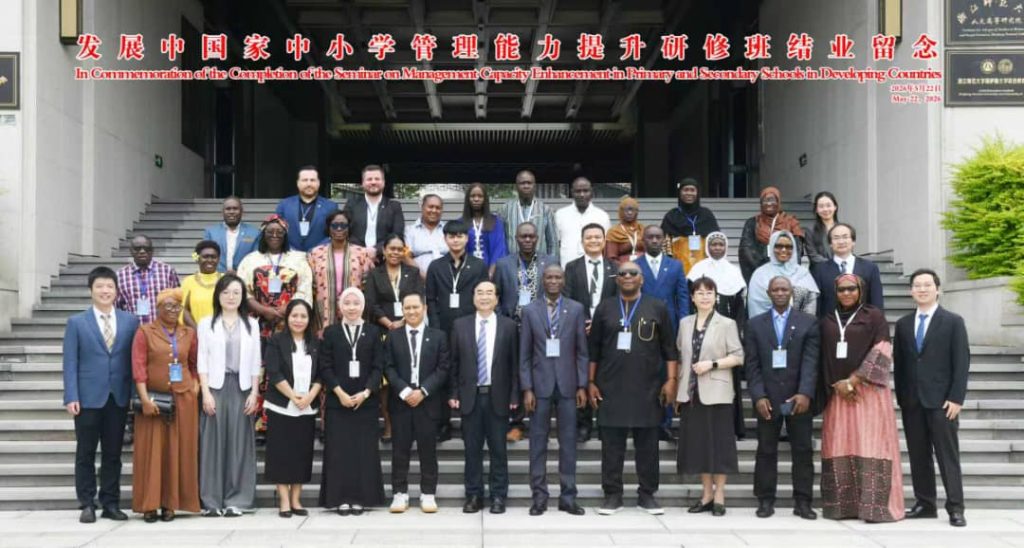
I landed in Jinhua on May 9, 2026, carrying more than a suitcase—I carried the weight of 139,772 empty teacher posts back home, and the hope that somewhere in China’s classrooms, I’d find answers we could adapt for Nigeria. For the next 14 days, from May 9 to May 22, I joined 28 other delegates from 7 developing countries for an intensive brain storming session on Management Capacity Enhancement in Primary and Secondary Schools in Developing Countries at Zhejiang Normal University [ZJNU] in Zhejiang Province, China.
What unfolded was not just a programme of lectures, tours and school visits. It was early mornings and afternoons in lecture halls listening to renowed professors deliver indepth lectures on data-driven school management and leadership, walks in the corridors of model schools where principals and teachers are highly motivated, and tour visits to the quiet and peaceful West Lake in Hangzhou and the energy of Shanghai’s Bund Architecture, among others. The sighta and sounds made me reflect: if China can align policy, people, and practice at this scale, what’s stopping us from doing the same, school by school, back home?
Founded in 1956, ZJNU is a public research university ranked among China’s top 100 institutions and a key provincial university designated to host Chinese Government Scholarship students. Its College of Teacher Education is ranked 47th in China for Education Majors, making it a fitting host for a programme focused on school leadership and teacher development. Over 14 days, we engaged with ZJNU faculty, visited model schools, and observed how policy, leadership, and data are aligned to improve learning outcomes.
Walking into the Programme
The tour began with a warm welcome at ZJNU’s campus in Jinhua. The opening ceremony set the tone: respectful, practical, and forward-looking. The Nigeria n delegates were paired with delegates from other developing countries which included, Guinea-Bissau, North Macedonia, the Gambia, Solomon Islands Sierra leone and Indonisia.
The academic component was rigorous. We had sessions on, “Beyond Macro Constructs: Multi- diamentional efforts for increased efficiency: Reform and Reflections on County level Teacher Professional Development Training Credit System”, “Transformation of campus sport”, “Gender Equality in China’s Basic Education”, “Teacher Education System”, “National Policy for Common Prosperity” among others.
What stood out was the dual methodology: theory in the morning, practice in the afternoon. We didn’t just hear about data-driven management; we visited a primary school affiliated to Zhejiang Normal University in Jinhua and saw how schools management aligns with national policy.
Learning Beyond the Classroom
The programme made space for China’s living culture, and those moments shaped my understanding as much as the lectures did. For instance we took a day trip to Hangzhou and spent hours walking around West Lake, a UNESCO World Heritage Site since 2011. The lake is framed by hills on three sides and the city on the fourth, with causeways, pagodas, and gardens layered into the landscape over a thousand years. What struck me was how intentional the design was—every bench, every path, every view seemed placed to encourage reflection and community. Our guide explained how Hangzhou now uses smart sensors and AI to monitor water quality and visitor flow, balancing heritage with modern management. Standing by the lake, I thought about how Nigerian schools could similarly use low-cost data and community spaces to create environments where children feel safe and inspired to learn.
The Bund, Shanghai
One evening we travelled to Shanghai and walked the Bund. It tells the story of Shanghai’s role in global trade. On the other, the futuristic skyline of Pudong rises with the Oriental Pearl Tower and Shanghai Tower. Our guide framed it as a metaphor: China’s education system also holds tradition and innovation in tension. We can’t discard cultural context when borrowing reforms. For Nigeria, that meant adapting China’s structured teacher development to fit our federal system and community realities.
Village and Intangible Cultural Experience
Midway through the tour, we visited a village in Suoyuan County as a case study of Education for Common Prosperity. China presents a living example of holistic education—academics linked to community life. intangible cultural heritage being passed down from generation to generation. For me, it reinforced that schools don’t operate in isolation. When communities own education, children stay engaged.
Core Takeaways
- Policy Coherence: Long-Term Planning Over Political Cycles.
China’s basic education system operates within a clear national strategy that remains consistent across administrative changes. The Ministry of Education’s Action Plan to Improve Basic Education in the New Era, released jointly with the National Development and Reform Commission and Ministry of Finance, sets targets for 2027 and 2030 to expand quality education resources and align enrolment with urbanization and demographic changes.
In Nigeria, basic education is decentralized across 36 states and the FCT. While the Federal Government sets policy, implementation varies, and leadership changes often disrupt ongoing reforms. For example, Nigeria still faces a deficit of 139,772 teachers in primary schools and 2,446 in junior secondary schools, and management challenges such as irregular career progression and inadequate supervision undermine teacher development.
Lesson for Nigeria: States should adopt multi-year education sector plans with measurable targets that survive political transitions. This gives schools stability to plan, budget, and deliver results without starting over every four years.
- Professional School Leadership: Training Principals as Instructional Leaders.
In China, principals are trained as both instructional leaders and managers. They are held accountable for student outcomes, teacher development, and school finances. This contrasts with Nigeria, where many principals are promoted by seniority with limited formal management training.
The Nigerian delegation observed how ZJNU’s programmes integrate school management theory with practical case studies from Chinese schools. ZJNU itself runs workshops on.The System of Chinese Higher Education and Practical Cases, exposing participants to university management models that can be adapted to basic education.
Lesson for Nigeria: Establish a mandatory School Leadership Certification Programme for principals. The curriculum should cover instructional leadership, data use, budgeting, and staff management, and be linked to promotion and posting. This requires focused training, not new infrastructure.
- Structured Teacher Professional Development: Credit Systems That Work.
China uses a county-level credit system where teachers earn credits for workshops, peer learning, and action research. Credits affect promotion and salary, creating incentives for continuous learning. In contrast, Nigeria’s in-service training is often project-based, irregular, and donor-driven.
However, Nigeria is already piloting solutions. UNICEF’s School-Based Teacher Professional Development Learning Lab model focuses on collaborative, school-based learning environments. The Teachers Registration Council of Nigeria, with GMind AI, launched and Naija Teacher AI also launched in August 2025 hopefully will equip 1.5 million licensed teachers with AI-powered tools and digital training. The National Commission for Colleges of Education is also revising curricula to include digital literacy, AI, entrepreneurship, and inclusive education.
Lesson for Nigeria: Pilot a Teacher Professional Development Credit System in a few states using SUBEB, NTI, and school-based peer learning circles. Link credits to career progression so teachers see direct benefit.
- Holistic Education and Data-Driven Management.
Chinese schools balance academics with sports, arts, moral education, and civic responsibility, often using community resources. Schools regularly review data to guide decisions. The Ministry of Education’s guidelines on strengthening science and technology education aim to establish a foundational system by 2030, with integrated evaluation and support mechanisms.
In Nigeria, the curriculum remains academically focused, and school-level data rarely drives action. However, the principle does not require large ICT investments. Every head teacher can track five indicators; attendance, test scores, teacher presence, textbook use, and dropout on paper or Excel, and review them monthly with staff. Schools can also use community elders, local markets, and fields to deliver practical, engaging lessons.
- Understanding the Chinese Context,
Beyond technical lessons, the tour deepened our understanding of the concepts shaping China’s education reforms: Reform and Opening Up, Socialism with Chinese Characteristics, New Era under Xi Jinping, Chinese Modernization, Common Prosperity, and the Global Development, Security, Civilisation, and Governance Initiatives. These ideas underpin the policy coherence and long-term orientation we observed.
On behalf of the Nigerian delegation, I thank Zhejiang Normal University for the excellent programme and warm hospitality, and the Government of the People’s Republic of China for facilitating this South-South exchange. We return to Nigeria with practical knowledge and renewed resolve.
What I’ll remember most isn’t just the slides or statistics. It’s that Education in China works because it’s tied to people, place, and purpose.
My commitment is to share these lessons in our ministries and institutions, advocate for pilot relevant practices, and engage policymakers to improve management capacity in basic education. The goal is not to copy China, but to adapt what works for Nigeria. If we focus on training principals, making teacher development continuous, using data at the school level, and strengthening holistic education, we can shift the system school by school.
Nigeria’s teacher education sector is already undergoing bold reforms. In March 2026, the NCCE introduced a two-year Bachelor of Education degree to restore confidence in Colleges of Education and align curricula with global realities. The challenge now is to connect these reforms to school-level management.
May this partnership with ZJNU continue to grow, and may the lessons learned translate into better learning outcomes for Nigerian children.

By Abigail David
The abducted principal of Community Grammar School, Esiele, Alamu Folawe, has appealed to Bola Tinubu and Seyi Makinde to negotiate with her captors rather than use force to secure the release of victims abducted in Oriire Local Government Area.
In a video shared online on Friday, the visibly distressed principal said she and other abductees, including children, had spent 13 days in the bush under harsh weather conditions since the attack.
According to her, the victims had been exposed to rain, cold and intense heat while in captivity, as she pleaded with authorities not to allow the kidnappers harm them.
Folawe also appealed to the Nigeria Union of Teachers and the Christian Association of Nigeria to intervene, warning that attempts to rescue them through force had worsened their situation.
She claimed that a recent security operation angered the abductors and allegedly placed the life of one of the captives at greater risk.
The appeal comes nearly two weeks after gunmen attacked Community High School, Ahoro-Esinele, Baptist Nursery and Primary School, Yamota, and L.A. Primary School, Alawusa, abducting seven teachers and 39 pupils on May 15.
During the attack, mathematics teacher Michael Oyedokun was killed, while a motorcyclist and a security operative also lost their lives during rescue attempts.
Sources said the abductors later opened communication channels with the Oyo State Government and insisted they would negotiate only with the governor rather than the victims’ families.
Governor Makinde had earlier assured residents that his administration was working round the clock to secure the release of the abducted victims.
Meanwhile, the Inspector-General of Police, Tunji Disu, announced the deployment of additional detectives from Abuja to support ongoing rescue operations, while the Defence Headquarters said troops had established contact with the abductors.



Italian police have arrested two Nigerians and three other African migrants over the alleged abduction and gang rape of a Colombian tourist in Rome.
According to reports by British media outlet Daily Express, the 32-year-old Colombian woman was allegedly lured away from a restaurant in the Italian capital on May 19 by a man who reportedly offered to sell her hashish.
Authorities said the victim was taken in a van to an abandoned building on the eastern outskirts of Rome, where she was allegedly held captive for about 72 hours.
Police said the woman was repeatedly raped, drugged and threatened before managing to escape from the building. She was later found half-naked on a pavement by a passerby who alerted emergency responders.
Following a raid on the property, police arrested five suspects identified as Saidykhan Lamin, Karamba Kanteh, Harouna Traore, Isibor Wisdom and Paul Nwabueze.
The suspects have been charged with gang rape aggravated by the victim’s vulnerable condition and remain in police custody.
Investigators said efforts were ongoing to apprehend other suspects believed to have participated in the incident, including the man who allegedly lured the victim away and the driver who transported her to the building.
Police also disclosed that 22 undocumented migrants were discovered during the operation, with 11 reportedly transferred to detention centres pending deportation procedures.


The Nigeria Centre for Disease Control and Prevention has placed Lagos, the Federal Capital Territory and eight other states on high Ebola alert following the outbreak of the Bundibugyo strain of the Ebola Virus Disease in parts of East and Central Africa.
In a public health advisory issued to state commissioners for health, the agency warned that Nigeria faces a high risk of importing the virus due to increasing regional transmission, international travel, porous borders and population movement.
States classified as high-risk include Rivers State, Kano State, Enugu State, Borno State, Akwa Ibom State, Cross River State, Taraba State and Adamawa State because of their airports, seaports, border routes and high human traffic.
The NCDC said Nigeria had not recorded any confirmed Ebola case but warned that a recent risk assessment showed the danger of importation remains high.
According to the agency, Uganda and the Democratic Republic of the Congo have recorded 1,077 suspected cases and 247 deaths linked to the outbreak, with a fatality rate of 24.6 per cent.
The agency explained that the Bundibugyo strain differs from the Zaire Ebola strain because there are currently no approved vaccines or specific treatments for it.
It also warned that symptoms may initially resemble malaria or Lassa Fever, making early detection more difficult.
As part of emergency response measures, the NCDC said its National Emergency Operations Centre had been activated in alert mode while state governments were directed to strengthen surveillance, identify isolation centres, equip health workers and intensify public awareness campaigns.
Meanwhile, the Lagos State Ministry of Health assured residents that no confirmed or suspected Ebola case had been detected in the state.
The Commissioner for Health, Akin Abayomi, said Lagos remained on high alert and had activated its biosecurity architecture to detect and contain any possible outbreak.
He noted that the state’s preparedness system, first tested during the 2014 Ebola outbreak and later strengthened during the COVID-19 pandemic, remains active in responding to infectious disease threats.
Nigeria’s renewed alert has revived memories of the country’s successful containment of Ebola in 2014 after infected traveller Patrick Sawyer arrived in Lagos.
Health authorities have urged Nigerians to remain calm, maintain proper hygiene, avoid misinformation and promptly report suspected symptoms as surveillance efforts intensify nationwide.
-
Fashion1 week ago
Uyo Fashion Week: A Fusion of Styles, Creativity & the GIM’S Exclusive brand
-
 Politics1 week ago
Eric Opah Campaign Denies Disqualification From Abia APC Governorship Primary
-

 News5 days ago
Kaduna Catholic Archdiocese Reports Killing of 9, Abduction of 25 Parish Members in Three Months
-
News3 days ago
Group Calls for Complete Dualisation of Aba–Ikot Ekpene Road After Fatal Accidents
-
News1 week ago
Plateau APC Primaries: Mutfwang Dominates Mikang and Langtang North as Party Leaders Hail Landslide Wins
-
Opinion1 week ago
Previewing The Recurring Camp Tent Headaches During Hajj Rites In Mina.
-
 Culture &Tourism1 week ago
China, Nigeria Strengthen Cultural Ties At Abuja Heritage Salon
-
News6 days ago
KUMO CONGRATULATES TINUBU ON PRIMARY VICTORY: “NIGERIA HAS FOUND IN YOU A LEADER WORTHY OF HER TRUST “